In summary:
- Focus on filtering invisible PM2.5 particles, not just visible smog, as they pose the greatest health risk.
- Equip your home with dual-filtration air purifiers (HEPA + Activated Carbon) to capture both particles and gases.
- Implement strategic ventilation in your home and car, purging stale air during low-pollution hours.
- Choose walking routes one block away from major roads to significantly reduce your exposure.
- Reinforce your body’s defenses with an antioxidant-rich diet to combat inflammation caused by pollutants.
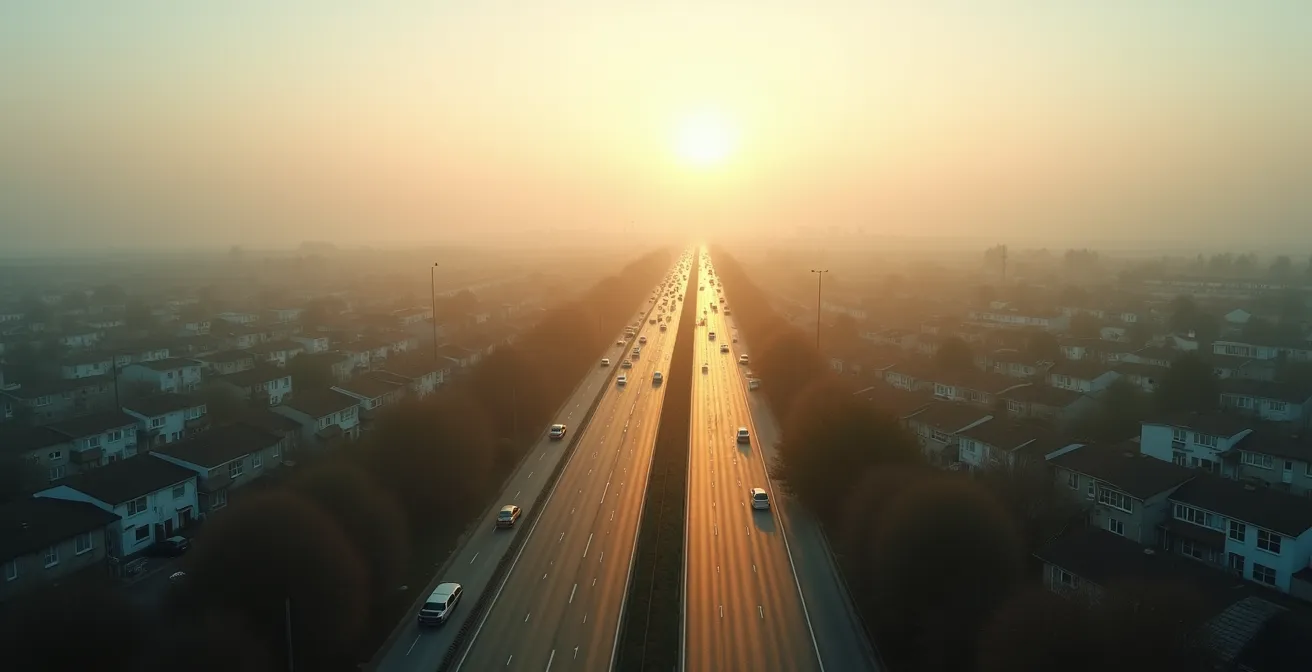
For families living near a major roadway, the low hum of traffic is a constant reminder of the urban environment. You see the dust settle on your windowsills and perhaps smell the exhaust during rush hour. The natural response is to shut the windows and try to keep the outside, out. Many believe that simply creating a physical barrier is enough, or that limiting strenuous outdoor activity is the primary solution to protecting their family’s health. As a pulmonologist, I must stress that these measures, while well-intentioned, are insufficient.
The most significant threat from traffic pollution is not the visible haze but the microscopic, invisible particles that easily bypass these simple defenses. These particles, known as PM2.5, and the associated gases can infiltrate our homes, our cars, and most alarmingly, the deepest recesses of our lungs and even our bloodstream. True protection is not about sealing yourself in; it’s about implementing a smarter, multi-layered strategy that actively filters and manages the air you breathe. It requires understanding the specific nature of traffic pollution and creating a protective bubble where your family is safest.
This guide will provide a clinical, evidence-based approach to mitigating the risks. We will move beyond the common platitudes and detail specific, actionable strategies to create a healthier environment inside your home, within your car, and even when you step outside. We will cover filtration technologies, ventilation tactics, route planning, and nutritional support to build a comprehensive defense system for your family’s respiratory well-being.
Summary: A Pulmonologist’s Framework for Mitigating Highway Pollution
- Why PM2.5 Particles Are More Dangerous Than Visible Smog?
- How to Choose an Air Purifier That Actually Removes Traffic Fumes?
- Main Road vs. Side Streets: Which Walking Route Exposes You to Less Gas?
- The Ventilation Mistake That Traps Pollutants Inside Your Car
- When to Exercise Outdoors: Reading the Air Quality Index Correctly
- The Ventilation Fan Mistake That Causes Black Mold on Your Ceiling
- The Ventilation Error That Cooks Your Shingles From the Inside Out
- A Balanced Diet for Executives: How to Avoid the Afternoon Energy Crash?
Why PM2.5 Particles Are More Dangerous Than Visible Smog?
When we think of pollution, we often picture the thick, brown haze that hangs over a city. While this smog is unhealthy, the most insidious danger comes from what you cannot see. The primary threat from highway traffic is Particulate Matter 2.5 (PM2.5)—ultrafine particles less than 2.5 micrometers in diameter, or about 30 times smaller than the width of a human hair. Their minuscule size is precisely what makes them so hazardous. Unlike larger particles that get trapped in the nose and throat, PM2.5 can be inhaled deep into the alveoli of the lungs, where oxygen exchange occurs.
From there, these particles can cross into the bloodstream, triggering systemic inflammation and contributing to a host of cardiovascular and respiratory diseases. The danger is most acute for those living in close proximity to highways. In fact, research shows that the highest concentration of these toxic particles exists within an invisible exposure zone of 300-500 meters from major roads. This isn’t a gentle slope; it’s a sharp, invisible gradient of risk that many families unknowingly live within.
Case Study: The “Invisible Gradient” Mapped in Oakland
A landmark UCLA study used Google Street View cars equipped with advanced air quality sensors to map pollution in Oakland, California. The data revealed a stark reality: concentrations of PM2.5 and other ultrafine particles, the most dangerous components of traffic exhaust, decreased by a staggering 60-80% within just 100 meters (about 330 feet) of a highway. This demonstrates that the highest toxic load is hyper-localized, creating an “invisible gradient” where moving just one block away can drastically reduce exposure.
Understanding this principle is the first step in protecting your family. It shifts the focus from the general, visible smog to the specific, invisible threat concentrated right outside your door. Protection, therefore, must be targeted at capturing these microscopic invaders before they enter your body.
How to Choose an Air Purifier That Actually Removes Traffic Fumes?
Given the threat of PM2.5 infiltration, an air purifier is not a luxury but a medical necessity for families near highways. However, not all purifiers are created equal. A standard HEPA filter is excellent at capturing particulate matter, but traffic pollution is a toxic cocktail of both particles (PM2.5, soot) and gases (Nitrogen Oxides, Volatile Organic Compounds or VOCs). A HEPA-only filter does nothing to remove these harmful gases.
From a clinical perspective, the only acceptable solution is a purifier that employs dual-filtration technology. This means it must have two distinct filter stages:
- A True HEPA filter to capture at least 99.97% of airborne particles down to 0.3 micrometers, including PM2.5.
- A substantial Activated Carbon filter to adsorb gases and odors. For traffic fumes, the weight and quality of the carbon are critical; look for units with several pounds of carbon, as this determines its capacity and lifespan for removing VOCs.
This two-stage approach ensures comprehensive protection against the full spectrum of roadway pollutants. The HEPA layer acts as a net for the particles, while the carbon acts as a sponge for the gases. One without the other leaves your family exposed.
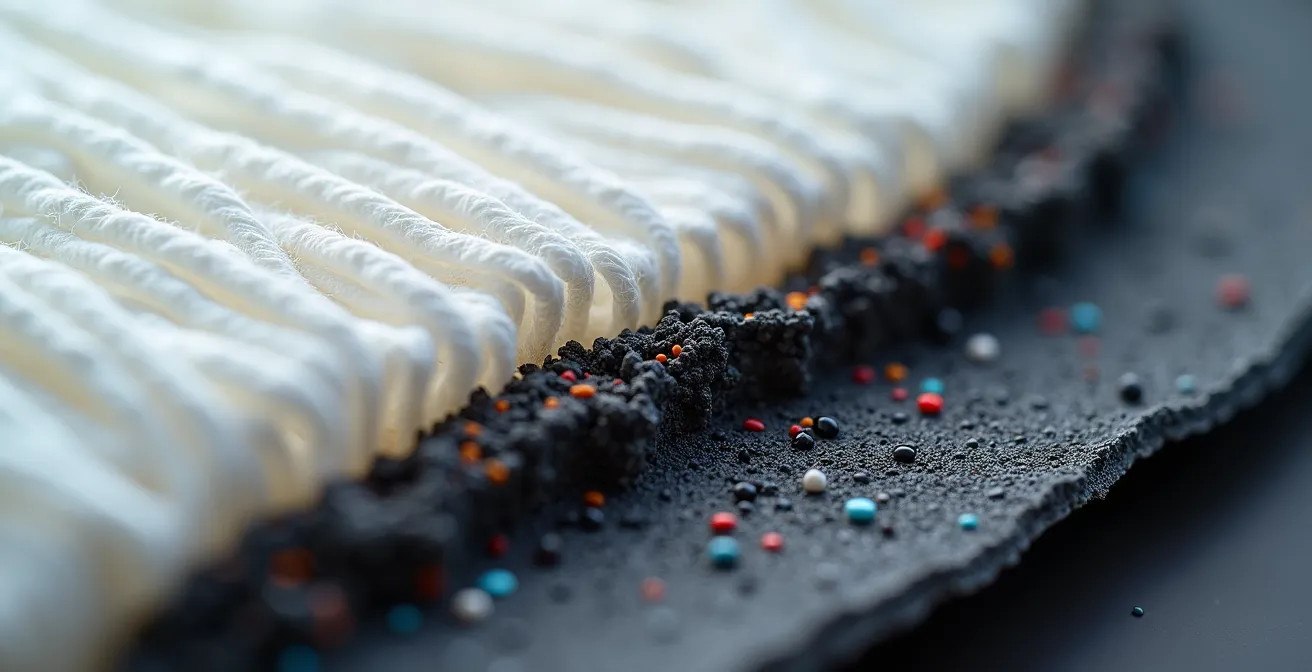
The table below highlights why a combined approach is non-negotiable for targeting traffic-related pollution. A HEPA-only system leaves you completely vulnerable to the gaseous components of exhaust fumes, which are known irritants to the respiratory system.
| Filter Type | PM2.5 Removal | NOx/VOC Removal | Maintenance Frequency |
|---|---|---|---|
| HEPA Only | 99.97% | 0% | 6-12 months |
| HEPA + Carbon | 99.97% | 60-80% | 3-6 months |
| MERV 13+ | 75-85% | 0% | 2-3 months |
Your Action Plan: Selecting the Right Air Purification System
- Calculate room volume (length × width × height) to determine the required Clean Air Delivery Rate (CADR) for effective filtration.
- Prioritize dual filtration: verify the unit has both a True HEPA filter and an activated carbon filter weighing at least 5 lbs.
- Check for distinct CADR ratings for both particles (like PM2.5) and gases (like NOx and VOCs) to ensure it handles both threats.
- Aim for a unit capable of 4-5 air changes per hour (ACH) in your primary living spaces and bedrooms to keep pollution levels low.
- Consider installing a separate indoor air quality monitor to get real-time data and verify the purifier’s effectiveness in reducing PM2.5 and VOCs.
Main Road vs. Side Streets: Which Walking Route Exposes You to Less Gas?
While creating a safe haven indoors is paramount, life requires us to venture outside. As a parent, choosing the route for a walk to the park or school is a powerful, yet often overlooked, health decision. The “invisible gradient” of pollution we discussed earlier is your most important guide. Pollutant concentrations are not uniform; they are intensely concentrated along major roadways and decay rapidly with distance. The difference between walking alongside a busy street versus one block over is not trivial—it can be the difference between high and moderate exposure.
Furthermore, the architecture of a city creates microclimates of pollution. Tall buildings flanking a street form what is known as an “urban street canyon.” In these canyons, wind is restricted, trapping vehicle emissions and preventing them from dispersing. A study of residents in Amsterdam, published in environmental health research, provided stark evidence of this effect. They found that pollutant concentrations in street canyons were up to two times higher than on parallel streets just one block away.
The study also revealed a crucial detail: the side of the street matters. The “downwind” sidewalk, where the wind blows pollutants, had significantly higher concentrations than the “upwind” side. The protective strategy is therefore two-fold and simple:
- Shift Your Route: Whenever possible, choose a walking path on a residential side street that is at least one block away from the main arterial road.
- Choose Your Side: If you must walk on a busier street, try to determine the wind direction and walk on the upwind side, putting the road between you and the direction the pollution is blowing.
These small adjustments to your daily routine are active measures of protection. They leverage scientific principles to minimize your family’s dose of inhaled pollutants with every step you take.
The Ventilation Mistake That Traps Pollutants Inside Your Car
Your car can feel like a personal bubble, a shield against the outside world. When stuck in heavy traffic, the intuitive response is to press the “recirculate” button to stop breathing in the exhaust of the car ahead. While this is a critical first step, relying on it as a perfect seal is a dangerous mistake. Your car’s cabin is not airtight. Even on recirculation mode, a significant amount of outside air—and its pollutants—can still infiltrate the cabin.
As the American Lung Association points out, this is not a perfect defense but a mitigation tool. Their experts highlight the reality of vehicle ventilation systems:
On ‘recirculate,’ 10-20% of outside air can still creep in. This highlights why recirculation is a mitigation tool, not a perfect shield.
– American Lung Association, Highway Air Pollution and Your Health Report
The most effective strategy is an active, timed approach to ventilation, not a passive one. You must periodically purge the stale, CO2-rich air that builds up inside and then return to a protective mode. A proper sequence can drastically reduce your in-car exposure:

A proactive ventilation strategy transforms your car from a passive container of accumulating pollutants into an actively managed clean-air environment. The key is to recognize that no setting is a “set it and forget it” solution.
- Initial Purge (First 60 seconds): When first entering the car, open all windows and set the fan to maximum on the fresh air intake setting. This flushes out any pollutants and VOCs that have built up while the car was parked.
- Transition Phase (Next 30 seconds): Close the windows but keep the system on fresh air mode briefly to establish positive pressure.
- Recirculation Mode: Now, switch to recirculation. This will reduce the infiltration of new traffic fumes by up to 80% while you are in the heaviest pollution zones.
- Filter Maintenance: This strategy is only effective if your cabin air filter is clean. For urban drivers, this filter should be replaced every 12,000 miles, or even more frequently, to ensure it’s effectively trapping particles.
When to Exercise Outdoors: Reading the Air Quality Index Correctly
For families who value an active lifestyle, the question is not *if* you should exercise, but *when* and *how*. A common mistake is to glance at the Air Quality Index (AQI) number and make a simple go/no-go decision. However, the single AQI number is a composite score. As a clinician, I advise you to look deeper. It is crucial to know *which pollutant* is driving the score, as different pollutants have different daily patterns.
The two main culprits in urban areas are PM2.5 and ground-level Ozone. Their peaks often occur at different times of the day:
- PM2.5: Sourced directly from combustion like traffic, its levels are often highest during morning and evening rush hours. It can also get trapped in cool, stagnant air during early morning inversions.
- Ozone: This is a secondary pollutant, formed when sunlight reacts with emissions (like NOx from cars). Its levels are typically lowest in the morning and peak in the late afternoon on hot, sunny days.
This knowledge allows for a strategic approach to outdoor activity. An AQI of 80 in the morning driven by PM2.5 presents a different risk than an AQI of 80 in the afternoon driven by Ozone. If PM2.5 is high in the morning, delaying a run until midday might be safer. Conversely, on a hot day with high Ozone predicted, an early morning workout is the best choice. The following table provides a general guide for making these decisions.
| AQI Range | PM2.5 Exercise Guide | Ozone Exercise Guide | Best Exercise Time |
|---|---|---|---|
| 0-50 (Good) | All activities safe | All activities safe | Any time |
| 51-100 (Moderate) | Reduce prolonged exertion | Avoid afternoon exercise | Early morning |
| 101-150 (Unhealthy for Sensitive) | Light activity only | Indoor exercise recommended | Late evening |
| 151+ (Unhealthy) | Avoid outdoor exercise | Avoid outdoor exercise | Indoor only |
Checking the daily air quality forecast for the specific pollutant breakdown, available on sites like AirNow.gov, transforms your decision from a guess into an informed medical choice. It empowers you to find the safest window for the outdoor activity that is so vital for your family’s health.
The Ventilation Fan Mistake That Causes Black Mold on Your Ceiling
While the title mentions black mold, the underlying issue—improper home ventilation and humidity control—has direct and serious consequences for managing traffic pollution. Many families run their bathroom or kitchen exhaust fans only when needed, to remove immediate steam or odors. This is a missed opportunity. Strategic, timed use of your home’s exhaust fans is a powerful tool for improving overall indoor air quality by managing both humidity and accumulated pollutants.
High indoor humidity (above 50-60%) creates a condition I refer to as “sticky air.” Microscopic water droplets in the air cause airborne particles like PM2.5 to clump together and deposit more readily onto surfaces like walls, furniture, and, unfortunately, the lining of your lungs. This means that on a humid day, the same amount of infiltrating pollution results in a higher dose being delivered to your body.
Study: The “Sticky Air” Effect on Indoor Pollution
Research from CalSPEC, highlighted in a report by UC Davis Health, found that homes with humidity levels above 60% had 2.5 times higher deposition of PM2.5 onto indoor surfaces. The key finding, however, was the solution: strategically running exhaust ventilation during low-pollution hours (e.g., midnight to 4 a.m.) reduced both indoor humidity and ambient particulate levels by an average of 40%.
The protective strategy is to use your existing ventilation systems not just reactively, but proactively. By installing a simple timer on your bathroom exhaust fans and setting them to run for an hour or two during the late night, you create a gentle, consistent negative pressure. This pulls stale, humid, and pollutant-laden air out of your home during the period when outdoor pollution levels are typically at their lowest. This simple habit helps purge the home of the day’s accumulated toxins and prevents the “sticky air” effect, reducing your family’s overall exposure.
Key takeaways
- The “stack effect” in poorly ventilated attics can actively pull ground-level traffic pollution into your living spaces.
- Sealing air leaks and ensuring proper attic ventilation are critical structural defenses against pollution infiltration.
- Nutrition acts as a biological shield; antioxidants in your diet help neutralize the cellular damage caused by inhaled pollutants.
The Ventilation Error That Cooks Your Shingles From the Inside Out
The structural integrity of your home and its ventilation system are your first line of defense against outdoor pollution. An often-overlooked vulnerability lies in the attic. A hot, poorly ventilated attic doesn’t just damage your roof; it can turn your entire house into a vacuum that actively sucks in traffic fumes from the ground level. This dangerous phenomenon is known as the “stack effect.”
As air in the upper levels of a house (like the attic) gets hot, it rises and escapes through gaps in the roof. This creates a subtle negative pressure in the lower levels of the house, which pulls in replacement air from the easiest available source. In a poorly sealed home, this means air is drawn in through cracks around windows, doors, and foundations—right where the heaviest traffic pollutants have settled. The EPA’s building science experts explain this mechanism clearly.
A hot, poorly ventilated attic creates a ‘stack effect,’ pulling air from the lowest parts of the house up into living spaces, actively sucking in traffic fumes that have settled at ground level.
– EPA Building Science Team, Near-Road Air Quality Mitigation Strategies
The problem is widespread, with Urban Institute research revealing that over 50% of residents in a city like Louisville live within 300 meters of major arterial roads, placing them squarely in the zone of highest risk for this effect. The protective measure here is structural. Ensuring your attic has proper soffit and ridge vents creates a continuous flow of air that keeps the attic cool and breaks the stack effect cycle. It stops your house from working against you. Sealing air leaks at the lowest level of your home is the second critical step, cutting off the primary pathway for pollutants to be drawn inside.
A Balanced Diet for Executives: How to Avoid the Afternoon Energy Crash?
While the previous sections focused on reducing your exposure to pollutants, this final layer of protection focuses on strengthening your body’s internal defenses. No matter how diligent you are, living in an urban environment means you will inevitably inhale some pollutants. The question then becomes: how can you help your body manage the assault? The answer lies in nutrition. Think of it as a nutritional shield that helps mitigate the cellular damage caused by pollution.
When you inhale pollutants like PM2.5, they can generate free radicals in your body, leading to oxidative stress and inflammation—the root causes of many chronic diseases. An antioxidant-rich diet can help neutralize these free radicals and support your body’s detoxification processes. This is not a fringe idea; it is a critical public health strategy for the millions of people living in high-exposure areas. Data from the CDC indicates that over 11.3 million Americans live within 150 meters of a major highway, all of whom could benefit from this dietary support.
Incorporating specific, powerful nutrients into your family’s diet can provide a measurable boost to their resilience. Consider this an anti-pollution protocol for your plate:
- Sulforaphane Boost: Found in cruciferous vegetables, especially broccoli sprouts, sulforaphane is a potent activator of the body’s natural detoxification pathways. Adding sprouts to a smoothie is an easy way to get a concentrated dose.
- Vitamin C Shield: High levels of Vitamin C, found in citrus fruits, bell peppers, and kiwi, are essential for protecting the delicate lining of your lungs from oxidative damage.
- Omega-3 Anti-Inflammatories: The inflammation triggered by pollution can be countered by Omega-3 fatty acids, abundant in walnuts, chia seeds, flaxseeds, and fatty fish.
- Antioxidant Powerhouse: Dark-colored berries (blueberries, blackberries) are packed with antioxidants called anthocyanins that directly combat free radicals throughout the body.
This is not about an “energy crash” for executives; it is about providing your family’s bodies with the specific tools they need to defend themselves at a cellular level from the daily, unavoidable exposure to traffic pollution.
By layering these strategies—purifying your indoor air, choosing smarter routes, managing ventilation, and fortifying your body—you can take meaningful, evidence-based control over your environment and provide the protection your family deserves.