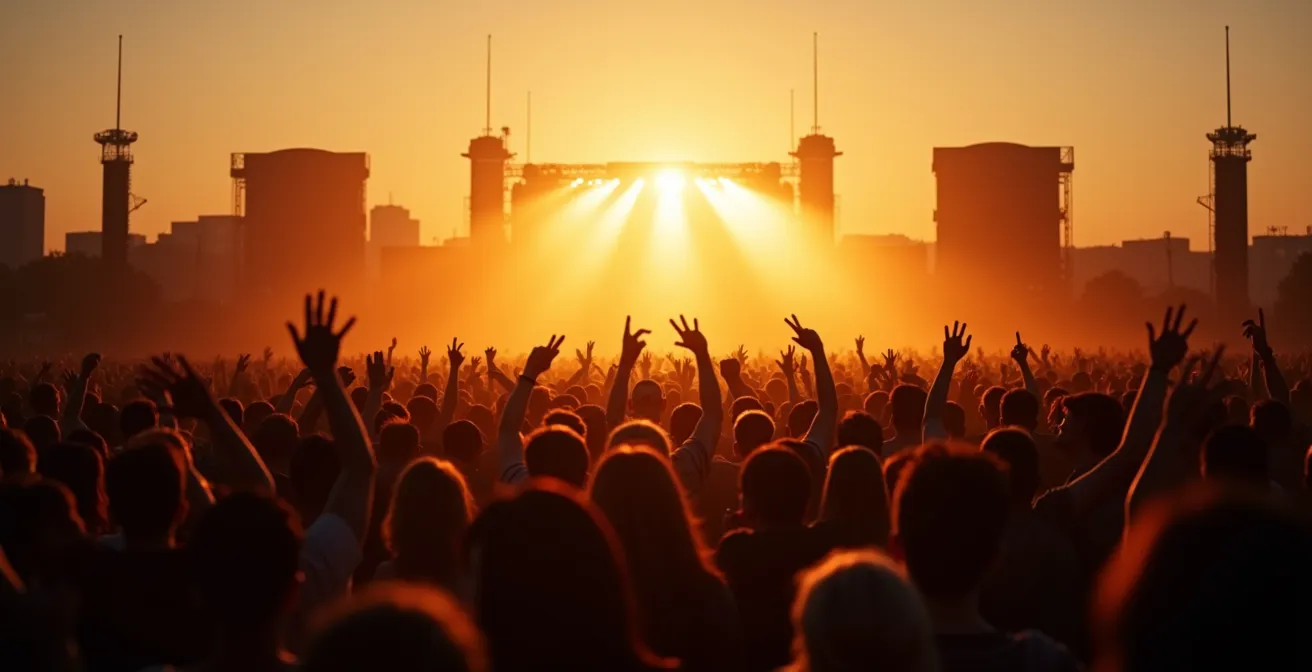
The explosion of live events isn’t just a rebound; it’s a fundamental shift toward a “Resonance Economy,” where the value lies in intentionally designed, transformative collective experiences.
- Biological drivers like synchronized movement trigger chemical bonding that digital platforms can’t mimic.
- Experience design now prioritizes sensory immersion and psychological safety over simple entertainment.
- A new “participation contract” is emerging, asking attendees to be present and co-create the moment.
Recommendation: Stop thinking about filling seats and start designing for deep, shared emotional and sensory resonance.
After years of screens mediating our connections, a quiet roar is building. It’s the sound of stadiums selling out in minutes, local parks buzzing with activity, and theaters filling with shared silence. We’ve emerged from a period of profound isolation with a hunger not just for company, but for something deeper: meaningful, collective experiences. Many assume this is a simple reaction, a pendulum swing away from digital fatigue. We are told that “we are social creatures” and that “technology can’t replace the magic of being there.” While true, these ideas barely scratch the surface.
The real story is far more fascinating. We are not just returning to old habits; we are seeking a new kind of value. The boom in live events isn’t just about being physically present. It’s about a craving for designed resonance—the intentional crafting of moments that make us feel part of something larger than ourselves. It’s the difference between watching a concert and feeling the bass drum beat in unison with ten thousand other hearts. This isn’t accidental magic; it’s a science and an art form that successful event organizers, community leaders, and artists are mastering.
But how does this resonance work? It’s a powerful cocktail of psychology, biology, and thoughtful design. This article deconstructs the architecture of modern collective experiences. We will explore the neurochemical triggers of shared movement, the design principles for fostering genuine community, the critical role of psychological safety, and the emerging social contracts that ask us to put our phones away and truly participate. It’s time to move beyond the platitudes and understand the mechanics of what makes us feel truly connected.
To navigate this new landscape, we will examine the core components that transform a simple gathering into a resonant, memorable event. The following sections break down the science, strategy, and soul behind today’s most powerful collective experiences.
Summary: Decoding the Architecture of Collective Resonance
- Why Synchronized Movement at Concerts Releases More Oxytocin?
- How to Organize a Local Event That Actually Brings Neighbors Together?
- Mega-Festivals vs. Intimate Gigs: Which Offers a Truer Connection?
- The Safety Oversight That Can Turn a Collective Event Into a Panic
- How to Experience a Concert Without Filming It on Your Phone?
- Streaming Services vs. Live Theater: Is the “Experience” Dying?
- How to Turn Negative Reviews Into Brand Loyalty Opportunities?
- Today’s Forms of Entertainment: Are We Losing the Ability to Be Bored?
Why Synchronized Movement at Concerts Releases More Oxytocin?
The feeling of unity at a concert, when thousands of people clap, sway, or jump to the same beat, is not just a psychological phenomenon; it’s a deeply biological one. This collective effervescence is powered by a surge of neurochemicals, with oxytocin—often called the “bonding hormone”—playing a leading role. When we move in sync with others, our brains interpret this shared rhythm as a powerful signal of social affiliation. It tells our ancient, tribal instincts that we are part of a cohesive group, safe and connected.
This isn’t just theory. Research is increasingly showing how our brains are wired for this kind of connection. The ability to synchronize with a beat is a uniquely human skill that directly impacts our social bonding mechanisms. As one study highlights, this process is fundamental to how we build relationships within groups. As researchers from the study noted in Scientific Reports:
The ability to synchronise to a musical beat is largely a human skill. Our study contributes to our understanding of how this form of human behaviour is affected by socio-biological factors, such as oxytocin and leader-follower relationships.
– L. Gebauer et al., Scientific Reports
For an experience designer, this is a powerful tool. It means that creating moments of synchronized action is not just for show; it’s a direct pathway to fostering a deep sense of community and positive emotion. Whether it’s a call-and-response chant, a unified light display from wristbands, or simply a song with an irresistible, easy-to-follow beat, these elements are the architectural keystones of designed resonance. They transform a crowd of individuals into a unified, oxytocin-fueled collective, creating a high that lasts long after the final encore.
How to Organize a Local Event That Actually Brings Neighbors Together?
After years of digital-first interactions, bringing neighbors together requires more than just a flyer for a block party. The anxiety of face-to-face interaction is real, and the most successful local events are those designed with a clear purpose that lowers the barrier to entry. The key is shifting from purely social gatherings to activities that provide a shared, low-pressure goal. Task-oriented events give people a reason to interact without the awkwardness of forced small talk, creating natural conversation and a sense of collective accomplishment.
Instead of a simple potluck, consider a community garden workday, a neighborhood clean-up, or a workshop to build a “Little Free Library.” These activities provide what social psychologists call a “superordinate goal”—a task that can only be accomplished through cooperation. This structure is especially effective for post-isolation communities where social muscles may have atrophied. It allows for connection to happen as a byproduct of a tangible, shared effort. This table illustrates the distinct advantages of structuring events around tasks versus pure socialization.
| Event Type | Examples | Connection Speed | Barrier to Entry | Long-term Impact |
|---|---|---|---|---|
| Task-Oriented | Community gardens, clean-ups, Little Free Library building | Fast (shared goal) | Low (clear purpose) | High (ongoing project) |
| Socially-Oriented | Block parties, potlucks, game nights | Moderate | Higher (social anxiety) | Moderate (one-time) |
| Hybrid | Progressive dinners, skills swap workshops | Fast | Low-Moderate | High (combines both) |
Building a successful community event is a process of intentional design. It begins with a clear purpose and a dedicated team, focusing on activities that foster natural interaction rather than demanding it. To make your next local gathering a true success in fostering connection, follow these proven steps.
Your Action Plan: Creating Connection-Focused Community Events
- Define a clear purpose: Decide if the goal is to welcome new residents, celebrate a local milestone, or simply build camaraderie through a fun activity.
- Gather an enthusiastic team: Assign specific roles like logistics, budget management, and communication based on individual strengths to ensure smooth execution.
- Choose task-oriented activities: Opt for projects like a community garden, a neighborhood cleanup, or a mural painting that give attendees a shared, low-skill goal.
- Integrate structured icebreakers: Use tools like ‘human bingo’ with meaningful prompts (e.g., “Find someone who has traveled to a place you want to visit”) to ease post-isolation social anxiety.
- Gather feedback for improvement: After the event, send a simple survey to understand what resonated with attendees and identify areas for improvement for future gatherings.
Mega-Festivals vs. Intimate Gigs: Which Offers a Truer Connection?
The live music industry is booming on two parallel tracks. On one hand, mega-tours are shattering records, with data showing the top 100 tours grossing over $9 billion in 2023, a staggering increase from previous years. The sheer scale of these events—the massive crowds, epic stage production, and shared adoration for a global superstar—creates a powerful sense of being part of a historic moment. The energy of a stadium singing in unison is an undeniable form of collective experience, a testament to the power of mass synchronization.
On the other hand, there is a growing appreciation for the profound connection found in smaller, more intimate settings. In these spaces, the “vulnerability threshold” is lower. The physical closeness between the artist and the audience, and among the audience members themselves, removes the layers of anonymity that define a mega-festival. You can see the artist’s expression, hear the subtle nuances in their voice, and feel the shared emotional response of the person sitting next to you. It’s a different kind of resonance—less about epic scale and more about shared, unshielded humanity.
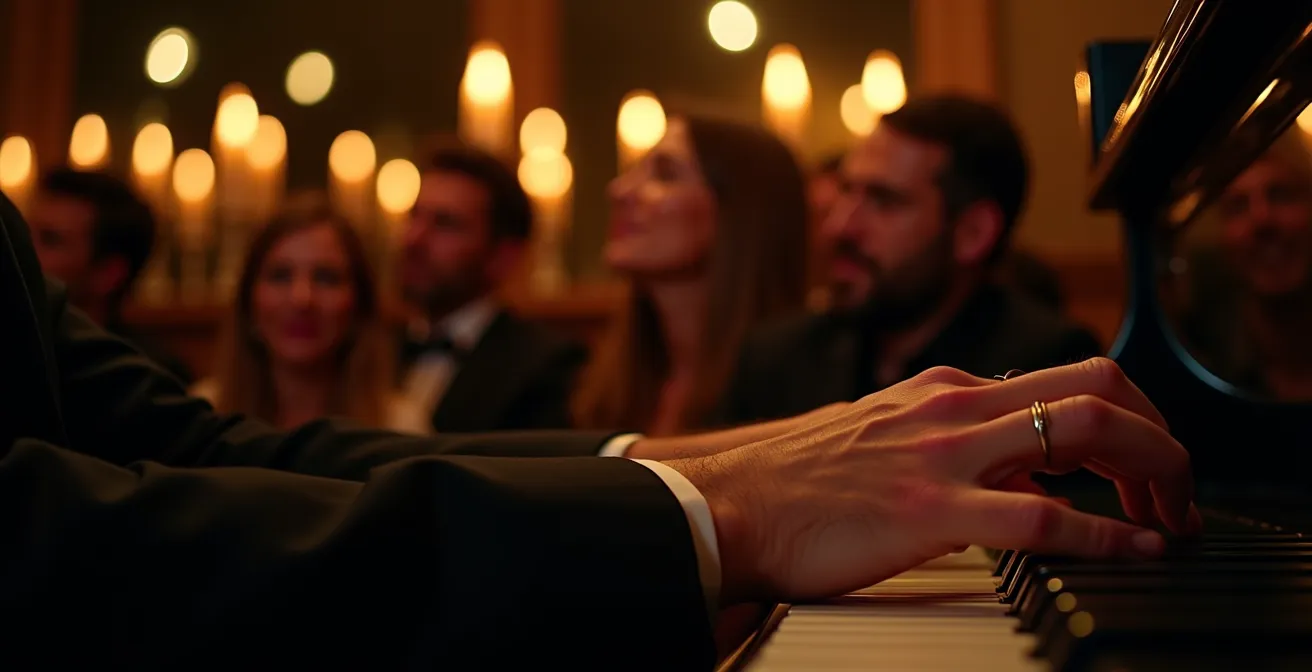
As this image of an intimate venue suggests, proximity and atmosphere are key ingredients for a certain kind of deep connection. The question is not which format is “better,” but what kind of connection you are seeking or aiming to create. Mega-festivals offer the thrill of anonymous unity and belonging to a massive tribe. Intimate gigs offer the risk and reward of authentic, personal connection, where the experience is co-created in real-time through shared glances, reactions, and a palpable collective focus. Both are valid, but they serve different human needs on the spectrum of collective experience.
The Safety Oversight That Can Turn a Collective Event Into a Panic
In the post-pandemic era, the concept of safety at live events has fundamentally expanded. It’s no longer just about physical security and crowd control; it’s about psychological safety. Attendees are hyper-aware of their environment, and their decision to attend, stay, and engage is deeply influenced by how safe they feel. In fact, a recent survey revealed that for over 70% of respondents, safety measures directly influence their choice to attend an event. Ignoring this can be the single greatest oversight an organizer can make, as a perceived threat can trigger an “information cascade”—where a few panicked individuals cause a wave of fear to spread through a crowd.
Designing for psychological safety means being proactive and transparent. It’s about creating an environment where attendees feel cared for and informed, which prevents anxiety from escalating into panic. This involves more than just security guards at the door. Modern safety design incorporates clear, multi-channel communication systems for real-time updates, designated “calm zones” for those feeling overwhelmed, and staff trained in de-escalation rather than confrontation. Contactless entry systems and high-quality air filtration, once a niche concern, are now expected standards that signal to attendees that their well-being has been considered from every angle.
The goal is to build trust through visible, thoughtful measures. When attendees see that an organizer has anticipated their needs—from hygiene to personal space to clear exit signage—they can relax and immerse themselves in the experience. This feeling of being looked after is the foundation upon which all other forms of connection are built. Without it, even the most spectacular performance can be undermined by an undercurrent of anxiety. An event that feels unsafe is an event that has already failed, regardless of what happens on stage.
How to Experience a Concert Without Filming It on Your Phone?
The “wall of screens” at concerts has become a defining, and often debated, feature of modern live events. While capturing a memory is a natural impulse, the act of filming often pulls us out of the very moment we wish to preserve. It shifts our role from active participant to passive documentarian, creating a digital barrier between us, the artist, and the people around us. In response, a powerful counter-movement is growing, centered on a new “participation contract” between performers and audiences, asking for one simple thing: be here now.
This is more than just a polite request; it’s a design choice being implemented through innovative solutions. The most prominent example is the use of phone-free pouches that are transforming the concert experience.
Case Study: The Rise of Phone-Free Shows with Yondr Pouches
Artists like Jack White, The Lumineers, and comedians like Dave Chappelle are increasingly requiring audiences to place their phones in lockable Yondr pouches upon entry. The phones remain with the attendees but can only be unlocked in designated areas. As reported at major venues throughout 2023, the effect is transformative. Without the distraction of screens, audience engagement skyrockets. People make eye contact, sing louder, and are more attuned to the performance and the collective energy of the room. This “social contract” doesn’t just remove a nuisance; it actively co-creates a more authentic, shared experience by eliminating the primary tool of digital disconnection.
This shift encourages us to engage with the event through our own senses, not through a 6-inch screen. It’s about feeling the bass vibrate through the floor, seeing the intricate play of stage lights with your own eyes, and sharing a reaction with a stranger next to you. It’s about trading a low-quality digital recording for a high-fidelity sensory and emotional memory.
Ultimately, experiencing a concert without your phone is an act of trust—trust that the memory your mind creates will be more valuable than the video on your camera roll. It’s a conscious choice to prioritize sensory immersion over digital capture, a practice that unlocks a deeper, more resonant level of connection to the art and the collective.
Streaming Services vs. Live Theater: Is the “Experience” Dying?
During the pandemic, livestreamed concerts and theater productions became a lifeline. For a moment, it seemed a new hybrid future was inevitable, one where the digital and physical experience would hold equal weight. And to some extent, that has held true; an Eventbrite survey found that 63% of event organizers plan to continue offering online streaming options, recognizing the value of accessibility. However, the predicted death of the live experience never materialized. In fact, the opposite happened.
The mass experiment with digital-only events inadvertently proved the irreplaceable nature of being there in person. While streaming offered a visual and auditory replica, it failed to transmit the most crucial element: the feeling of shared presence. It couldn’t replicate the collective gasp of a theatrical plot twist, the electricity in the air before an encore, or the subtle social cues exchanged between audience members. This distinction became glaringly obvious once restrictions were lifted. As Pollstar aptly summarized in its annual recap:
While people soon found out that meetings could easily be held digitally, livestreamed concerts just couldn’t recreate the magic of the real thing, which at least partly explains how the industry surged back from the brink once restrictions were lifted.
– Pollstar, Annual Industry Recap
The “experience” is not dying; it’s being redefined and valued more highly than ever. Streaming has found its place as a valuable supplement—a way to reach a global audience, create archival content, or provide access for those unable to attend. The Greek National Opera, for example, reached 360,000 global viewers through streaming. But it is not a replacement. The digital window can show you the performance, but only being in the room allows you to become part of the performance’s energy field. This visceral, un-streamable component is precisely what people are now paying a premium for.
How to Turn Negative Reviews Into Brand Loyalty Opportunities?
In the world of live events, a negative review is not an endpoint; it’s a starting point for building a stronger community. In the past, a bad review was something to be buried. Today, savvy organizers understand that public criticism is a gift—an opportunity to demonstrate transparency, responsiveness, and a genuine commitment to the attendee experience. This approach, known as the “service recovery paradox,” can turn a dissatisfied customer into one of your most vocal advocates. The key is to handle the feedback not as a threat, but as a dialogue.
The process involves a few critical steps: publicly acknowledging the complaint’s validity, moving the conversation to a private channel for a personal resolution, and—most importantly—implementing visible changes based on the feedback. When other attendees see that an organization listens and acts, it builds immense trust and a sense of shared ownership over the event’s success. This turns the relationship from a simple transaction (ticket for entertainment) into a collaborative partnership.
A brilliant example of this principle in action is the Bésame Mucho Festival, which harnessed community feedback to create unprecedented demand.
Case Study: The Bésame Mucho Festival’s Feedback Loop Success
Following its inaugural event, the Bésame Mucho Festival faced criticism regarding logistics and crowd flow. Instead of becoming defensive, the organizers created a public feedback system and actively engaged with the community’s concerns. They implemented tangible changes for the following year based directly on this input. The result? The 2023 festival sold out in just 70 minutes. By addressing negative reviews head-on, they didn’t just fix problems; they strengthened their brand identity and proved to their audience that their voices mattered, fostering immense loyalty.
This approach transforms negative feedback from a liability into an asset. It allows you to refine your offering while simultaneously building a resilient, loyal community that feels invested in your success because they have a hand in shaping it.
Key Takeaways
- Human connection is a biological process; experiences designed with synchronized movement and shared goals can actively foster it.
- The debate isn’t about big versus small events, but about impersonal versus resonant ones. Both scales can achieve deep connection through intentional design.
- A new “participation contract” is emerging, where the best experiences are co-created between organizers who ensure safety and attendees who choose to be present.
Today’s Forms of Entertainment: Are We Losing the Ability to Be Bored?
The forced stillness of the pandemic created a unique cultural moment. With the world on pause, we were confronted with something many of us hadn’t experienced in years: boredom. The constant stream of entertainment, notifications, and obligations vanished. This period of deprivation, starkly illustrated by data from Live Nation showing its annual events dropping from 40,000 in 2019 to just 8,000 in 2020, created a profound void. And in that void, a powerful longing grew—not just for entertainment, but for the visceral thrill of live, collective experiences.
This period of “deprivation,” as Pollstar called it, was the fertile ground from which the current live event boom sprouted. The absence of these experiences didn’t just make us miss them; it made us re-evaluate their importance. The endless scroll of on-demand content, while convenient, proved to be a poor substitute for the unpredictable, unrepeatable magic of a live performance. It highlighted the difference between passive consumption and active participation.
A clear part of the wind beneath the live industry’s wings in the last two years was deprivation – oh how absence makes the live music fans’ hearts grow fonder.
– Pollstar, Annual Industry Recap 2023
Perhaps we haven’t lost the ability to be bored, but rather, we’ve rediscovered the value of what lies on the other side of it: genuine, unmediated engagement. The current hunger for live events is a direct rejection of the algorithmically-perfected, infinitely-available stream. It’s a collective choice to embrace the imperfect, the ephemeral, and the deeply human. It is a declaration that some things are worth waiting for, worth showing up for, and worth experiencing together, in the same room, at the same time.
The journey from passive viewer to active participant is the definitive story of our time. To truly harness the power of this movement, the next step is to begin designing every gathering—from a neighborhood meeting to a music festival—with the principles of resonance, safety, and shared experience at its core.