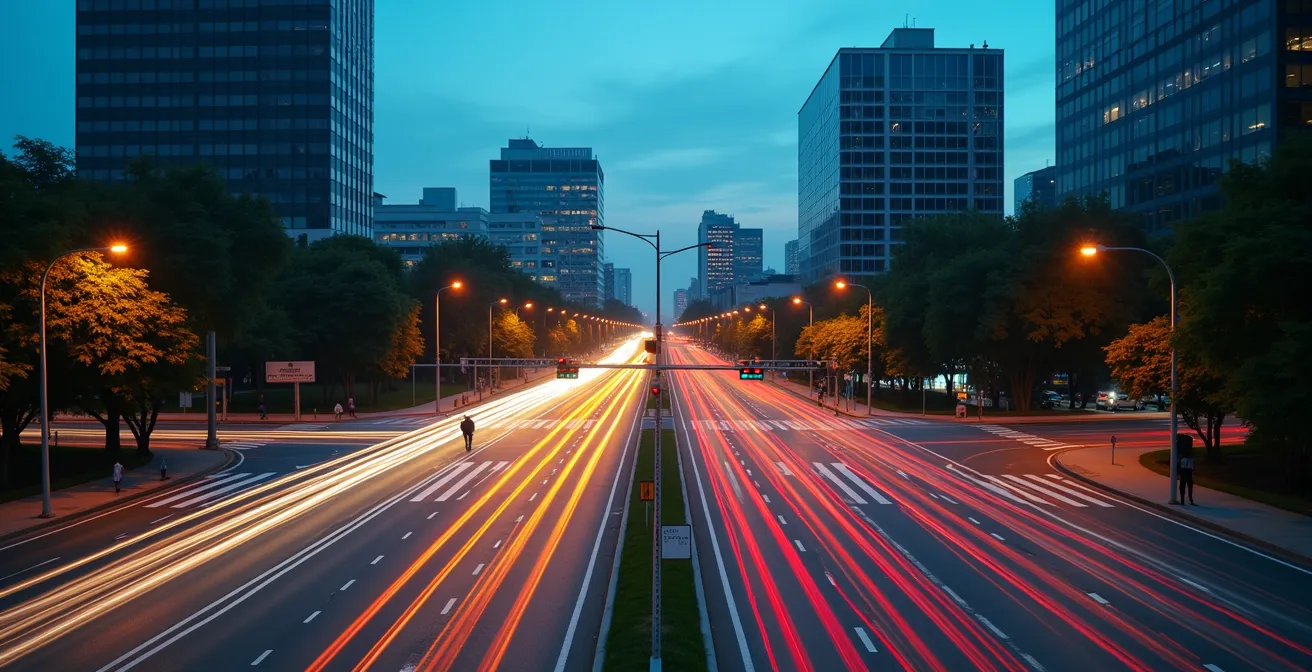
The constant stopping at red lights isn’t an isolated issue; it’s a symptom of a disconnected, outdated traffic grid. AI offers a systemic solution by transforming this grid into a single, predictive organism.
- Traditional traffic lights operate on fixed timers, causing predictable delays and ignoring real-time conditions.
- AI-powered systems use real-time data from multiple sources to anticipate traffic flow and coordinate signals across entire city sections, not just one intersection.
Recommendation: Instead of viewing traffic as a series of individual lights, we must adopt a network-level approach where intelligent, predictive control is the new baseline for urban mobility.
For any driver who has waited at an empty intersection for a red light to change, the feeling is universal: a sense of profound inefficiency. This daily frustration is more than just an annoyance; it’s a clear signal that our urban traffic management systems are fundamentally misaligned with reality. For decades, the prevailing solution has been a mix of widening roads and optimizing pre-programmed light timers. We’ve been taught that traffic is an unavoidable consequence of density, a problem to be endured rather than solved.
But what if this premise is wrong? What if the endless cycle of stop-and-go isn’t caused by the number of cars, but by the “dumb” system managing them? The true bottleneck is not the asphalt but the archaic logic of isolated timers that cannot communicate, adapt, or predict. This article moves beyond the simplistic view of traffic. We will not rehash platitudes about leaving earlier or the vague promise of “smart cities.” Instead, we will adopt the perspective of an engineer to deconstruct the system itself.
The core argument is this: AI’s revolutionary potential is not in making a single traffic light “smarter,” but in creating a fully integrated, predictive network organism that manages flow on a city-wide scale. By understanding the deep-seated causes of delays, the unseen ripple effects of driver behavior, and the true power of predictive analytics, we can see a clear path toward a future where rush hour congestion is no longer an inevitability. This guide will explore the systemic failures of our current approach and detail how an AI-driven grid can actively dismantle traffic jams before they even begin.
To understand this complex system, we will deconstruct it piece by piece. The following sections explore the core inefficiencies of traditional methods, the limitations of popular workarounds, and the specific ways AI technology provides a cohesive, network-level solution.
Summary: How AI-Powered Grids Are Solving Urban Congestion
- Why Traditional Timers Cause 30% of Unnecessary Delays?
- How to Use Waze to Bypass Gridlock Without Getting Stuck in Neighborhoods?
- Roundabouts vs. Traffic Lights: Which Moves More Cars per Hour?
- The Braking Error That Causes Traffic Jams for No Reason
- When to Implement Congestion Pricing to Shift Demand Patterns?
- Why Traditional Forecasting Fails During Seasonal Demand Spikes?
- How to Identify Which Tasks Are Ripe for Automation in 30 Minutes?
- Transportation Systems: How Cities Are redesigning Grids to Ban Cars?
Why Traditional Timers Cause 30% of Unnecessary Delays?
The fundamental flaw of most urban traffic systems is that they are not systems at all. They are merely collections of isolated, pre-programmed devices operating on fixed timers. These timers are typically set based on historical traffic data, meaning they are optimized for an “average” day that rarely exists. This static approach cannot account for real-time fluctuations: a minor accident, a local event, or even just a random cluster of cars. The result is a system that is perpetually out of sync with actual demand, creating delays by its very design.
This systemic inefficiency is not a minor issue. Federal analysis shows that outdated traffic signal timing accounts for more than 10 percent of all traffic delays. At an empty intersection, a driver’s wait is a direct consequence of the timer’s inability to see that no cross-traffic exists. On a larger scale, uncoordinated lights create a “ripple effect” of braking and acceleration, wasting fuel and time. The light ahead turns red not because of immediate conditions, but because a clock told it to.
AI-powered adaptive signal control technology directly confronts this problem. Instead of relying on historical averages, these systems use a network of sensors—cameras, radar, and other data sources—to build a live, dynamic model of the traffic grid. The algorithm’s goal is no longer to simply follow a schedule but to actively optimize flow. As a result, the system can extend a green light for an approaching platoon of cars or shorten a red light when no vehicles are waiting. This isn’t just a smarter timer; it’s a shift from a clock-based to a demand-responsive paradigm. The success of this approach is well-documented; for instance, Pittsburgh’s early adoption of an AI-driven system managed to reduce time lost in traffic by 40%.
How to Use Waze to Bypass Gridlock Without Getting Stuck in Neighborhoods?
In the face of systemic gridlock, drivers have turned to their own technological fix: navigation apps like Waze or Google Maps. These platforms promise a way to “outsmart” traffic by dynamically rerouting vehicles away from congested arteries onto what appear to be faster secondary roads. From the individual driver’s perspective, this is a logical and often effective strategy. However, from a city-wide engineering perspective, this uncoordinated “solution” can inadvertently create new problems by pushing high volumes of traffic into areas never designed to handle it.
When thousands of individual users are rerouted through quiet residential streets, it creates “cut-through” traffic that leads to noise, safety concerns for pedestrians, and localized gridlock in neighborhoods. This phenomenon highlights a critical difference between optimizing a single journey and optimizing an entire network. Waze solves the problem for the user, but it doesn’t solve the city’s overall traffic problem; it often just moves it somewhere else. The system lacks a holistic view, leading to a classic “tragedy of the commons” scenario on local roads.
The image below provides an aerial perspective on how arterial congestion can spill over into residential grids, illustrating the challenge of unmanaged rerouting.
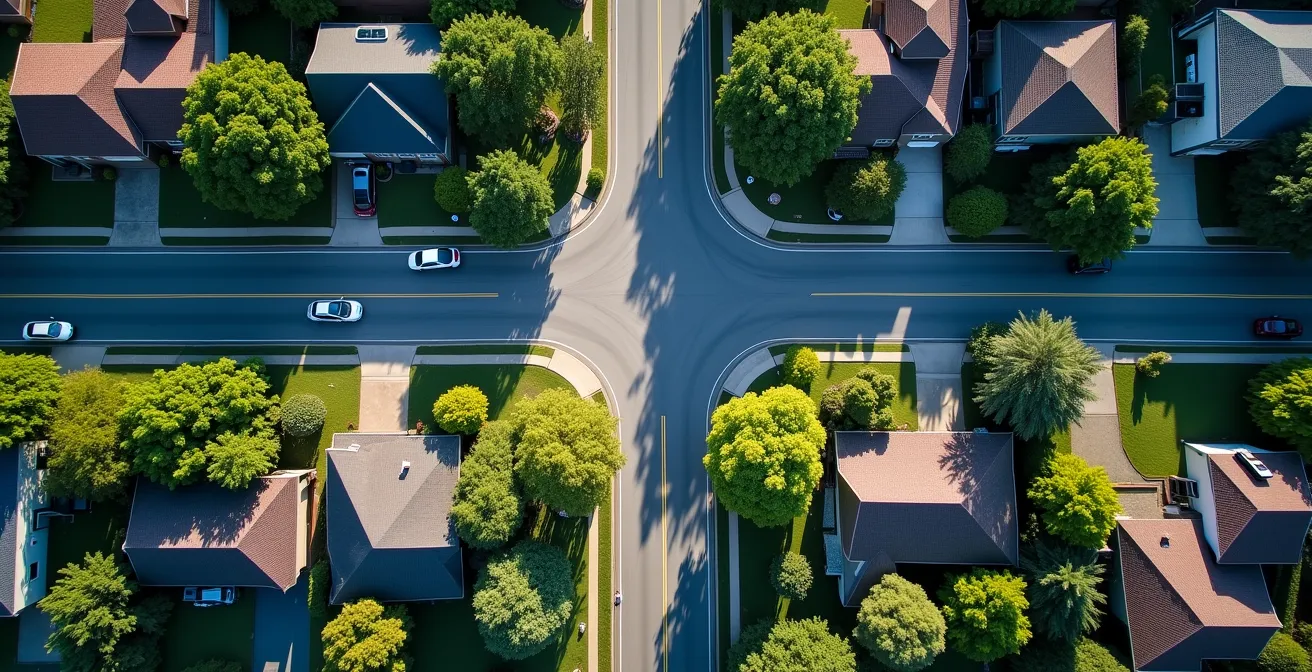
A truly smart traffic system, however, integrates this challenge. As Yossi Matias, a Vice President at Google, notes, the goal is to go beyond single-intersection optimization. The key is “coordinating across several adjacent intersections to create waves of green lights.” An AI-powered central system can do this at scale, making the main arteries so efficient that the incentive to use residential shortcuts diminishes. By treating the city grid as a cohesive network organism, AI can improve flow for everyone, preventing the very gridlock that sends drivers searching for a bypass in the first place.
Roundabouts vs. Traffic Lights: Which Moves More Cars per Hour?
When discussing traffic flow, the conversation often turns to physical infrastructure changes, with the modern roundabout frequently championed as superior to the traditional intersection. From a pure vehicle throughput perspective, the data is compelling. Roundabouts eliminate the start-stop nature of traffic lights, allowing for a continuous, albeit slower, flow of traffic. This typically reduces conflict points and can decrease certain types of accidents. However, building a roundabout is a major capital investment, requires significant physical space, and is not always feasible in dense urban cores.
While roundabouts are a proven hardware solution for specific locations, AI-adaptive signals represent a powerful software solution that can be deployed across an entire existing grid. Instead of redesigning an intersection, we are upgrading its intelligence. Studies in cities like Pittsburgh have shown that AI systems can dramatically improve performance with a 25% travel time reduction and a 40% decrease in idle time at intersections. This demonstrates that intelligence can often yield results comparable to, or even exceeding, physical reconstruction, but with greater flexibility and scalability.
The real advantage of AI is its adaptability. A roundabout is a static improvement. An AI system is dynamic. The table below compares the performance of adaptive systems (which form the basis of AI control) with older “actuated” signals that use simple sensors.
| System Type | Delay Reduction | Wait Time Improvement |
|---|---|---|
| Adaptive Systems | Up to 20% decrease | 30-40% reduction |
This data, highlighted in a comparative analysis of traffic control technologies, shows that intelligent systems deliver significant gains in efficiency. The choice is not always between a roundabout or a light; it is between a static solution and a dynamic one. For a network-wide impact, upgrading the grid’s intelligence offers a more scalable and cost-effective path forward than isolated physical overhauls.
The Braking Error That Causes Traffic Jams for No Reason
One of the most frustrating traffic phenomena is the “phantom jam”—a sudden slowdown on a highway or major road that occurs for no apparent reason, such as an accident or an obstruction. From an engineering standpoint, these jams are a classic example of a system failure triggered by human behavior. They often begin with a single driver braking unnecessarily hard. The driver behind them reacts by braking even harder, creating a chain reaction that amplifies backward through the line of traffic. This wave of braking can eventually bring cars to a complete stop miles behind the initial event.
This happens because each driver is an isolated agent reacting only to the car immediately in front of them. There is no system-wide coordination. Even with cruise control, most systems are reactive, not predictive. The phantom jam is a perfect illustration of how small, uncoordinated actions can lead to large-scale systemic collapse. It proves that traffic flow is incredibly fragile and highly susceptible to human input.
This is where AI’s network-level view becomes a game-changer. By coordinating traffic lights to create “green waves,” an AI system can smooth out the flow of vehicle platoons, reducing the likelihood of the sudden braking that initiates a phantom jam. When traffic flows more predictably, drivers are less likely to make erratic speed adjustments. The goal of the AI is to maintain a stable system state, preemptively managing vehicle spacing and speed through signal timing. This turns a collection of reactive human drivers into a more cohesive, managed flow. The long-term success of Los Angeles’s ATSAC program, which started for the 1984 Olympics and has since expanded, shows the power of this approach; the system has slashed intersection delays by over 32% across the city, reducing the kind of stop-and-go behavior that can trigger these jams.
When to Implement Congestion Pricing to Shift Demand Patterns?
Even the most intelligent AI traffic system can be overwhelmed if demand infinitely exceeds the physical capacity of the road network. AI is brilliant at managing supply (road space), but it doesn’t directly manage demand (the number of cars wanting to use the road at a given time). This is where economic levers like congestion pricing become a powerful complementary strategy. Congestion pricing involves charging drivers a fee to enter a specific, high-demand area during peak hours. Its purpose is not to punish drivers, but to incentivize a shift in demand patterns.
By making it more expensive to drive during the busiest times, congestion pricing encourages people to shift their travel to off-peak hours, use public transportation, or consolidate trips. This flattens the “peak” of rush hour, making traffic more manageable for the AI system. It’s a classic supply-and-demand intervention. An AI traffic grid and congestion pricing work in symbiosis: the pricing reduces the overall load, while the AI efficiently manages the remaining traffic.
This visualization represents how traffic density concentrates in urban centers, the very areas where congestion pricing can be most effective at redistributing demand.

Implementing congestion pricing is most effective when a city has a clear understanding of its traffic patterns and has viable alternatives (like robust public transit) in place. The data gathered by an AI traffic grid is invaluable for determining where and when to apply such pricing for maximum effect. Projects like Google’s Green Light initiative, which can achieve up to a 30 percent reduction in stops at intersections, make the remaining traffic so much smoother. When paired with pricing, the combined effect is a powerful one-two punch against gridlock: one tool to optimize flow, and another to rationalize demand.
Why Traditional Forecasting Fails During Seasonal Demand Spikes?
Traditional traffic forecasting models are built on a foundation of historical data. They excel at predicting the rhythm of a normal Tuesday morning commute because they have thousands of similar Tuesdays to reference. However, these models often fail when faced with novel or anomalous events, such as major holiday travel, an unexpected sporting event victory parade, or extreme weather. These “black swan” events have no deep historical precedent, causing the models to produce inaccurate forecasts and leading to unprepared traffic management systems.
The core limitation is that these old models are descriptive, not predictive in a true sense. They can describe what has happened in the past but cannot effectively reason about new, emerging situations. A seasonal shopping spike, for example, might be bigger than last year’s due to economic factors the traffic model doesn’t consider. The system is brittle because it is backward-looking. It can only react once congestion is already forming, at which point it’s often too late.
This is where machine learning offers a paradigm shift. As one analysis of U.S. traffic systems states, “In fact, AI doesn’t just react—it anticipates.” An AI system doesn’t just look at historical traffic data. It can integrate a much wider array of real-time inputs: weather forecasts, event schedules from public APIs, social media trends, and GPS data showing real-time vehicle movement. By identifying patterns across these diverse datasets, the AI can make predictive forecasts about demand spikes hours or even days in advance. It can anticipate a surge in traffic around a stadium and proactively adjust signal timings on surrounding corridors *before* the game ends, effectively preparing the grid for the coming load.
How to Identify Which Tasks Are Ripe for Automation in 30 Minutes?
For a city planner or traffic engineer, the prospect of implementing a full-scale AI grid can seem daunting. However, the transition from a traditional system to a fully predictive one is not a single leap but a journey through progressive levels of automation. Understanding this progression is key to identifying which parts of a traffic network are ready for the next step. A city can assess its current infrastructure and create a strategic roadmap for incremental upgrades.
The journey to full automation can be broken down into distinct stages, each building on the last. It begins with the most basic fixed timers and moves toward a fully proactive, learning system. This framework allows cities to identify low-hanging fruit—such as creating coordinated “green wave” corridors—while planning for the more complex, network-wide implementations. The key is to match the technology to the specific need and capacity of the existing infrastructure.
By using a clear framework, cities can quickly evaluate their network’s maturity and identify the most logical next step for automation, ensuring that investments are strategic and impactful. It provides a clear path from simple, isolated automation to a truly intelligent and integrated transportation network.
Action Plan: Your Traffic Automation Readiness Framework
- Level 1: Fixed Timers (No Automation): Identify all intersections still using pre-set, non-responsive timing schedules. These are the primary targets for any upgrade.
- Level 2: Actuated Signals (Local Automation): Inventory intersections that have basic sensors (like induction loops) to detect vehicles. Are these sensors calibrated and integrated effectively?
- Level 3: Green Waves (Scripted Coordination): Pinpoint major arterial roads where traffic flows in one primary direction. These are ripe for synchronized timing to create coordinated corridors.
- Level 4: Reactive AI (Full-System Reactive): Assess the city’s data infrastructure. Is there a central hub capable of collecting real-time data from multiple corridors to make network-wide adjustments?
- Level 5: Predictive AI (Proactive Network): Evaluate the availability of external data feeds (weather, events, GPS) and the computational power to run machine learning models that anticipate future traffic states.
Key takeaways
- Traffic congestion is a systemic failure of a disconnected network, not just a problem of too many cars.
- AI’s true strength is its ability to create a single, predictive “network organism” that manages traffic holistically.
- Moving from reactive to predictive control is the fundamental paradigm shift that enables AI to dismantle jams before they form.
Transportation Systems: How Cities Are redesigning Grids to Ban Cars?
The ultimate evolution of the AI-powered traffic grid is not just to move existing cars more efficiently, but to integrate into a larger vision of urban mobility where the private car is no longer the default mode of transport. As cities like Brisbane plan massive infrastructure upgrades ahead of events like the Olympics, they are not just installing smarter lights; they are building a digital foundation for a multimodal future. This includes systems that can manage buses, cyclists, and even large crowds of pedestrians with the same level of sophistication.
However, this future presents immense technical challenges. A truly multimodal system requires extraordinarily accurate and comprehensive data. As Mark Nicholson, CEO of VivaCity, points out, “Data needs to be highly accurate and truly multimodal to ensure control systems can respond to sudden peaks in demand, including demand for road crossings close to venues from large numbers of pedestrians.” An AI that can manage cars is complex; one that can balance the needs of cars, buses, bikes, and people in real-time is an order of magnitude more so. It requires sensor fusion and algorithms that can understand the different speeds and patterns of each mode of transport.
Ultimately, the goal of redesigning urban grids is not simply to “ban” cars through restriction, but to make alternative modes of transport so efficient, reliable, and seamlessly integrated that the private car becomes the less logical choice for many trips. An AI-powered grid is the central nervous system that makes this possible. It ensures that the bus arrives on time because its route has been cleared by intelligent signals, and it provides safe passage for cyclists and pedestrians by dynamically allocating right-of-way. It turns the grid from a car-centric system into a people-centric mobility network.
The journey toward smarter cities begins with a single, crucial shift in perspective: seeing traffic not as a collection of individual problems, but as a single, interconnected system. To take the next step, evaluate your own city’s grid against the automation framework and advocate for an intelligent, predictive, and holistic approach to traffic management.