The survival of e-scooters hinges less on the vehicle itself and more on mastering the complex operational intelligence that powers the entire system.
- Success is driven by predictive fleet management and AI, not just by deploying more scooters on the street.
- Solving urban chaos requires smart infrastructure and behavioral nudging, which are more effective than penalties alone.
Recommendation: To gauge the long-term viability of a micro-mobility service, look past the scooter’s design and scrutinize the data-driven efficiency of its operations.
For any city dweller, the “last-mile problem” is a familiar frustration. It’s that awkward distance between a subway station and your office, or from the bus stop to your front door—too far to walk, too short for a taxi. E-scooters burst onto the scene as a vibrant, seemingly perfect solution: a fun, electric, and supposedly green way to bridge that gap. Cities worldwide were suddenly flooded with these new vehicles, promising a revolution in personal transport.
However, the initial utopia quickly gave way to a more chaotic reality. Sidewalks became impassable obstacle courses, and reports of injuries and vandalism soared. It became clear that simply deploying hardware is not a sustainable business model. The common discourse focuses on generic advice like “wear a helmet” or debates about dockless versus docked systems, but this misses the point entirely. These are symptoms, not the disease. The real challenge, and the true innovation, is happening behind the scenes.
What if the key to unlocking the future of transport isn’t the scooter itself, but the invisible network of data, AI, and economic strategy that manages it? The long-term viability of micro-mobility is a question of operational intelligence. It’s about creating an integrated, responsive, and economically sound ecosystem. This is where the fad ends and the future begins.
This article moves beyond the surface-level debate to dissect the core systems that will determine the fate of e-scooters. We will explore the data-driven strategies for ensuring rider safety, the sophisticated logistics of fleet management, the critical economics of battery technology, and the behavioral science that can finally bring order to our streets.
For those who prefer a visual introduction, the following video offers a glimpse into the daily experience of a micro-mobility commuter, highlighting the human side of this transport revolution.
To fully understand this complex ecosystem, we have structured this analysis into several key areas. The following table of contents will guide you through the critical components that define modern, intelligent micro-mobility.
Table of Contents: Unpacking the E-Scooter Ecosystem
- Why Micro-Mobility Use Exploded by 200% in Urban Centers?
- How to Ride an E-Scooter in Traffic Without Getting Injured?
- Electric Unicycle vs. Folding E-Bike: Which Is Best for Train Commuters?
- The Parking Error That Gets Scooter Fleets Banned From Cities
- How to Manage a Shared Fleet to Ensure 95% Availability?
- Tesla Powerwall vs. Generic Modular Batteries: Are You Paying for the Brand?
- Docked vs. Dockless Bikes: Which System Keeps Sidewalks Tidy?
- Self-Service Bicycles: How Bikeshare Systems Are Reducing Urban Obesity Rates?
Why Micro-Mobility Use Exploded by 200% in Urban Centers?
The explosion of micro-mobility is more than a fleeting trend; it’s a direct response to the increasing density and changing needs of modern urban life. As cities grow, traditional transport methods struggle to provide the flexibility required for short, spontaneous trips. This created a vacuum that app-based, on-demand services were perfectly positioned to fill. The convergence of smartphone ubiquity, GPS technology, and cashless payments created the fertile ground for this new market to flourish, transforming the urban landscape almost overnight.
The economic scale of this shift is staggering. Projections show that the global electric scooter market is forecast to reach $41.98 billion by 2030. This isn’t just about consumer appetite; it reflects a fundamental realignment of urban transport priorities. Cities and investors are recognizing that catering to the “last mile” is no longer a niche concern but a central pillar of a functional, modern metropolis.
Europe has been a key demonstrator of this potential. In 2024, it emerged as the largest region in the e-scooter sharing market. Major operators like VOI and Lime didn’t just dump scooters onto the streets; they worked to create system integration. By establishing extensive networks across Western European cities, they proved that micro-mobility could successfully complement and extend existing public transport systems, rather than simply competing with them. This strategic integration, which treats scooters as part of a cohesive transport web, is the true reason behind its explosive and sustained growth.
This growth wasn’t accidental; it was the result of a perfect storm of technological readiness and unmet urban demand, setting the stage for the operational challenges to come.
How to Ride an E-Scooter in Traffic Without Getting Injured?
The initial narrative around e-scooter safety placed the burden of responsibility almost entirely on the rider: wear a helmet, follow traffic laws, and be vigilant. While personal caution is essential, this view is dangerously incomplete. True urban safety is not merely a matter of individual behavior but of systemic design and infrastructure. Relying on riders to navigate infrastructure designed exclusively for multi-ton vehicles is a recipe for disaster. The future of safe micro-mobility lies in creating environments that inherently protect vulnerable road users.
This involves a shift towards defensive urban design, where the infrastructure itself mitigates risk. Instead of just painting a line on the road, cities must build systems that anticipate and prevent conflict between different modes of transport.
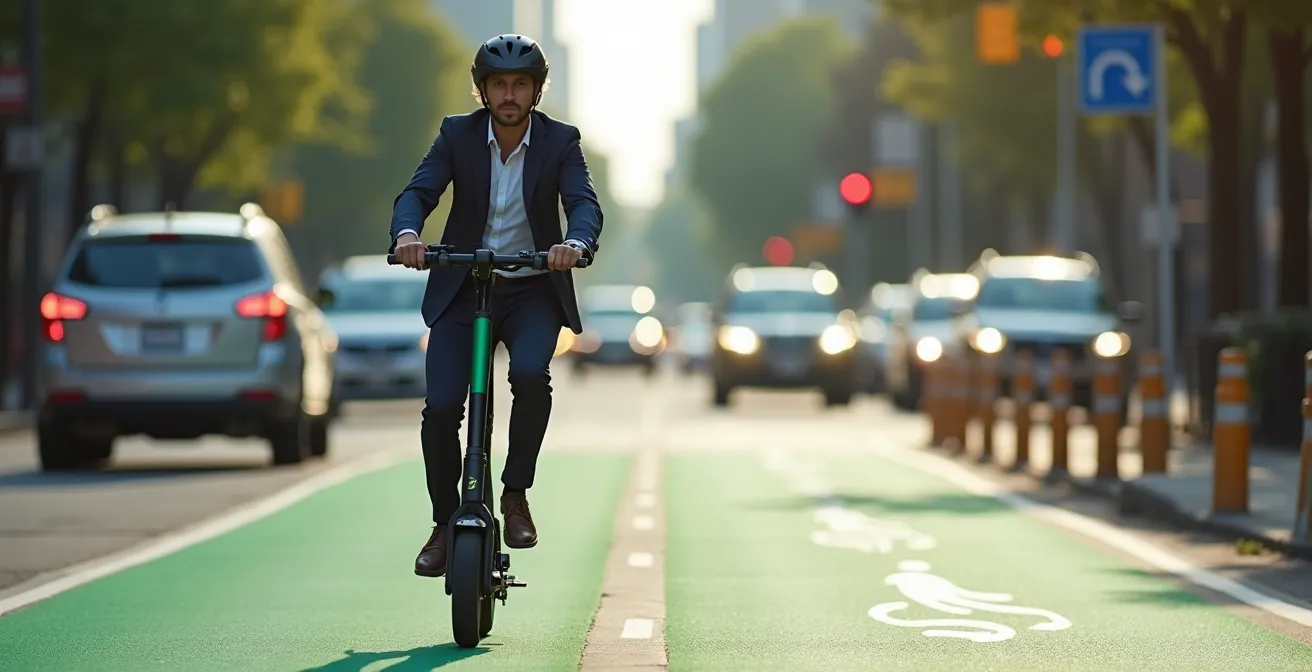
As the image above demonstrates, physical protection is paramount. The most effective safety strategies are those baked directly into the streetscape. Data-backed solutions are proving far more effective than simple awareness campaigns. Forward-thinking cities are now implementing a range of intelligent infrastructure upgrades, including:
- Installing protected micro-mobility lanes that are physically separated from both vehicle traffic and pedestrian walkways.
- Implementing “daylighting” at intersections, which involves removing parking spaces near corners to dramatically improve visibility for all parties.
- Reducing speed limits in mixed-traffic zones with high scooter usage to give drivers more reaction time.
- Deploying IoT sensors to collect real-time data on sudden braking and swerving, creating “heat maps” that identify dangerous road segments for targeted improvements.
Ultimately, a safe ride is the product of a safe system. By focusing on intelligent infrastructure, cities can move from reacting to accidents to proactively preventing them.
Electric Unicycle vs. Folding E-Bike: Which Is Best for Train Commuters?
For the multi-modal commuter, the choice of a personal electric vehicle is a masterclass in trade-offs. The goal is seamless system integration with public transport, and the battle often comes down to two distinct contenders: the hyper-portable Electric Unicycle (EUC) and the familiar folding e-bike. The decision hinges on a user’s priorities, particularly the balance between learning curve and ultimate portability. Commuters in the U.S. and Canada took a staggering 157 million shared micromobility trips in 2023 alone, proving this is a mainstream consideration.
The core differences between these two options are not just about form but function, especially in the context of a crowded train platform or a cramped office elevator. The EUC offers unparalleled compactness, but it comes at the cost of a steep learning curve. The folding e-bike, conversely, is instantly usable by anyone who can ride a bicycle but remains cumbersome even when folded.
| Factor | Electric Unicycle (EUC) | Folding E-Bike |
|---|---|---|
| Skill Floor | High (steep learning curve) | Zero (instant familiarity) |
| Utility Ceiling | Very High (extreme portability) | Moderate (bulk limits flexibility) |
| Space Footprint | Minimal (12-16 inches diameter) | Moderate (folded: 30×20 inches) |
| Transition Time | 5-10 seconds deploy/stow | 30-60 seconds fold/unfold |
| Platform Navigation | Excellent (hands-free carry) | Challenging (two-handed carry) |
| Weight Range | 25-35 lbs | 30-45 lbs |
As the table illustrates, the EUC excels in transition. Its “utility ceiling” is higher because its minimal footprint and quick deployment make it truly agile in a multi-modal journey. Navigating a turnstile or a flight of stairs with a 35-lb e-bike is an awkward, two-handed ordeal; doing so with an EUC is as simple as picking up a briefcase. This is where the investment in learning to ride pays its dividends.
For the commuter who prioritizes a frictionless transition between riding and walking, the EUC is the clear winner. For those unwilling to invest the time to master a new skill, the folding e-bike remains a reliable, if bulkier, workhorse.
The Parking Error That Gets Scooter Fleets Banned From Cities
Nothing has damaged the public perception of e-scooters more than the sight of them littered across sidewalks, blocking access for pedestrians and creating urban blight. This single issue—improper parking—is the fastest way for a scooter fleet to get banned from a city. Early attempts to solve this problem relied on punitive measures like fines, but these proved largely ineffective and created friction with users. The future of orderly scooter parking lies not in punishment, but in behavioral nudging and smart technology.
The most successful operators are now deploying systems rooted in behavioral economics. Instead of simply penalizing bad behavior, they actively reward good behavior. This shift in mindset is crucial for fostering a collaborative relationship between the service, its users, and the city. With a significant portion of the population adopting these services—an ADAC study found that 15 percent of Germans aged 16 and over now use e-scooters—finding a scalable solution is imperative.
Case Study: Behavioral Economics in Action
Cities that have implemented positive reinforcement systems have seen dramatic improvements in parking compliance. Features like “bounty modes,” which offer ride credits to users who relocate improperly parked scooters to designated zones, turn a problem into a crowdsourced solution. Similarly, offering small discounts for ending a ride in a preferred, high-demand area incentivizes users to contribute to the fleet’s operational efficiency. These gamified incentives have proven far more effective at maintaining sidewalk order than the threat of a fine alone.
This intelligent approach is often paired with next-generation parking technology. Hyper-precise geofencing and embedded Bluetooth beacons can create virtual parking corrals that are accurate to within inches, ensuring a ride can only be ended when the scooter is in a designated spot.

By shifting from a model of enforcement to one of incentive and intelligent design, scooter companies can transform their biggest public relations liability into a demonstration of civic responsibility.
How to Manage a Shared Fleet to Ensure 95% Availability?
A shared scooter is useless if it’s not charged, functional, and located where someone needs it. Achieving a high availability rate—the holy grail of 95% or more—is the central challenge of fleet management. This isn’t a simple logistics game of moving vehicles around; it is a complex exercise in predictive operational intelligence. The most successful operators are no longer reacting to demand; they are using artificial intelligence to anticipate it before it even happens.
The core of this strategy is a move from reactive to predictive analytics. A reactive system only sends a team to charge a scooter after its battery is dead. A predictive system, however, analyzes historical usage data, local event calendars, weather patterns, and public transport schedules to forecast demand hotspots. It enables “predictive rebalancing,” where vehicles are moved to an area *before* the evening rush hour begins, not during it. This ensures that supply is always positioned to meet anticipated demand, maximizing both revenue and user satisfaction.
Furthermore, this data-driven approach extends to the health of the fleet itself. Instead of relying on fixed maintenance schedules, modern fleets use IoT sensors to monitor the real-time condition of key components like brakes, batteries, and motors. This allows for predictive maintenance, where a scooter is serviced before a component fails, dramatically reducing downtime and improving the unit economics of each vehicle.
Action Plan: Implementing AI-Powered Fleet Management
- Deploy machine learning models to analyze weather, local events, and public transport schedules to forecast demand.
- Implement predictive rebalancing algorithms that move vehicles to high-demand zones before surges occur.
- Use IoT sensors to monitor the real-time health of components like brake wear, battery degradation, and motor efficiency.
- Schedule predictive maintenance based on live component data rather than arbitrary fixed intervals.
- Optimize the strategy between swapping entire batteries versus swapping the entire vehicle based on operational cost and efficiency data.
Ultimately, a 95% availability rate isn’t achieved through manpower alone; it’s the product of a sophisticated, self-learning system that makes the entire fleet smarter, more efficient, and more profitable.
Tesla Powerwall vs. Generic Modular Batteries: Are You Paying for the Brand?
While the Tesla Powerwall is a benchmark for stationary home energy, the “brand vs. generic” debate in the e-scooter world takes on a different, more critical dimension. Here, it’s not about a logo, but about the fundamental unit economics of the battery itself. For a fleet operator, the battery is the heart of the operation and its single greatest ongoing cost. The choice is less about a consumer brand like Tesla and more about a strategic decision between proprietary, single-use systems and open, modular, or second-life approaches.
A proprietary, non-swappable battery system may offer sleek integration, but it creates a massive logistical bottleneck. When a scooter’s battery dies, the entire vehicle must be taken off the street and transported to a charging hub. This drastically increases operational costs and vehicle downtime. In contrast, modular, swappable batteries allow a “gig economy” worker to simply swap a depleted battery for a fresh one on the spot, keeping the scooter in service and generating revenue.
However, the most forward-thinking economic model looks beyond a battery’s first life. This is where the concept of a circular economy becomes a game-changer for profitability and sustainability.
Case Study: The Circular Economy of Second-Life Batteries
The future of battery economics lies in second-life applications. An e-scooter battery, after degrading to a point where it’s no longer suitable for the high-demand needs of mobility (typically around 80% of its original capacity), is far from useless. Innovative companies are now bundling these degraded batteries into large, modular energy storage systems for stationary use, such as powering charging hubs or providing grid balancing services. This creates a circular economy model that extends the return on investment (ROI) of each battery far beyond its primary use in a scooter, simultaneously reducing electronic waste and creating new revenue streams.
In the end, the winning strategy isn’t about paying for a brand; it’s about investing in an intelligent system that maximizes the economic value of every component, from its first ride to its second life as part of the energy grid.
Docked vs. Dockless Bikes: Which System Keeps Sidewalks Tidy?
The debate between docked and dockless systems has long defined the conversation around shared mobility. Docked systems, like many public-private bikeshare programs, are praised for keeping sidewalks tidy but criticized for their lack of flexibility. Dockless systems, backed by venture capital, offer unparalleled user convenience but have been plagued by the urban chaos of scooter and bike clutter. framing this as a binary choice, however, misses the evolution of the market toward a smarter, more nuanced solution: the hybrid “dock-lite” system.
This emerging model seeks to combine the best of both worlds. Instead of expensive, physically-installed docking stations, it uses GPS and geofencing to create mandatory or incentivized virtual parking zones. This gives users more flexibility than a fixed dock while providing cities with the control needed to maintain public right-of-way. The business model and optimization focus are fundamentally different across these three approaches.
The following table, based on an analysis of different mobility infrastructures, breaks down the key distinctions:
| Aspect | Docked Systems | Dockless Systems | Hybrid ‘Dock-Lite’ |
|---|---|---|---|
| Business Model | Public-private partnership | VC-backed private | Mixed funding |
| Optimization Focus | Public good & transit integration | User acquisition & growth | Balance of both |
| Infrastructure Cost | High (physical stations) | Low (GPS only) | Medium (virtual docks) |
| Sidewalk Impact | Minimal at stations | Potentially high | Controlled zones |
| User Flexibility | Limited to dock locations | Maximum flexibility | Guided flexibility |
The “Hybrid ‘Dock-Lite'” column represents the maturation of the industry. It acknowledges that total freedom (pure dockless) leads to chaos, while total restriction (pure docked) limits utility. The hybrid model is a form of operational intelligence, using technology to guide user behavior toward a mutually beneficial outcome: “guided flexibility.” It allows operators to balance the growth-focused goals of a private company with the public good mandate of a city partner.
As the market matures, it’s clear that the most sustainable systems will not be purely docked or dockless, but intelligent hybrids that use technology to create order without sacrificing convenience.
Key Takeaways
- The future of micro-mobility is data-driven fleet management, not just better hardware.
- Smart infrastructure and behavioral incentives are far more effective than penalties for solving urban chaos.
- Long-term viability depends on system-level thinking, from multi-modal transit integration to circular battery economies.
Self-Service Bicycles: How Bikeshare Systems Are Reducing Urban Obesity Rates?
Beyond solving the last-mile problem, the rise of shared mobility systems like bikeshare and e-scooters is having a profound and often overlooked impact on public health. While the primary motivation for users may be convenience, the cumulative effect is a significant increase in active transportation. This shift is not only helping cities meet ambitious environmental goals but is also making a measurable dent in sedentary lifestyles, a leading cause of urban health crises like obesity.
The environmental case is clear and compelling. The average gas-powered vehicle produces approximately 4.6 metric tons of CO2 per year. Every trip taken on a bike or e-scooter instead of a car is a direct contribution to cleaner air and helps cities move closer to vital climate targets, such as the pledge by the United States to cut emissions by 50-52 percent by 2030. However, the health benefits might be even more impactful on a personal level.
The Active Transport Multiplier Effect
Research reveals that the adoption of shared mobility creates a powerful “active transport multiplier.” Users who regularly use services like bikeshare don’t just replace car trips; they also tend to increase their overall walking distance by connecting to and from vehicles. One study found that 40% of surveyed users began to consider e-bikes a regular part of their mobility mix, demonstrating a behavioral shift towards a more active lifestyle. This shows how micro-mobility encourages multi-modal active transport, weaving physical activity back into the fabric of daily routines.
This multiplier effect is the key. Micro-mobility is not just about the few minutes spent on the vehicle; it’s about re-engineering daily commutes to include more movement. It makes the active choice the convenient choice, subtly nudging entire populations toward better health outcomes. The bikeshare station five blocks away or the e-scooter a short walk from the subway exit becomes an invitation to move.
To truly embrace this shift, urban planners and commuters alike must look beyond the handlebars and focus on building intelligent, integrated systems that not only power a smarter, cleaner city, but a healthier one too.