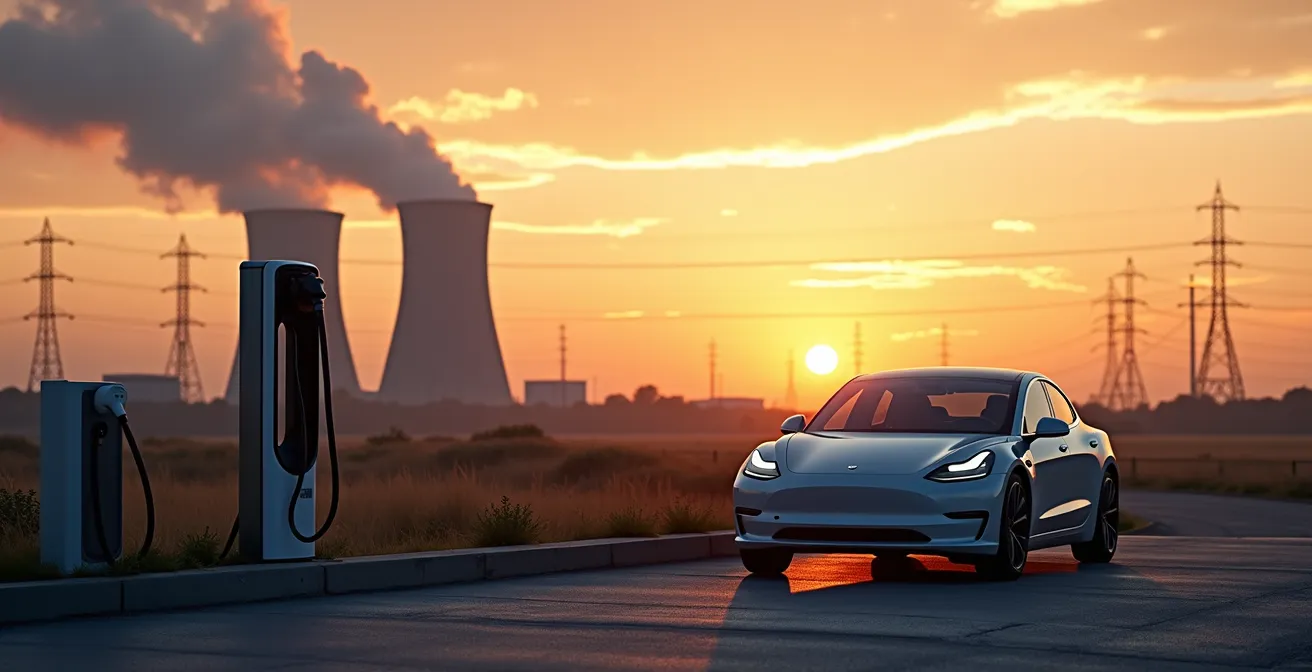
An electric vehicle’s environmental impact is not a fixed attribute determined at purchase, but an operational variable that the owner can actively manage and optimize.
- The high emissions from battery manufacturing create a “carbon debt” that is paid back over time, with a breakeven point that varies from 8,400 to 35,000 miles depending on your local grid.
- Your driving, charging, and battery maintenance habits directly influence your EV’s real-world carbon footprint and its potential for a “second life.”
Recommendation: Shift your focus from the “zero-emission” label to actively managing your vehicle’s lifecycle carbon by optimizing charging strategies, adopting energy-efficient driving techniques, and preserving battery health.
For the eco-conscious driver, the decision to switch to an electric vehicle (EV) often feels like a definitive step toward reducing one’s personal carbon footprint. The promise of “zero tailpipe emissions” is a powerful motivator, painting a picture of silent, clean transportation contributing to healthier cities. However, a nagging question often surfaces, especially as the EV charges overnight: if the electricity powering this supposedly green machine comes from a grid burning coal or natural gas, is it really making a difference?
The common discourse presents a simple dichotomy: clean tailpipe versus dirty power plant. This leads to endless debates about the carbon cost of battery manufacturing and the “long tailpipe” of grid emissions. While these points are valid, they often miss the most crucial element of the equation. They treat an EV’s environmental credentials as a static, predetermined fact. This perspective is fundamentally flawed and overlooks the significant agency that an owner has over their vehicle’s lifetime impact.
The real question isn’t a simple “yes” or “no” to whether your EV is green. The more accurate and empowering approach is to ask: “How can I actively manage my vehicle to maximize its environmental benefits?” This article reframes the debate, moving away from a passive analysis of the grid and toward a proactive strategy for the EV owner. We will dissect the complete lifecycle of an EV’s carbon footprint—from manufacturing to disposal—and reveal the critical leverage points you control.
This guide will walk you through the nuanced realities of EV emissions, debunk common myths, and provide a clear framework for understanding and optimizing your vehicle’s true environmental performance. By the end, you will see that an EV’s greenness is not just a feature to be purchased, but a result to be achieved.
Summary: Is Your Electric Car Really Green If the Grid Is Coal?
- Why European Cities Are Banning Diesel Cars Sooner Than Expected?
- How to Use Hypermiling Techniques to Save 20% on Fuel?
- Hybrid vs. Full EV: Which Has a Lower Lifetime Carbon Footprint?
- The “Zero Emission” Label Mistake That Misleads Consumers
- How to Recycle EV Batteries to Prevent a Toxic Waste Crisis?
- How to Perform a Lifecycle Assessment (LCA) on Your Key Products?
- Why Reliance on Grid Power Is Becoming a Strategic Risk for Factories?
- Transportation Systems: How Cities Are redesigning Grids to Ban Cars?
Why European Cities Are Banning Diesel Cars Sooner Than Expected?
The global shift towards electric mobility is not solely driven by climate change concerns; it’s also a direct response to a public health crisis unfolding in urban centers. The primary culprit is nitrogen oxides (NOx), a group of toxic gases that cause severe respiratory problems. According to extensive research, an astonishing 80% of all NOx emissions from vehicles in Europe come from diesel cars. This has created air quality in many city centers that is dangerously poor, forcing municipalities to take drastic and accelerated action.
This public health imperative is why many European cities are implementing Low Emission Zones (LEZs) and outright bans on diesel and petrol vehicles far ahead of original schedules. A prime example is Stockholm, which is set to ban all petrol and diesel cars from its city center starting at the end of 2024. This isn’t a gradual phase-out; it’s a decisive move to reclaim the urban environment for pedestrians and cyclists and to drastically improve air quality for residents. The goal is to eliminate the primary source of urban pollution at its root.

As this illustration suggests, these policies are catalyzing a complete redesign of the urban landscape. Streets once choked with traffic are being transformed into cleaner, quieter, and more people-centric spaces. This trend underscores the broader societal move away from internal combustion engines, making the optimization of EV technology more critical than ever.
How to Use Hypermiling Techniques to Save 20% on Fuel?
While the carbon intensity of your local grid is a major factor in your EV’s footprint, your driving behavior is an equally powerful variable that is entirely within your control. “Hypermiling”—the practice of driving to maximize energy efficiency—is not just for gasoline cars. For an EV, it’s a core strategy for reducing your operational footprint and extending your range. Mastering these techniques is a direct way to lower your energy consumption, regardless of its source.
Unlike gasoline cars where efficiency is lost to heat and friction, EVs offer unique ways to conserve and even recapture energy. The key is to shift your mindset from a simple “point A to point B” mentality to one of “energy management.” The following techniques, specific to electric vehicles, can significantly reduce your watt-hours per mile consumption:
- Master one-pedal driving: Learn to use regenerative braking to its fullest potential. By anticipating stops and easing off the accelerator, you can recapture a significant amount of kinetic energy back into the battery, effectively “recycling” your momentum.
- Pre-condition your cabin: Heating or cooling the car’s interior is a major energy drain. Do this while the vehicle is still plugged in, drawing power from the grid instead of depleting your battery charge before you even start driving.
- Choose smarter routes: A shorter route isn’t always the most efficient one. Use navigation apps that account for elevation changes; a flatter, slightly longer route will often consume less energy than a shorter, hillier one.
- Minimize “vampire drain”: Modern EVs have many connected features that consume power even when parked. Disable unnecessary functions like constant connectivity or sentry modes when not needed to preserve battery charge.
By integrating these practices into your daily driving, you actively reduce the amount of electricity your car needs. This not only saves you money but also directly lessens the environmental demand your vehicle places on the grid.
Hybrid vs. Full EV: Which Has a Lower Lifetime Carbon Footprint?
The debate between hybrid vehicles and fully electric vehicles (EVs) is often oversimplified. Conventional wisdom suggests that a full EV is always the greener choice. However, a nuanced lifecycle analysis reveals that the answer is highly dependent on the carbon intensity of the local electricity grid and the driver’s charging habits. A plug-in hybrid (PHEV) can, under specific conditions, have a lower lifetime carbon footprint than a battery-electric vehicle (BEV).
The manufacturing process for a large EV battery has a significant upfront carbon cost. If that EV is then charged for its entire life on a grid powered heavily by coal, its overall emissions can be substantial. In contrast, a PHEV has a much smaller battery and therefore a lower manufacturing footprint. The following table, based on data from the International Council on Clean Transportation (ICCT), illustrates this crucial nuance.
| Vehicle Type | Lifetime Emissions Reduction vs Gasoline | Key Condition |
|---|---|---|
| Battery Electric (EU Average) | 73% | Current EU grid mix |
| Plug-in Hybrid | 30% | If properly charged daily |
| Standard Hybrid | 20% | No external charging needed |
| Battery Electric (Coal-heavy grid) | 25% | Poland example |
The data is clear: a BEV running on a coal-heavy grid, like Poland’s, offers only a 25% reduction in lifetime emissions compared to a gasoline car. This is less than the 30% reduction offered by a PHEV that is diligently charged and used in its electric mode. This highlights the “active management” principle: the environmental benefit of a PHEV is entirely contingent on the owner’s commitment to plugging it in. If used primarily as a gasoline car, its benefits are negligible. For a BEV owner on a dirty grid, the path to greener driving involves advocating for cleaner energy sources and optimizing charging times to coincide with renewable energy production.
The “Zero Emission” Label Mistake That Misleads Consumers
The “zero emission” sticker on an electric vehicle is one of the most effective but misleading marketing tools in the automotive industry. It refers only to what comes out of the tailpipe—or rather, what doesn’t. It completely ignores the two other major sources of a vehicle’s environmental impact: the emissions from manufacturing and the “non-exhaust” emissions generated during operation. A true assessment requires a full lifecycle perspective.
A comprehensive lifecycle analysis reveals that an average EV generates around 110 grams of CO2 per mile over its entire life, from raw material extraction to recycling. While this is a dramatic improvement over the 410 grams per mile for a comparable new gasoline car, it is far from zero. The majority of this upfront carbon cost comes from the energy-intensive process of manufacturing the battery.

Furthermore, the “zero emission” label conveniently overlooks non-exhaust emissions. As EVs are typically heavier than their gasoline counterparts due to the battery pack, they can produce more particulate matter from tire and brake wear. This is a significant point highlighted in a case study on EV pollution. These fine particles (PM2.5) are a serious air pollutant and health hazard, meaning that even a fully electric car contributes to urban air pollution, albeit in a different way than a diesel vehicle. Understanding this complete picture is essential for a truly honest environmental assessment.
How to Recycle EV Batteries to Prevent a Toxic Waste Crisis?
The long-term sustainability of the EV revolution hinges on a critical challenge: what happens to the batteries at the end of their useful life? As millions of EVs hit the road, the prospect of mountains of toxic battery waste looms large. Currently, the infrastructure and processes for recycling lithium-ion batteries are dangerously underdeveloped. Shockingly, only 5% of the world’s lithium batteries are recycled, a stark contrast to the 99% recycling rate for traditional lead-acid car batteries in the U.S. This gap represents a massive environmental risk and a wasted opportunity to recover valuable materials like lithium, cobalt, and nickel.
However, the solution begins long before the battery reaches a recycling plant. It starts with the owner. The most effective way to mitigate the end-of-life problem is to extend the battery’s primary life and maximize its suitability for “second-life” applications, such as stationary energy storage for homes or the grid. A battery that has degraded to 70-80% of its original capacity may no longer be suitable for a car, but it can serve for many more years in a less demanding role. The owner’s habits directly impact this potential.
Your Action Plan for Maximizing Battery Longevity
- Charging Habits: Avoid regularly charging to 100%. For daily use, aim for a maximum of 80-90%. This reduces stress on the battery cells and significantly slows degradation.
- Charging Speed: Minimize the use of DC fast chargers. While convenient, the high heat and current they generate cause more wear than slower, Level 2 AC charging. Use them when necessary for travel, not for daily top-ups.
- Thermal Management: Keep the battery at a moderate temperature. Use pre-conditioning features to warm or cool the battery while plugged in, and park in the shade on hot days whenever possible.
- State of Charge: Avoid leaving the battery at very high or very low states of charge for extended periods. The optimal range for long-term health is between 20% and 80%.
- End-of-Life Value: When selling the vehicle, a battery with a documented history of careful maintenance will have a higher “second-life” value, making it a more attractive asset for energy storage companies and contributing to a circular economy.
By treating the battery as a long-term asset rather than a disposable component, owners can play a crucial role in preventing a future waste crisis and ensuring the materials within are passed on to a new life.
How to Perform a Lifecycle Assessment (LCA) on Your Key Products?
A Lifecycle Assessment (LCA) is the scientific method used to quantify the total environmental impact of a product from “cradle to grave.” For an electric vehicle, this means accounting for everything from raw material extraction for the battery, manufacturing and assembly, operational use (including the electricity consumed), and finally, end-of-life recycling or disposal. This framework is essential for moving beyond the simplistic “tailpipe emissions” debate and understanding the real carbon footprint.
One of the key metrics derived from an LCA for an EV is the “carbon payback period.” This is the time it takes for the EV’s lower operational emissions to offset its higher manufacturing emissions compared to a gasoline car. As Jarod C. Kelly, a principal energy systems analyst at Argonne National Laboratory, explains, “Under current conditions it would take an electric car 19,500 miles, or less than two years of typical driving in the U.S., to pay back the increased emissions of the manufacturing process and break even with a comparable gasoline car.” After this point, every mile driven in the EV represents a net greenhouse gas reduction.
However, this breakeven point is not a fixed number. It is highly sensitive to the carbon intensity of the grid used for charging. The cleaner the grid, the faster the payback. The following table, based on data from MIT, illustrates this dramatically.
| Grid Type | EV Equivalent MPG | Breakeven Miles |
|---|---|---|
| Hydropower (Washington) | 219 MPG equivalent | 8,400 miles |
| US Average Mix | 94 MPG equivalent | 19,500 miles |
| Coal-Heavy (West Virginia) | 57 MPG equivalent | 35,000 miles |
This data empowers the consumer. By knowing your local grid’s energy mix, you can calculate a more accurate estimate of your own car’s payback period and understand the true scale of its environmental benefit. An owner in Washington state achieves a net positive climate impact in less than a year, while an owner in West Virginia will need nearly three years of driving to clear their car’s manufacturing “carbon debt.”
Why Reliance on Grid Power Is Becoming a Strategic Risk for Factories?
For both individual EV owners and large-scale industrial operations, reliance on a centralized power grid carries inherent risks, from price volatility to blackouts. However, for an EV owner, this dependency has a unique silver lining: the grid is consistently getting cleaner. This means that an electric car purchased today will have a progressively smaller carbon footprint each year of its life, without the owner doing anything at all.
This decarbonization trend is well-documented. A Union of Concerned Scientists analysis shows a dramatic shift in the U.S. energy mix. In 2012, 44% of U.S. electricity came from coal, with wind and solar contributing less than 2%. By 2022, coal’s share had plummeted to under 20%, while wind and solar had surged to 14%. As this trend continues, the “long tailpipe” of every EV on the road effectively shrinks, making them an increasingly better environmental investment over time.

The future of the grid-vehicle relationship is even more dynamic. Technologies like Vehicle-to-Grid (V2G) are set to transform EVs from passive consumers of electricity into active participants in grid stability. As described in a case study on V2G implementation, this technology allows EVs to act as a distributed battery network, feeding power back to the grid during periods of high demand and charging during off-peak hours. This not only helps stabilize the grid and prevent blackouts but also enables greater integration of intermittent renewable sources like wind and solar. For the EV owner, it also presents a future opportunity to be compensated for providing this valuable service, turning their car into an energy asset.
Key Takeaways
- An EV’s true environmental impact must be measured across its entire lifecycle, including manufacturing, operation, and disposal—not just at the tailpipe.
- Every EV begins with a “carbon debt” from its energy-intensive manufacturing process, which is “paid back” over thousands of miles of driving as it displaces gasoline consumption.
- The ultimate greenness of an EV is determined by a combination of factors: the carbon intensity of the local grid, the owner’s driving and charging habits, and how well the battery’s health is maintained for a potential “second life.”
Transportation Systems: How Cities Are redesigning Grids to Ban Cars?
The push to redesign cities and restrict car access is fundamentally a public health initiative. The negative externalities of vehicle-centric transportation—from toxic air quality to noise pollution—have a measurable human cost. As the Clean Cities Campaign notes, “Air pollution causes hundreds of thousands of premature deaths in Europe each year, and more than 40,000 in France alone. Many of the victims live in big cities where road transport, diesel cars especially, are the main contributors to nitrogen dioxide (NO2).” This stark reality is the primary catalyst for the accelerated timelines of car bans and the redesign of urban transportation systems.
France, in particular, has emerged as a leader in this transition, with several major cities committing to aggressive phase-out plans. According to a case study on French Low Emission Zones (LEZs), diesel vehicles will be banned from Greater Paris by the end of 2024, from the center of Greater Lyon by 2026, and from Greater Strasbourg and Greater Montpellier by 2028. This coordinated effort is creating a powerful momentum that makes the transition to cleaner transportation, including well-managed EVs, an inevitability rather than a choice.
This macro-level transformation provides the ultimate context for the individual choices discussed throughout this article. By actively managing your EV’s carbon footprint—optimizing its efficiency, preserving its battery, and being mindful of its energy source—you are not just reducing your personal impact. You are aligning yourself with a larger, systemic shift towards healthier, more sustainable, and more human-centric urban environments. Your individual actions become a vital part of the collective solution.
By understanding and actively managing your vehicle’s lifecycle footprint, you move beyond being a passive consumer and become a key participant in the energy transition. The next step is to assess your own driving patterns and local grid to start optimizing your impact today.