
Optimizing routes isn’t just about faster deliveries; it’s a strategic system for recovering thousands in hidden operational costs.
- Manual data entry introduces costly errors, and untracked empty miles directly drain your fuel budget.
- Transparently deployed telematics can reduce insurance premiums and improve driver retention, directly impacting the bottom line.
Recommendation: Stop viewing telematics as an expense and start leveraging it as an essential ROI-driven tool for asset intelligence and profit recovery.
For logistics managers, the relentless pressure of rising fuel costs feels like a constant battle. The default strategy is often a defensive crouch: negotiating fuel cards, demanding shorter idle times, and scrutinizing every mile. But these are surface-level tactics. The real financial hemorrhaging in a fleet operation doesn’t just come from the fuel pump; it stems from a web of hidden inefficiencies, what we call operational friction. It’s the cost of a poorly routed truck, the wasted hours correcting a manual data entry error, the insurance premiums inflated by a lack of safety data, and the profit lost on every empty mile.
The common perception is that digital traffic management tools are a significant capital expense. We’re told to get “driver buy-in” and “leverage data,” but these platitudes ignore the core issue. The truth is, the cost of inaction—of clinging to manual dispatch sheets and reactive problem-solving—is already far higher than the subscription fee for a modern telematics platform. This isn’t about adding another line item to your budget. This is about performing a ruthless audit of your current operations to uncover and reclaim the profit you’re already losing.
The crucial shift in mindset is to stop seeing your fleet as just vehicles and start treating them as data-generating assets. The question is no longer “Can we afford this software?” but rather “How much longer can we afford the hidden costs of *not* having this intelligence?” This guide provides a data-driven framework to dissect those costs, moving from reactive management to a state of proactive, data-driven command. We will analyze the real price of operational friction and demonstrate how route optimization tools are, in fact, a powerful profit-recovery system.
This article provides a comprehensive audit of the key operational levers you can pull. We will dissect everything from the direct costs of fleet inaction to the subtle, yet expensive, drain of manual processes, providing a clear path to transforming your logistics from a cost center into a strategic advantage.
Summary: A Technologist’s Roadmap to Fleet Efficiency
- Why Not Tracking Your Fleet Is Costing You More Than the Software Subscription?
- How to Install GPS Trackers Without Triggering Driver Revolt?
- SaaS vs. On-Premise: Which Routing Software Fits a Growing Fleet?
- The Data Collection Mistake That Leads to GDPR Lawsuits
- How to Use Data to Reduce Empty Miles (Deadheading) by 20%?
- Why Manual Data Entry Is Costing You $15,000 per Year in Hidden Errors?
- How to Design a One-Page Dashboard That Your CEO Will Actually Read?
- How to Automate Repetitive Tasks in Your SME Without Losing Human Touch?
Why Not Tracking Your Fleet Is Costing You More Than the Software Subscription?
The most common objection to adopting fleet telematics is the subscription cost. This view, however, ignores a fundamental business principle: the cost of inaction. Sticking with an untracked fleet is not a zero-cost decision; it’s an active acceptance of multiple, often invisible, financial drains. The most significant and quantifiable of these is insurance. Insurers base premiums on perceived risk, and a fleet without data is a black box of unknown variables. A fleet with telematics, on the other hand, provides concrete evidence of safety protocols, driver behavior, and risk mitigation.
This data is not just for internal use; it’s a powerful negotiation tool. Research from McKinsey & Company demonstrates that implementing telematics can lead to a 25% reduction in insurance premiums. For a mid-sized fleet, this saving alone can often exceed the annual cost of the telematics subscription. The ROI is direct and immediate. The software stops being a cost center and becomes a self-funding efficiency engine. By providing underwriters with data on speed compliance, harsh braking events, and adherence to geofenced routes, you are replacing their risk model with your verified safety record.
Beyond insurance, the cost of inaction includes inflated fuel usage from non-optimized routes, higher maintenance costs from unmonitored vehicle abuse, and the financial and legal fallout from accidents where you have no objective data to defend your driver. When you sum these hidden expenses, the cost of a software subscription pales in comparison to the money leaking out of the operation every single day.
Action Plan: Negotiating Lower Insurance Premiums with Telematics Data
- Implement a comprehensive telematics system, including dash cameras and GPS tracking, to capture driver behavior data.
- Collect 3-6 months of baseline safety data, including speed compliance, harsh braking incidents, and accident rates.
- Generate quarterly safety reports that clearly highlight improvements in driver behavior and a quantifiable reduction in incidents.
- Present this hard data to your insurance providers, demonstrating a proactive commitment to safety through consistent telematics monitoring.
- Negotiate for the typical 10-25% discount offered to fleets that have a proven, data-backed telematics safety program.
How to Install GPS Trackers Without Triggering Driver Revolt?
The second major barrier to telematics adoption is cultural: the fear of driver backlash. The narrative of “Big Brother” is pervasive and can create significant operational friction. However, framing the implementation of GPS trackers as a surveillance tool is a strategic failure. The correct approach is to position it as a system for driver empowerment and protection. When drivers perceive the technology as a tool that works for them, rather than against them, resistance evaporates. The key is absolute transparency and focusing on benefits that directly affect the driver’s daily work and safety.
This isn’t theoretical. The C.J. Driscoll 2023-24 Survey on video telematics provides hard data to dismantle the “driver revolt” myth. It revealed that over 75% of fleets experienced little to no resistance from drivers during implementation. The decisive factor was communication. Successful fleets involved drivers early, explaining that the technology serves to exonerate them in not-at-fault accidents, validate their performance, and provide a clear, objective record of their service. When a driver understands that a camera can prove they were not at fault in a collision, the tracker transforms from a threat into a vital piece of personal protective equipment.
The most effective strategy is to give drivers access to their own data. Provide them with a simple dashboard showing their safety score, efficiency metrics, and positive events. This fosters a sense of ownership and professionalism. It shifts the conversation from “management is watching me” to “I am managing my performance.”
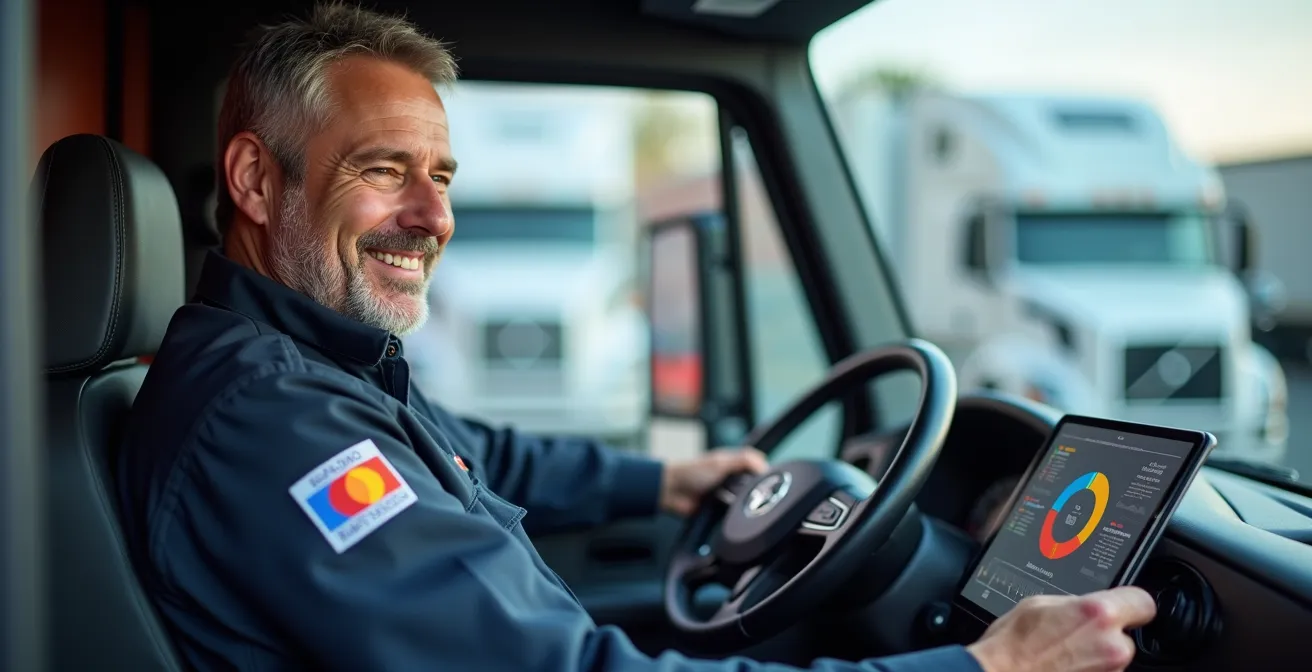
As you can see, the focus is on enabling the driver with asset intelligence. When they see the technology as a tool for self-improvement and defense, it builds trust and defuses potential conflict. The goal is to create a culture where data is seen not as a weapon for punishment, but as a shared tool for safety, efficiency, and professional recognition.
SaaS vs. On-Premise: Which Routing Software Fits a Growing Fleet?
Once the strategic decision to adopt digital traffic management is made, the next critical choice is the deployment model: Software-as-a-Service (SaaS) or a traditional On-Premise installation. This is not merely a technical decision; it is a fundamental choice about scalability, capital expenditure, and long-term total cost of ownership (TCO). For a growing fleet, where flexibility and predictable costs are paramount, the SaaS model presents a clear and compelling advantage. An on-premise solution requires a massive upfront investment in licenses and server hardware, plus the ongoing cost of a dedicated IT team to manage maintenance, security, and updates. This model is rigid and slow to adapt.
In contrast, a SaaS solution operates on a predictable monthly subscription, eliminating the initial capital barrier. Scalability is instantaneous; as your fleet grows, you simply adjust your subscription. There’s no need to procure new hardware or engage in lengthy installation projects. This agility is vital for a business navigating market fluctuations. As John Biblis, a Senior Safety and Loss Control Specialist at TrueNorth Companies, astutely points out, focusing only on upfront costs is a common mistake. In his words, “Fleets tend to focus on the initial cost of fleet insurance against their bottom line. There are hidden costs associated with accidents, cargo claims, and employee injury that may be more expensive in the long run.”
Fleets tend to focus on the initial cost of fleet insurance against their bottom line. There are hidden costs associated with accidents, cargo claims, and employee injury that may be more expensive in the long run.
– John Biblis, TrueNorth Companies
This logic applies perfectly to the SaaS vs. On-Premise debate. The “hidden costs” of an on-premise solution—such as server downtime, security patch management, and the opportunity cost of a slow-to-update system—can far outweigh the predictable subscription fee of a SaaS platform. The modern logistics environment demands speed and adaptability, making the SaaS model the superior choice for any fleet with growth aspirations.
| Factor | SaaS Solution | On-Premise Solution |
|---|---|---|
| Initial Cost | Low (Monthly subscription) | High (Upfront licensing + hardware) |
| Implementation Time | Days to weeks | Months |
| IT Staff Required | Minimal | Dedicated team needed |
| Scalability | Instant scaling up/down | Requires hardware upgrades |
| Updates & Maintenance | Automatic, vendor-managed | Manual, internal responsibility |
| Integration Capabilities | Pre-built ecosystem (WMS, ERP) | Custom development required |
| Data Security | Cloud-based, vendor responsibility | Full internal control |
| 5-Year TCO | Predictable, subscription-based | Variable, includes hidden costs |
The Data Collection Mistake That Leads to GDPR Lawsuits
In the rush to gather data, many fleets make a critical, and potentially expensive, error: they collect everything possible without a clear, stated purpose. This “collect it all” mentality is a direct violation of fundamental data privacy principles like GDPR and can expose a company to significant legal and financial risk. The core tenet that must be respected is data minimization. This principle dictates that you should only collect and process data that is essential for a specific, legitimate, and clearly communicated purpose. Tracking a vehicle’s location to optimize a delivery route is a legitimate purpose. Using that same location data for unauthorized surveillance or selling it to third-party marketers is not.
The key to compliance and building driver trust is to manage driver data with the same rigor as any other private information. Industry experts stress that this data should be summarized, aggregated, and only shared with third parties like insurance companies in an anonymized, aggregate form. For specific incidents, such as an accident investigation, the data should be readily available but protected under strict privacy protocols. This is not about hiding information; it’s about respecting the individual and adhering to the law. Is fleet tracking legal? Absolutely, provided it is done with transparency and for a legitimate business purpose.
Achieving a balance between compliance and operational efficiency requires a structured approach. Fleets must implement purpose-specific consent forms. A driver should give explicit consent for data to be used for different functions: one consent for route optimization, another for performance reviews, and a third for safety monitoring. This granular consent, combined with clear data retention policies that automatically delete data after it’s no longer needed, creates a robust compliance framework. This not only protects the company from lawsuits but also reinforces the message to drivers that their data is being handled responsibly, turning a potential legal liability into a trust-building asset.
How to Use Data to Reduce Empty Miles (Deadheading) by 20%?
Empty miles, or “deadheading,” represent pure, unadulterated waste in a logistics operation. It’s fuel burned, driver hours paid, and vehicle wear-and-tear incurred with zero revenue generated. Reducing deadheading is one of the most direct ways to boost profitability, and it is an area where data-driven route optimization provides a monumental advantage. Manual dispatching, based on gut feeling or simple geographic proximity, is incapable of seeing the complex, multi-variable picture required to truly minimize empty miles. Modern route optimization algorithms, however, can process thousands of variables in seconds—traffic patterns, delivery windows, vehicle capacity, driver hours of service, and potential backhaul opportunities—to create the most efficient schedule possible.
How does route optimization actually work? It’s not just about finding the shortest path between two points. It’s a dynamic system that constantly re-evaluates the entire network. A logistics company implementing such a system reported a 15% reduction in fuel expenses, a direct result of smarter routing that eliminates unnecessary travel. The software can identify opportunities for a truck that has just completed a delivery to pick up a nearby inbound shipment, effectively turning a deadhead return trip into a revenue-generating leg.
Case Study: Crate & Barrel’s Fleet Optimization
Crate & Barrel provides a powerful example of this principle in action. After implementing route optimization software, they successfully reduced their required truck fleet by 15%. With 300,000 deliveries annually, the company used data to tighten delivery windows from 4 hours to just 2 hours and now processes over 80% of its deliveries using the optimized system. This maximized vehicle utilization, reduced the number of trucks on the road, and significantly cut both labor and fuel costs, demonstrating a clear ROI on their technology investment.
The strategy is to shift from single-trip planning to holistic network optimization. By feeding the system with real-time data, it can identify clusters of deliveries, sequence them intelligently, and proactively find backhaul opportunities that a human dispatcher would almost certainly miss. This transforms the fleet from a series of individual assets into a coordinated, highly efficient system where every mile is scrutinized for its contribution to the bottom line.
Why Manual Data Entry Is Costing You $15,000 per Year in Hidden Errors?
Manual data entry is the silent killer of operational efficiency. It seems like a minor, low-skill task, but its cumulative cost is staggering. Every time a dispatcher manually types an address, order number, or delivery window, they introduce a point of potential failure. An industry-average error rate of 1-3% might sound small, but when multiplied across thousands of orders, it creates a cascade of expensive problems. A single transposed digit in an address can lead to a failed delivery, a frustrated customer, a wasted driver-hour, and the fuel cost of a return trip—all followed by the administrative time needed to identify and correct the original mistake.

This operational friction has a direct and measurable financial impact. While route management tools can achieve an impressive 15% decrease in travel time through better planning, this benefit is eroded if the input data is flawed. The “garbage in, garbage out” principle applies with brutal force in logistics. The cost isn’t just in the time spent fixing errors; it’s in the opportunity cost of what your dispatchers *could* be doing instead of chasing down typos—like managing exceptions, communicating with high-value clients, or strategic planning.
Calculating this cost for your own operation is a critical exercise. By automating the flow of information from your order management system directly to your routing software, you eliminate the manual entry step entirely. This ensures data integrity, frees up human capital for higher-value tasks, and plugs a significant, often overlooked, financial leak. The initial setup to integrate these systems is a one-time investment that pays dividends indefinitely by eradicating an entire class of costly errors.
- Variable 1: Count the number of daily orders requiring manual entry (multiply by 260 working days).
- Variable 2: Estimate error rate (industry average is 1-3% for manual data entry).
- Variable 3: Calculate the average time to identify and fix an error (typically 15-30 minutes).
- Variable 4: Determine the fully-loaded hourly wage of the employee fixing the error.
- Variable 5: Include indirect costs like failed delivery charges, customer support calls, and re-routing expenses.
- Formula: Annual Cost = (Total Orders × Error Rate × Fix Time × Wage) + Indirect Costs.
How to Design a One-Page Dashboard That Your CEO Will Actually Read?
Executive leadership doesn’t have time to sift through dense spreadsheets or dozens of disconnected metrics. To get buy-in and demonstrate the value of your logistics operation, you must present data with brutal clarity. The goal is a one-page dashboard that tells a compelling story at a glance. It should answer three fundamental questions instantly: Are we efficient? Are we compliant? Are we profitable? Any metric that doesn’t contribute to answering one of these questions is noise and should be eliminated.
An effective CEO dashboard focuses on a few Key Performance Indicators (KPIs) that are trended over time. Instead of showing a static number, show the metric’s performance this week versus last week, or this month versus last year. Key metrics should include:
- Cost Per Delivery: The ultimate measure of efficiency.
- On-Time Delivery Rate: The primary indicator of customer satisfaction.
- Fleet Utilization (%): A measure of how effectively assets are being used.
- Safety Score (e.g., incidents per 10,000 miles): A clear indicator of risk and compliance.
These high-level KPIs should be visually represented with simple charts (line or bar charts are best) and color-coded indicators (green for good, red for bad). The numbers must be contextualized. A 95% on-time rate is good, but a 95% that has dropped from 98% last month signals a problem that requires attention.
Case Study: United Supermarkets’ Capacity Discovery
The power of a clear dashboard is perfectly illustrated by United Supermarkets. Their initial scheduling was conservative, allowing only two deliveries per hour to avoid backlogs. However, by implementing route optimization analytics and visualizing their operations, their management team made a stunning discovery: they had enough unutilized capacity to handle a 50% increase in deliveries with their existing fleet. The visual dashboards showing real-time capacity and delivery performance gave them the confidence to unlock this hidden potential, dramatically improving their service capabilities without adding a single truck. This is the power of translating raw data into executive-level asset intelligence.
The one-page dashboard is not just a report; it’s a strategic communication tool. It proves the ROI of your investments, highlights operational wins, and flags emerging problems before they become crises. It replaces long meetings and confusing reports with a single source of truth that drives decisive action.
Key Takeaways
- The ‘cost of inaction’ in fleet management, from inflated insurance to manual errors, often exceeds the price of telematics software.
- Successful GPS implementation hinges on transparency, framing the technology as a tool for driver protection and empowerment, not surveillance.
- Data minimization is not just a legal requirement (GDPR); it’s a strategy for building trust and reducing liability.
How to Automate Repetitive Tasks in Your SME Without Losing Human Touch?
Automation in logistics is not about replacing humans with robots; it’s about augmenting human capability. The goal is to automate the 80% of tasks that are repetitive, predictable, and low-value, freeing up your team to focus on the 20% that require empathy, complex problem-solving, and strategic judgment. This “human-in-the-loop” approach creates a hyper-efficient operation that still delivers a premium customer experience. For small and medium-sized enterprises (SMEs), this is the key to competing with larger players without a massive headcount.
The low-hanging fruit for automation includes customer communications. ETA notifications, “out for delivery” alerts, and delivery confirmations can all be triggered automatically by the telematics system based on a vehicle’s real-time location. This proactive communication reduces inbound “Where is my order?” calls, freeing up customer service staff and delighting customers. This efficiency also has a profound impact on safety. According to recent data, fleets integrating telematics with targeted training report up to a 72% reduction in crashes and claims, as automated alerts can flag risky behaviors for immediate follow-up.
The human touch is reserved for where it matters most: exceptions. When a critical shipment is delayed, a VIP customer has a complex issue, or an unexpected roadblock requires creative re-routing, that is when a human dispatcher should intervene. The system should flag these exceptions, but the resolution should be human-led. This 80/20 framework allows a small team to manage a large volume of activity with precision. The system handles the routine, while the humans manage the relationships and the crises. This is not about losing the human touch; it’s about applying it with surgical precision where it creates the most value.
- Automate 80% of routine communications: Set up automated ETA notifications, ‘out for delivery’ texts, and standard delivery confirmations.
- Reserve human touch for 20% high-stakes situations: Handle complex delivery issues, VIP customer concerns, and delayed critical shipments with human empathy.
- Implement rule-based personalization: Configure automated messages based on customer tier (e.g., VIPs get a warmer tone) and delivery type.
- Create proactive delight triggers: Automate positive updates like ‘ahead of schedule’ notifications.
- Empower drivers with automated suggestions: Let algorithms find the next best job for early-finishing drivers, but leave final approval to human dispatchers.
To put these principles into practice, the logical next step is to conduct a detailed audit of your own operational friction. Identify the top three repetitive tasks draining your team’s time and quantify their cost. Start there. The ROI from automating just one of these processes will build the business case for a broader, more strategic deployment of these profit-recovery tools.
Frequently Asked Questions on Digital Traffic Management
How should fleet managers handle driver data privacy concerns?
According to industry experts, data should be managed as any private data would be—summarized, aggregated, and shared with insurance companies only in aggregate form. The data should be readily available for incident investigation but protected under standard privacy protocols to build trust and ensure compliance.
What is the principle of data minimization in fleet management?
Data minimization means collecting only the data essential for specific, stated purposes. For fleets, this involves tracking location for routing and safety, not for unauthorized surveillance. This focus reduces liability, simplifies compliance with regulations like GDPR, and respects driver privacy.
How can fleets balance compliance with operational efficiency?
The key is to implement purpose-specific consent forms for different data uses (e.g., routing, performance reviews, safety monitoring). This should be combined with establishing clear data retention policies that automatically delete information once it is no longer required, satisfying both legal and operational needs.