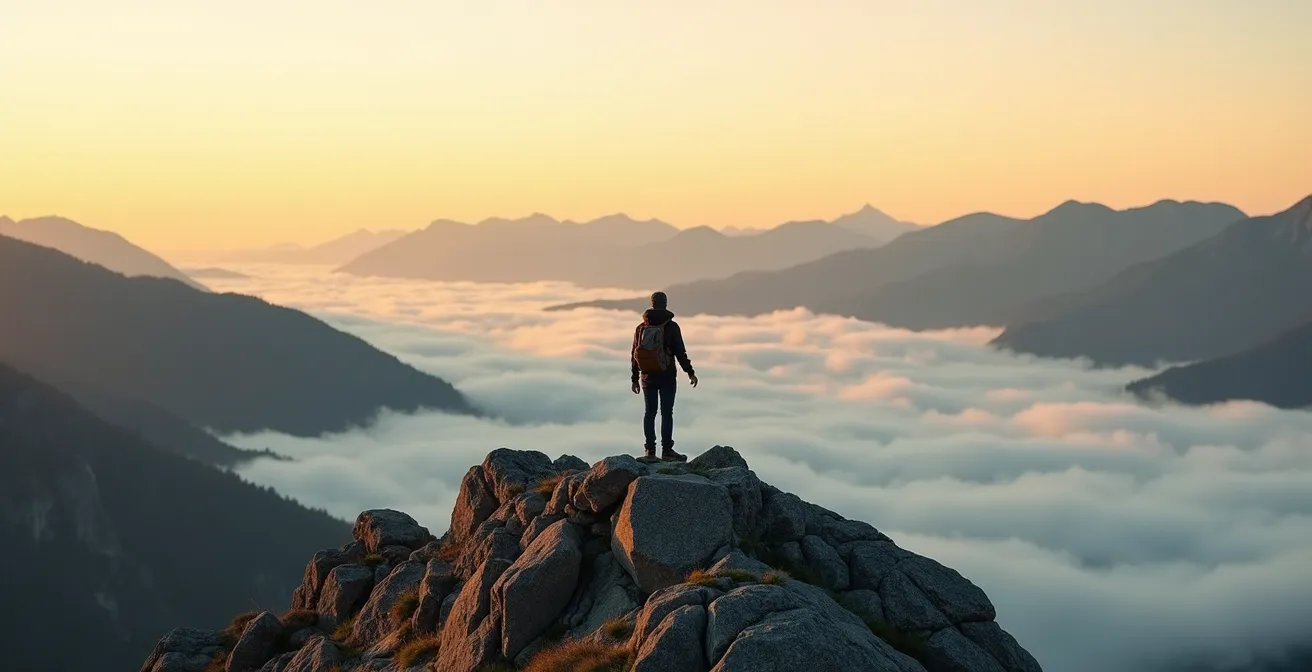
Contrary to popular belief, mental resilience isn’t forged with self-help mantras. It’s a physiological process. This guide reveals how intentional, effort-based adventures in the wild physically reset your brain’s dopamine and stress systems. It’s about trading cheap, passive stimulation for earned rewards, forging a robust strength that the predictability of city life simply cannot replicate.
The hum of the city, the predictable rhythm of the week, the endless scroll on a glowing screen—for many urban dwellers, life settles into a groove so deep it starts to feel like a cage. You feel a pull for something more, a vague sense of stagnation that no new series or restaurant can fix. The common advice is to “step outside your comfort zone,” a phrase so overused it’s lost its raw, primal meaning. It’s often interpreted as simply trying a new hobby or talking to a stranger.
But what if the key isn’t just novelty, but intensity? What if true mental resilience isn’t just a change of scenery, but a fundamental recalibration of your brain’s chemistry? This isn’t about collecting experiences; it’s about confronting challenges that demand your full physical and mental presence. The real transformation happens when you swap the cheap dopamine hits of modern life for the profound, effort-based rewards that only the wild can offer.
This guide isn’t a collection of platitudes. It’s a field manual for psychological growth, grounded in science and forged in the wilderness. We’ll explore the neurochemical reset that occurs when you embrace controlled risk, provide practical blueprints for preparation, and show you how to integrate this rugged mindset into every facet of your life, from your career to your daily habits. It’s time to stop just existing and start building a resilient mind, one wild adventure at a time.
This article serves as your trail map, guiding you through the science, strategy, and practical steps needed to build a more resilient self. Below is a summary of the key waypoints we will cover on this expedition.
Summary: The Trail Map to Building Your Mental Fortitude
- Why Controlled Risk-Taking Resets Your Dopamine Levels?
- How to Pack for Patagonia With Only Carry-On Luggage?
- Solo Expedition vs. Guided Group: Which Builds More Confidence?
- The Preparation Oversight That Leads to Hypothermia on the Trail
- When to Visit Popular Parks to Avoid Crowds and Experience True Silence?
- When to Take a Gap Year: Pros and Cons for Academic Maturity
- How to Build a Workout Habit That Survives Busy Work Weeks?
- Captivating Lifestyle: How to Become a Digital Nomad Without Ruining Your Career?
Why Controlled Risk-Taking Resets Your Dopamine Levels?
Your brain is wired for efficiency, not for growth. In the predictable environment of modern life, it seeks out the easiest path to a reward, often through passive consumption like social media or sugary foods. This creates a cycle of “cheap dopamine,” where the reward is high but the effort is low, ultimately desensitizing your motivation circuits. You need more stimulation to feel the same level of satisfaction, leading to a state of perpetual low-grade dissatisfaction.
Controlled risk-taking in the wild shatters this pattern. When you face a genuine, effort-based challenge—like navigating a tricky ridgeline or pushing through a storm—you engage a different neurochemical pathway. It’s not about the reward at the end, but the reward inherent in the struggle itself. Research from Princeton University shows that the act of overcoming stress, when paired with dopamine, builds resilience. It’s the effort that makes the reward meaningful and rewires your brain.
This is because your brain doesn’t just register success; it registers the effort that led to it. Groundbreaking research confirms this, showing that actively confronting a challenge can trigger a 73% higher dopamine activity in reward systems, reinforcing resilient behavior. By choosing difficult but achievable tasks in nature, you’re not just having an adventure; you are performing a targeted dopamine recalibration, teaching your brain to once again value effort over ease and building a foundation of authentic mental toughness.
How to Pack for Patagonia With Only Carry-On Luggage?
The first step in any wild adventure is shedding the unnecessary. This principle applies as much to your mindset as it does to your gear. Packing for a demanding environment like Patagonia with only a carry-on isn’t an exercise in deprivation; it’s a masterclass in efficiency and an assertion of freedom. It forces you to distinguish between what you *want* and what you *need*, a critical skill on and off the trail. The goal is a modular, multi-functional system where every item earns its place.
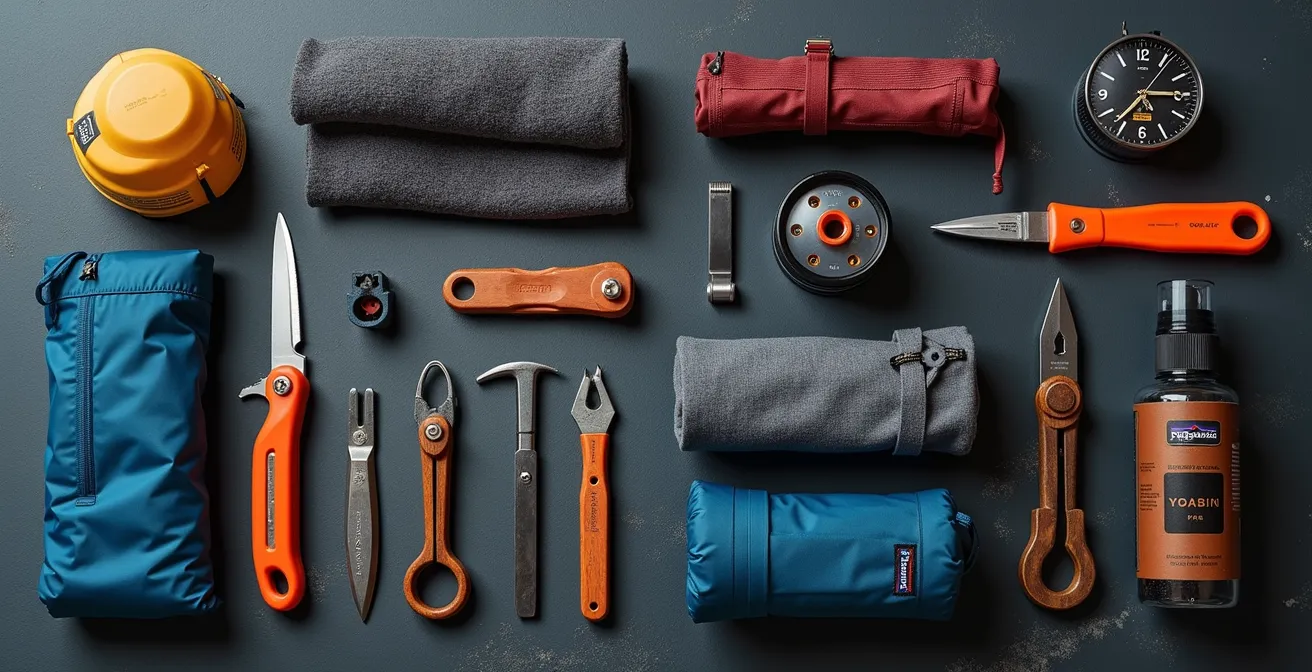
The core of this minimalist approach is the 3-layer system. This isn’t just about clothes; it’s a dynamic solution to unpredictable weather, allowing you to adapt your personal climate second-by-second. Forget bulky jackets and cotton essentials. Think in terms of performance layers that work in concert.
- Base Layer: Merino wool (150-200g) is non-negotiable. It insulates even when damp, wicks sweat, and is naturally antimicrobial, meaning you can wear it for days without offending your tent-mate.
- Mid Layer: This is your insulation. A synthetic fleece or a compressible down jacket traps warm air created by your body. It must be lightweight and pack down to almost nothing.
- Shell Layer: Your shield against the elements. A high-quality waterproof and breathable jacket (look for a minimum 20,000mm rating) protects you from wind and rain. It’s your most critical piece of survival gear.
Beyond layering, every other item must serve at least two purposes. A buff can be a hat, a scarf, or a sun shield. A durable water bottle can be used to collect water and as a hot water bottle in your sleeping bag on a cold night. This philosophy of radical efficiency is the first practical test of your expedition mindset.
Solo Expedition vs. Guided Group: Which Builds More Confidence?
Outside of your comfort zone is where you’ll find growth, new experiences, fulfilment, love, belonging and many of the things you might feel your life is currently lacking. That could be up a mountain – or today it might just be leaving the house. Either way, perhaps it’s time to take that step.
– Shore Coaching, Resilience Coaching & Your Comfort Zone
The trail offers two distinct paths to building confidence: the solitary test of a solo expedition and the shared challenge of a guided group. Neither is inherently superior; they simply forge different facets of resilience. The right choice depends on what part of your mental fortress you need to reinforce.
A solo expedition is an unfiltered dialogue between you and the wilderness. Every decision—from navigation to camp setup—is yours alone. There is no one to second-guess or to fall back on. This environment cultivates radical self-reliance. You learn to trust your own judgment because you have no other choice. The confidence gained here is quiet, internal, and profound. It’s the unshakeable knowledge that you, and you alone, can handle adversity. However, the risk is also entirely your own, and the learning curve can be brutally steep.
A guided group expedition, on the other hand, builds collaborative resilience. The challenge is shared, and success is a collective achievement. You learn to trust others, communicate under pressure, and find your role within a team. The confidence built here is social and external. It comes from knowing you are a reliable part of something larger than yourself and that you can contribute to a group’s survival and success. A good guide manages the risk, allowing you to push your limits in a safer context, making it an ideal environment for learning technical skills and building a foundation for future solo endeavors.
The Preparation Oversight That Leads to Hypothermia on the Trail
In the wild, the most dangerous threat isn’t a predator or a sudden storm; it’s the quiet creep of your own cognitive biases. The single greatest oversight leading to life-threatening situations like hypothermia is not gear failure, but a failure of mindset. Stunning research on wilderness accidents shows that 87% of hypothermia cases involve optimism bias rather than simple gear failure. This is the ingrained belief that “it won’t happen to me,” causing hikers to push on when they should turn back, or to neglect small, crucial maintenance tasks.
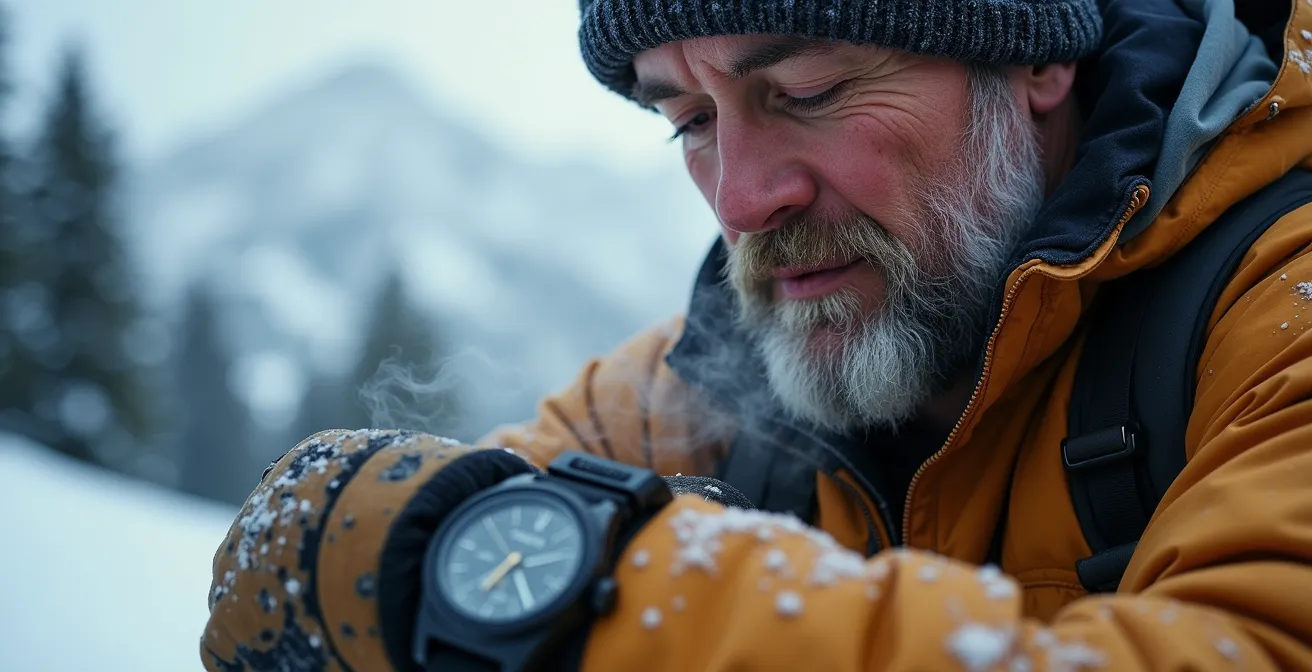
Hypothermia doesn’t happen in an instant. It’s a slow, insidious drain of energy caused by a negative balance in your body’s thermal regulation. It begins with small, seemingly insignificant oversights: not stopping to delayer before a big climb, leading to sweat-soaked clothes; skipping a snack, depleting your caloric furnace; or ignoring the first signs of uncontrollable shivering. To combat this, you need a system—a non-negotiable, disciplined ritual that overrides your brain’s lazy optimism.
Your defense is a simple, hourly self-audit. It’s a mental checklist that forces you to confront reality, not your hopeful version of it. Every 60 minutes, you must stop and ask:
- Am I dry? Assess every layer for moisture, both from sweat and the environment. Dampness is your enemy.
- Am I fueled? You must consistently feed the fire. Consume 100-200 calories of easily digestible food every hour, even if you don’t feel hungry.
- Am I hydrated? Dehydration accelerates hypothermia. Check your urine color and drink regularly.
- Am I aware of my turnaround time? Where are you in relation to your plan and the remaining daylight? Hope is not a strategy.
This discipline is the truest form of preparation. It’s an admission of fallibility and the ultimate tool for survival.
When to Visit Popular Parks to Avoid Crowds and Experience True Silence?
The paradox of popular national parks is that we seek wilderness but often find crowds. The true reward of nature—the profound, mind-clearing silence—is often buried under the noise of fellow visitors. However, solitude is not a matter of finding a secret location; it’s a matter of timing and strategy. It requires seeing the park’s rhythm not as an obstacle, but as a code to be cracked.
True silence has a measurable effect on the brain. Research on the brain’s Default Mode Network (DMN)—the “chatter” of your mind when it’s at rest—shows that quiet, natural settings help to calm it down. By mentally rehearsing your journey in these quiet places, you can even build new neural pathways that make the real experience feel more manageable and less stressful. The goal is to find “micro-windows” of solitude where you can let this neurological reset happen.
The most effective strategy is the “alpine start.” This means being on the trail long before anyone else has had their morning coffee, typically starting your hike two hours before sunrise. You’ll move in the cool, still air of the pre-dawn, reaching iconic viewpoints just as the first light hits the peaks, experiencing them in absolute solitude. Another powerful technique is to leverage weather. Monitor the forecast for clearing storms. While most visitors wait for a perfect bluebird day, the hours immediately after a weather system passes are often magical, with clean air, dramatic clouds, and completely empty trails.
Finally, think three-dimensionally. Most visitors stick to the main, well-marked trails. Use topographical maps and satellite imagery to identify parallel ridges or adjacent valleys. These alternative routes often offer nearly identical views without the human traffic, providing the raw silence your brain craves. It’s not about avoiding people, but about intentionally seeking the quiet that allows for deep introspection and connection.
When to Take a Gap Year: Pros and Cons for Academic Maturity
The traditional path from high school to university is often presented as a non-stop conveyor belt. But for some, stepping off that belt for a “gap year” isn’t a delay; it’s an accelerator for personal and academic growth. When structured around adventure and challenge, a gap year becomes a crucible for forging the very skills higher education demands: self-discipline, problem-solving, and resilience. It’s a strategic investment in academic maturity.
The primary benefit is a dramatic increase in resilience. Immersed in unfamiliar cultures and facing real-world problems without a safety net, students learn to navigate uncertainty—a skill far more valuable than anything learned in a lecture hall. This isn’t just an anecdotal claim; it’s backed by data. According to Harvard research on student resilience, students who complete adventure-based gap years show 45% lower dropout rates. They return to their studies not just with stories, but with a renewed sense of purpose and a proven ability to overcome obstacles.
As Jessica A. Kent from Harvard Summer School notes, this process is fundamental to personal development. “Challenging yourself to move outside your comfort zone can increase your resilience as well. You’ll gain more confidence in how you handle failure or setbacks and become more comfortable with increased levels of stress, anxiety, and uncertainty.” The “con” is often a perceived loss of momentum. However, this is a misconception. The real risk isn’t a year of adventure; it’s four years of uninspired, disengaged study because a student hasn’t yet discovered their own inner drive. The choice is between starting early and unmotivated, or starting a year later, forged, focused, and ready for the real work.
How to Build a Workout Habit That Survives Busy Work Weeks?
For the aspiring adventurer with a demanding job, the biggest hurdle isn’t the mountain; it’s the calendar. Conventional gym workouts often feel disconnected from any real purpose, making them the first thing to be sacrificed during a busy week. The key to building a resilient workout habit is to stop “exercising” and start “training.” You need a mission. A workout is a chore; training for a mission is a calling.
This approach reframes fitness from a health obligation to a necessary preparation for a specific, inspiring adventure goal. It creates a powerful “why” that will pull you through the days when motivation is low. Instead of aimless sets and reps, every workout becomes a direct deposit into your “adventure bank account.” This shift also has cognitive benefits; a Stanford study found a 23% improvement in creative problem-solving from regular unfamiliar activities, and mission-based training is a perfect example.
To implement this, you need a framework that connects your daily grind to your future summit. This isn’t about finding more time; it’s about making your training time more potent and purposeful.
Your Action Plan: The Mission-Based Training Framework
- Define Your Mission: Set a specific, tangible adventure goal. Not “get in shape,” but “Summit Mt. Rainier in 6 months” or “Complete the Tour du Mont Blanc circuit.” It must be a concrete objective.
- Create Milestone Markers: Break the mission down into monthly fitness benchmarks. For example, Month 1: Hike 10 miles with a 15lb pack. Month 3: Achieve 3,000 feet of elevation gain in a single outing.
- Design Functional Workouts: Your training must mimic the demands of your mission. Replace bicep curls with weighted stair climbs. Swap the treadmill for balance drills on uneven surfaces. Your body must adapt to the specific stresses it will face.
- Schedule Micro-Adventures: Integrate small-scale versions of your mission into your week. A pre-dawn trail run with a headlamp, a lunch break dedicated to hill sprints, or a weekend carrying a heavy pack on a local trail.
- Track Adventure-Specific Metrics: Forget the scale. Track what matters: elevation gain capacity, pack weight tolerance, and recovery time. These are the true indicators of your readiness.
Key Takeaways
- Resilience is physiological: It’s built through effort-based rewards that recalibrate your brain’s dopamine system, not through passive experiences.
- Preparation is a mental discipline: The greatest risks in the wild come from cognitive biases like optimism. A structured, disciplined mindset is more critical than any piece of gear.
- Adventure is an integrated strategy: From daily workouts to career choices, a “mission-oriented” approach transforms abstract goals into tangible, motivating steps for both personal and professional growth.
Captivating Lifestyle: How to Become a Digital Nomad Without Ruining Your Career?
The dream of the digital nomad—working from a laptop on a tropical beach—often clashes with the harsh reality of career stagnation and shallow cultural experiences. A successful transition to this lifestyle requires a more intentional approach than simply booking a one-way ticket. The secret is to reframe it from a permanent vacation to an “adventure-anchored” career strategy, where travel becomes a tool for skill development, not a distraction from it.
Case Study: The Adventure Hub Base Camp Strategy
A growing number of successful digital nomads are abandoning the “one city per week” model. Instead, they establish 3-6 month “base camps” near major adventure hubs (e.g., Chamonix, France; Squamish, Canada; or Bariloche, Argentina). This approach allows for deep immersion in both the local culture and the surrounding wilderness. By engaging with different cultures and consistently tackling outdoor challenges, they build flexibility, cross-cultural communication skills, and adaptability—all highly valuable assets that directly enhance their professional lives and résumés. This strategy fosters genuine self-discovery while maintaining high work productivity.
This adventure-anchored model creates a powerful symbiosis between personal growth and professional advancement. The challenges faced in the mountains or on the trail—problem-solving, risk assessment, and perseverance—translate directly into a more resilient and creative approach to work. It builds a unique portfolio of “soft skills” that are impossible to acquire in a traditional office setting. This method fundamentally differs from standard remote work, which often just transplants the office to a home environment without the transformative element of challenge.
The following table breaks down the key differences between a conventional remote setup and this purpose-driven nomadic lifestyle.
| Aspect | Traditional Remote | Adventure-Anchored |
|---|---|---|
| Location Stability | Permanent home base | 3-6 month adventure hubs |
| Skill Development | Professional only | Professional + outdoor expertise |
| Community Building | Local only | Global adventure network |
| Mental Resilience Gains | Limited | Significant through regular challenges |
The final step is to take action. Stop dreaming of the horizon and start mapping the first leg of your journey. Your transformation begins not when you reach the summit, but when you take the first, deliberate step onto the trail. Evaluate your goals, pick a mission, and begin your training today.
Frequently Asked Questions About Wild Adventure and Resilience
What time should I start for the ‘alpine start’ strategy?
Begin hiking 2 hours before official sunrise. This typically means 3-4 AM starts in summer, ensuring you reach popular viewpoints when completely alone.
How do weather windows create solitude opportunities?
Hike during clearing storms when the forecast shows improvement. Most visitors wait for perfect conditions, leaving trails empty during these weather transitions.
Which mapping tools help identify less-traveled areas?
Use topographical maps combined with satellite imagery to find parallel ridges or adjacent valleys that offer similar views without the crowds.