
The common belief that condos offer ‘easy’ returns is a dangerous oversimplification; true cash flow is a direct result of operational control, which is fundamentally limited in a condo and maximized in a multi-family property.
- Condo investors are renters of building control, subject to surprise assessments and strategic limitations imposed by an HOA.
- Multi-family owners can directly influence Net Operating Income (NOI) through value-add improvements and management efficiencies, creating forced appreciation.
Recommendation: Investors seeking maximum returns should prioritize multi-family assets where they retain full control over expenses, income streams, and long-term strategy.
The real estate investment landscape is dominated by a central question for those looking to build a portfolio: should you buy a condo or a multi-family home? The conventional wisdom presents a simple trade-off: the hands-off ease of a condo, managed by a Homeowners Association (HOA), versus the higher potential returns of a multi-family property. This dichotomy suggests a choice between passive income and active management, a balance of convenience against profit.
However, this surface-level analysis misses the most critical factor determining long-term financial success: operational control. While HOAs handle landscaping and exterior maintenance, they also strip the investor of the power to make strategic decisions, manage costs effectively, and unlock hidden value. Relying on an HOA is not investing; it is outsourcing your financial destiny to a committee whose goals may not align with yours. The allure of “easy” management often conceals significant financial risks and missed opportunities.
What if the key to superior cash flow isn’t about the number of doors, but about the degree of control you have over what happens behind them? This analysis moves beyond the platitudes to dissect the core mechanics of each asset class. We will explore how factors like reserve fund health, tenant quality, revenue diversification, and management scale are not just minor details but are the fundamental levers that an investor can pull—or is prevented from pulling—to drive profitability. The ultimate goal is to reframe the debate: the best investment is the one that gives you the most control over its outcome.
This article provides a detailed, comparative analysis to help you understand the true financial implications of each choice. We will dissect everything from hidden fees to income potential, giving you the framework to decide which asset class truly aligns with your investment goals.
Summary: A Deep Dive into Condo vs. Multi-Family Investment Mechanics
- Why Low Condo Fees Can Be a Red Flag for Special Assessments?
- How to Spot a Property That Attracts Long-Term Tenants vs. Transients?
- Airbnb vs. Long-Term Lease: Which Yields More After Management Costs?
- The Foundation Check Mistake That Costs Buyers $20k After Closing
- How to Choose the Right Mix of Studios and 2-Bedrooms for Maximum Occupancy?
- Airbnb vs. Coliving Spaces: Which Is Better for Productivity?
- How to Estimate the Solar Yield of Your Commercial Roof in 10 Minutes?
- Rental Management: How to Self-Manage 10 Units in Under 4 Hours a Week?
Why Low Condo Fees Can Be a Red Flag for Special Assessments?
For many investors, a low condo fee seems like a clear advantage, directly translating to higher monthly cash flow. However, this seemingly positive metric can be a significant red flag, masking a poorly managed or severely underfunded reserve fund. A reserve fund is the HOA’s savings account for major capital repairs—such as roof replacement, repaving, or structural work. When this fund is inadequate, the cost of these inevitable repairs is passed directly to owners through a “special assessment,” a one-time lump-sum payment that can easily wipe out years of profit.
This is not a rare occurrence. An analysis from the Condominium Authority of Ontario revealed that 16% of condo corporations issued special assessments between 2018 and 2023, with the average cost hitting $3,525 per unit. For an investor, this represents a complete loss of control over major expenses. Unlike a multi-family owner who can proactively budget for capital expenditures, a condo owner is at the mercy of the HOA’s financial planning, or lack thereof. An artificially low fee is often a sign of an association kicking the can down the road, leaving future owners to foot the bill for deferred maintenance.
Therefore, thorough due diligence on the HOA’s financial health is non-negotiable. An investor must act like a forensic accountant, scrutinizing documents to uncover these hidden liabilities. A high fee in a well-run building is predictable and can be underwritten; a surprise assessment is a cash flow catastrophe.
Action Plan: Assessing Reserve Fund Health
- Request the latest Reserve Study from the condo association (it should be updated every 3-5 years).
- Calculate the “Percent Funded” ratio by dividing the current reserve balance by the “fully funded” balance recommended in the study. A ratio below 70% is a warning sign.
- Verify that the association allocates at least 10% of its annual operating budget to the reserves, a common requirement for mortgage lenders like Fannie Mae.
- Review the last 12 months of HOA meeting minutes for discussions of postponed repairs or multiple bids for a large project without a decision.
- Check for compliance with state or provincial-specific reserve laws, which are becoming increasingly strict.
How to Spot a Property That Attracts Long-Term Tenants vs. Transients?
Consistent cash flow is built on the foundation of stable, long-term tenants. High tenant turnover is a profit killer, introducing vacancy losses, marketing costs, and repair expenses. While both condos and multi-family units can attract great tenants, the property’s location and surrounding amenities—its “lifestyle infrastructure”—play a crucial role in tenant retention. Properties that are deeply integrated into a walkable, vibrant community are more likely to attract “nesters” rather than transient renters.
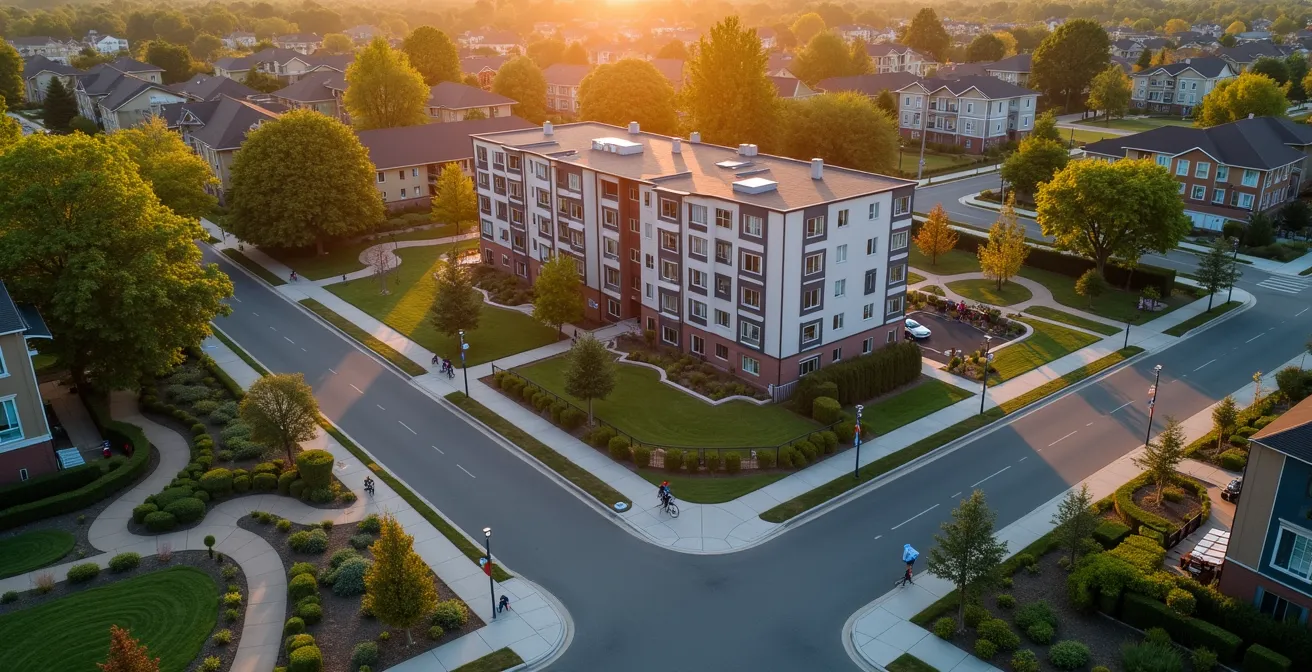
Look for properties anchored by features that enhance daily life: parks, bike paths, community gardens, local coffee shops, and grocery stores. These amenities create a “sticky” environment that makes tenants want to stay longer. A multi-family investor often has more control in selecting an asset in such a location, whereas a condo purchase is restricted to available units in specific buildings, which may or may not be ideally situated. This visual below highlights the kind of neighborhood infrastructure that supports long-term tenancy and minimizes costly turnover.
Furthermore, the financial impact of a vacancy differs dramatically. A Baselane study on tenant retention highlighted that a three-month vacancy in a single-family home (or condo) represents a 25% annual vacancy rate. In a 10-unit multi-family building, the same three-month vacancy on one unit results in only a 2.5% annual vacancy rate for the entire property. The inherent diversification of a multi-family asset provides a powerful buffer against the financial shock of turnover. The study also found that properties with desirable in-unit features like laundry and dedicated storage boasted a 40% longer average tenant tenure, a level of control a multi-family owner can implement across all units.
Airbnb vs. Long-Term Lease: Which Yields More After Management Costs?
The allure of short-term rentals (STRs) like Airbnb is powerful, with promises of significantly higher nightly rates compared to long-term leases. However, gross revenue is a vanity metric; net profit is what matters. When you peel back the layers of costs associated with STRs, the picture becomes far more complex. While top-line revenue can be higher, the operational costs can erode profits to a level that is often on par with, or even below, a stable long-term lease.
A market analysis from Baselane shows that while Airbnb properties can generate 30% higher revenue, this is before accounting for significant, STR-specific expenses. These include platform fees (3-15%), professional cleaning between every guest, higher utility bills (paid by the owner), accelerated wear and tear, and significantly higher property management fees, which can run from 20-30% of revenue. This doesn’t even include occupancy taxes, which can be as high as 14% in major tourist destinations. The table below breaks down the true cost difference, revealing the hidden expenses of the STR model.
| Cost Category | Airbnb (Monthly) | Long-Term Rental (Monthly) |
|---|---|---|
| Platform/Service Fees | 3-15% of revenue | $0 |
| Cleaning & Turnover | $300-600 | $0 |
| Utilities | $200-400 (owner pays) | $0 (tenant pays) |
| Property Management | 20-30% of revenue | 8-10% of rent |
| Maintenance & Wear | 5-8% (accelerated) | 2-3% of rent |
| Insurance Premium | 25-40% higher | Standard rate |
| Occupancy Tax | 10-14% in major cities | $0 |
This is where the multi-family investor gains a distinct strategic advantage. As real estate investor Brandon Turner points out, the structure of a multi-family property allows for a hybrid approach that a condo owner simply cannot replicate.
Multi-family properties offer unique flexibility for a hybrid strategy – you can run long-term leases for stable base income while operating one or two units as short-term rentals, something impossible with a single condo investment.
– Brandon Turner, BiggerPockets Multifamily Investment Guide
This ability to diversify income streams within a single asset is a powerful form of operational control, allowing the investor to capture the upside of the STR market while maintaining a stable foundation of long-term rental income.
The Foundation Check Mistake That Costs Buyers $20k After Closing
No investment can withstand a faulty foundation. While every buyer knows a home inspection is critical, many fail to appreciate the profound difference between a standard residential inspection for a condo and the commercial-grade inspection required for a multi-family property. When you buy a condo, you are typically inspecting the “walls-in” unit. The structural integrity of the building, its foundation, roof, and major systems are the responsibility of the HOA, and your insight is limited to the documents they provide. You are a passive observer.
In contrast, a multi-family buyer has the control and obligation to conduct a much deeper level of due diligence. Properties with five or more units often require a commercial inspection, which scrutinizes load-bearing walls, multi-unit plumbing and electrical systems, and overall structural health in a way that residential inspections do not. This control can be a deal-saver. In one case, a Portland investor discovered $45,000 in deferred maintenance on a six-unit building that a standard inspection missed. Armed with the commercial inspection report, they successfully negotiated a $60,000 price reduction—a financial outcome impossible for a condo buyer who discovers a building-wide issue post-closing.
Even before hiring a professional, an astute investor can perform a preliminary visual scan for major red flags. This initial audit helps focus the professional inspector’s attention and provides an early warning system for potentially catastrophic issues.
Action Plan: Your 5-Point Pre-Inspection Audit
- Points of Contact: Walk the entire perimeter and basement, systematically looking for any visual signs of stress: cracks in foundation walls, brickwork, or interior drywall.
- Collect Evidence: Inventory and photograph every crack or sign of water intrusion. Note their location, length, width, and direction (vertical, horizontal, or stair-step).
- Check for Coherence: Compare your visual findings with the seller’s property disclosure statement and any available HOA documents. Do the official documents omit visible problems?
- Assess Severity: Differentiate between minor settling issues (hairline vertical cracks) and major structural red flags (any horizontal cracks, bulging walls, or stair-step cracks in brickwork).
- Create an Integration Plan: Compile your photos and notes into a concise report for your professional inspector, highlighting your specific areas of concern for their expert evaluation.
How to Choose the Right Mix of Studios and 2-Bedrooms for Maximum Occupancy?
A key advantage of multi-family investing is the ability to diversify your risk within a single asset. Unlike a condo, which represents a single bet on one unit type and size, a multi-family building can contain a mix of units—studios, one-bedrooms, two-bedrooms—that appeal to different segments of the rental market. This internal diversification is a powerful tool for maximizing occupancy and stabilizing cash flow. If demand for studios wanes, strong demand for two-bedrooms can keep the building’s overall vacancy rate low.
Choosing the right unit mix is a strategic decision based on local market demographics. A neighborhood near a university might have high demand for studios and one-bedrooms, while a suburban area may favor larger two or three-bedroom units for families. The multi-family investor has the operational control to select a property with a mix that precisely matches this demand, or even to reconfigure units to better align with market needs. Recent market data shows that this is a significant advantage, as properties with 5+ units have a diversified unit mix that can reduce vacancy risk by up to 60% compared to single-unit assets.

This strategic layout, often visualized in architectural models, is about more than just filling space. It’s about creating a balanced portfolio of rental products under one roof. The condo investor, by contrast, is locked into a single product. If market demand shifts away from their specific unit type (e.g., luxury one-bedrooms), their entire investment is at risk, with no other units to buffer the impact. The ability to select and manage a diverse unit mix is a fundamental, and often overlooked, benefit of multi-family properties.
Airbnb vs. Coliving Spaces: Which Is Better for Productivity?
When considering alternatives to traditional leases in a multi-family asset, the conversation often stops at Airbnb. However, a more sophisticated and potentially more profitable model is emerging: coliving. For the investor, the “productivity” in question is not about the tenant’s work output, but about the financial and operational productivity of the asset. Coliving, where tenants rent a private bedroom but share common spaces and amenities, can offer a more stable and efficient revenue stream than the high-turnover Airbnb model.
Unlike the volatile, seasonal demand of Airbnb, coliving spaces are typically based on medium to long-term leases (3-12 months), creating predictable monthly income. The revenue model is also more robust. Instead of just a nightly rate, coliving operators generate income from a base rent plus fees for additional services like cleaning, high-speed internet, and community events. This transforms the property from a simple rental into a service-oriented hospitality business with multiple revenue streams.
| Revenue Source | Traditional Airbnb | Coliving in Multi-Family |
|---|---|---|
| Base Income | Nightly rates only | Monthly rent + membership fees |
| Additional Services | Cleaning fees | Cleaning, events, coworking access |
| Income Volatility | High (seasonal) | Low (stable contracts) |
| Management Hours/Unit | 10-15 hrs/month | 4-6 hrs/month |
| Tenant Acquisition Cost | Continuous marketing | Community referrals reduce cost 40% |
This operational model is also remarkably efficient at scale, a point highlighted by BiggerPockets expert Dave Meyer. The structured nature of coliving drastically reduces the management burden compared to the constant guest communication, check-ins, and turnover of an STR.
In a coliving setup within multi-family properties, implementing shared services and a community manager can reduce management time per unit by up to 50% compared to high-turnover Airbnb operations.
– Dave Meyer, BiggerPockets Real Estate Podcast
This advanced strategy is another example of operational control exclusive to multi-family owners. It requires the ability to redesign common areas and manage the entire building as a single, cohesive business—something fundamentally impossible for a condo investor.
How to Estimate the Solar Yield of Your Commercial Roof in 10 Minutes?
The title’s focus on solar yield points to a much broader and more powerful concept in multi-family investing: forced appreciation. While condo investors rely almost entirely on market appreciation—hoping the value of all properties in the area goes up—multi-family owners have the control to create value themselves. They can implement “value-add” strategies that directly increase the property’s Net Operating Income (NOI). Because commercial properties are valued based on their NOI (Value = NOI / Cap Rate), any increase in income or decrease in expenses directly increases the property’s value.
Adding solar panels is a prime example. A multi-family owner can install a solar array on the roof to reduce or eliminate common area electricity costs. As detailed in a case study on Grant Cardone’s investment strategy, adding solar panels to a 20-unit building cut common area electricity costs by $800 per month. This $9,600 annual savings, at an 8% capitalization rate, instantly increased the property’s value by $120,000. This is value that was *created*, not waited for. A condo owner has no such power; they cannot decide to install solar panels on the building’s roof.
Solar is just one piece of the puzzle. A savvy multi-family owner can “stack” multiple forms of ancillary income to boost NOI. This goes far beyond simply collecting rent and demonstrates true operational control over the asset’s profitability.
Action Plan: Ancillary Income Stack for Multi-Family Properties
- Tier 1 (Immediate): Install coin-operated or card-operated laundry facilities, which can generate $150-$300 per unit annually.
- Tier 2 (Low Investment): Implement paid reserved parking spots or covered parking, adding $50-$150 per month per spot in high-demand areas.
- Tier 3 (Moderate Investment): Convert unused basement or ground-floor space into secure storage units, renting for $50-$100 per month each.
- Tier 4 (Utility Recapture): Implement a Ratio Utility Billing System (RUBS) to bill tenants for their share of water, sewer, and trash, reducing a major operating expense.
- Tier 5 (Premium Amenities): Add a rooftop deck, dog park, or small fitness center, which can justify 10-20% rent premiums across all units.
Key Takeaways
- Condo ownership offers perceived simplicity but sacrifices operational control, exposing investors to risks like special assessments and strategic limitations.
- Multi-family properties provide direct control over expenses, income streams, and management, allowing for risk mitigation through diversification and value creation.
- Superior cash flow is less about property type and more about an investor’s ability to actively manage an asset to increase NOI and force appreciation.
Rental Management: How to Self-Manage 10 Units in Under 4 Hours a Week?
At first glance, managing ten units seems exponentially more difficult than managing one. This leads many investors to believe that a portfolio of scattered condos is easier to handle than a single ten-unit multi-family building. The reality is the exact opposite. Managing a centralized multi-family property benefits from immense economies of scale, while managing scattered condos creates significant “administrative drag” that consumes time and erodes returns.
Imagine a plumbing issue. In a 10-unit building, you make one call to one plumber to service one location. If you own ten condos in ten different buildings, you may need to coordinate with ten different HOAs, navigate ten different sets of rules for vendor access, and potentially deal with ten different plumbers. This administrative overhead is a hidden cost of diversification by condo. In fact, property management efficiency studies demonstrate that managing a 10-unit building requires 50% less time than managing just five scattered condos due to these centralized efficiencies.
With modern property management software, the process becomes even more streamlined. By leveraging technology to automate rent collection, maintenance requests, and accounting, a self-managing investor can handle a 10-unit building with remarkable efficiency. This level of systemization is far more difficult with a scattered portfolio, where each property is its own separate administrative entity. The goal is to build a system for your portfolio, not to create ten separate jobs for yourself. For multi-family investors, this systematic approach transforms management from a burden into a competitive advantage.
Frequently Asked Questions About Condo vs. Multi-Family Investing
Why is managing multiple condos harder than one multi-family building?
Managing multiple condos involves significant administrative drag. Each condo has different HOA rules, separate maintenance contacts, varying fee payment schedules, and requires its own insurance policy. This “context switching” between properties creates massive administrative overhead compared to the streamlined, centralized management of a single multi-family building with one set of rules and one point of contact for building-wide issues.
What software stack enables 4-hour weekly management for 10 units?
An effective software stack for a multi-family property can automate over 80% of routine management tasks. A common and effective combination includes using a platform like Baselane for automated rent collection and property-specific banking, Buildium or TenantCloud for handling and tracking maintenance requests, and QuickBooks Online for streamlined bookkeeping and financial reporting.
How does ‘context switching’ impact ROI for condo investors?
“Context switching”—the mental and administrative cost of juggling different properties, rules, and contacts—has a direct negative impact on an investor’s return on time. Managing five condos across different buildings can add approximately 10 hours of coordination time per month compared to a five-unit multi-family. This extra time, if valued, can effectively reduce the investor’s hourly ROI by 40% or more, making the “passive” condo portfolio far more active and less profitable than anticipated.
The choice between a condo and a multi-family home is more than a simple comparison of price and unit count; it is a fundamental decision about your role as an investor. Opting for a condo is choosing to be a passenger, placing your trust in an HOA to steer the asset. Investing in a multi-family property is choosing to be the pilot, with full control over the levers that determine your financial destination. While this requires greater initial diligence, the long-term rewards—in the form of forced appreciation, diversified income, and scalable management—are what separate passive hobbyists from strategic wealth builders. To truly maximize cash flow, the next step is to analyze your local market and identify which asset class gives you the most control.