Car parks are among the most hazardous low-speed environments drivers encounter. Pedestrians step out from between parked vehicles with little warning, sightlines are frequently obstructed by columns, ramps and parked cars, and drivers are often distracted by finding a space rather than watching for people on foot. Unlike public roads, most car parks are private land, which gives operators considerable freedom to design and enforce speed control measures without the same statutory constraints that apply to the highway. This article sets out the practical risks specific to car park environments, the physical and technological measures available to manage vehicle speed, the signage and layout considerations that support compliance, and the ongoing maintenance needed to keep these measures effective over time.
Understanding vehicle speed risks in car park environments
Speed management in car parks is not simply a scaled-down version of highway traffic calming. The mix of pedestrians, trolleys, prams, cyclists and vehicles manoeuvring in tight spaces creates a distinct risk profile that requires its own approach to design and enforcement.
Pedestrian-vehicle conflict points in Multi-Storey and surface car parks
The greatest hazards in any car park occur where pedestrian movement and vehicle movement intersect unpredictably. Common conflict points include:
- Aisle ends and junctions where drivers are looking for spaces rather than for people crossing
- Ramp entries and exits in multi-storey structures, where visibility is often reduced by structural columns
- Areas immediately around entrances, lifts and stair cores, where pedestrian footfall concentrates
- Spaces between parked vehicles, where pedestrians—particularly children—can emerge suddenly and without warning
These conflict points are made more dangerous by the tight turning circles, reversing manoeuvres and frequent stop-start movement typical of car park driving, all of which reduce a driver’s ability to react in time.
Impact of kinetic energy at Low-Speed impacts: the 5mph vs 15mph threshold
The relationship between vehicle speed and pedestrian injury severity is not linear—it increases sharply as speed rises. This principle, well established in road safety research, applies just as strongly within the confines of a car park. Even modest increases in speed within a car park setting translate into markedly higher risk of serious injury if a pedestrian is struck, because the forces involved in a collision escalate disproportionately with speed rather than in simple proportion to it.
This is why most car park operators set internal speed limits well below typical road limits, often around 5mph in pedestrian-dense zones such as near entrances or trolley bays, rising to no more than 10–15mph on clear thoroughfares. The goal is to keep impact speeds low enough that, in the event of a collision, the likelihood of serious or fatal injury remains minimal.
Common incident data from retail and hospital car park studies
Retail and hospital car parks share particular risk characteristics: high pedestrian footfall, vulnerable users (including elderly visitors, families with young children, and patients with mobility difficulties), and frequent vehicle movement as visitors arrive and depart. These sites typically experience a higher concentration of low-speed collisions involving pedestrians than general car park stock, reinforcing the case for robust, consistently applied traffic calming measures in these settings specifically.
Physical traffic calming measures for car park speed reduction
Physical measures remain the most reliable way to enforce speed reduction, because they compel a change in driver behaviour through vehicle geometry rather than relying solely on driver compliance with signage.
Speed bumps, speed cushions and speed humps: specifications to BS EN 1436
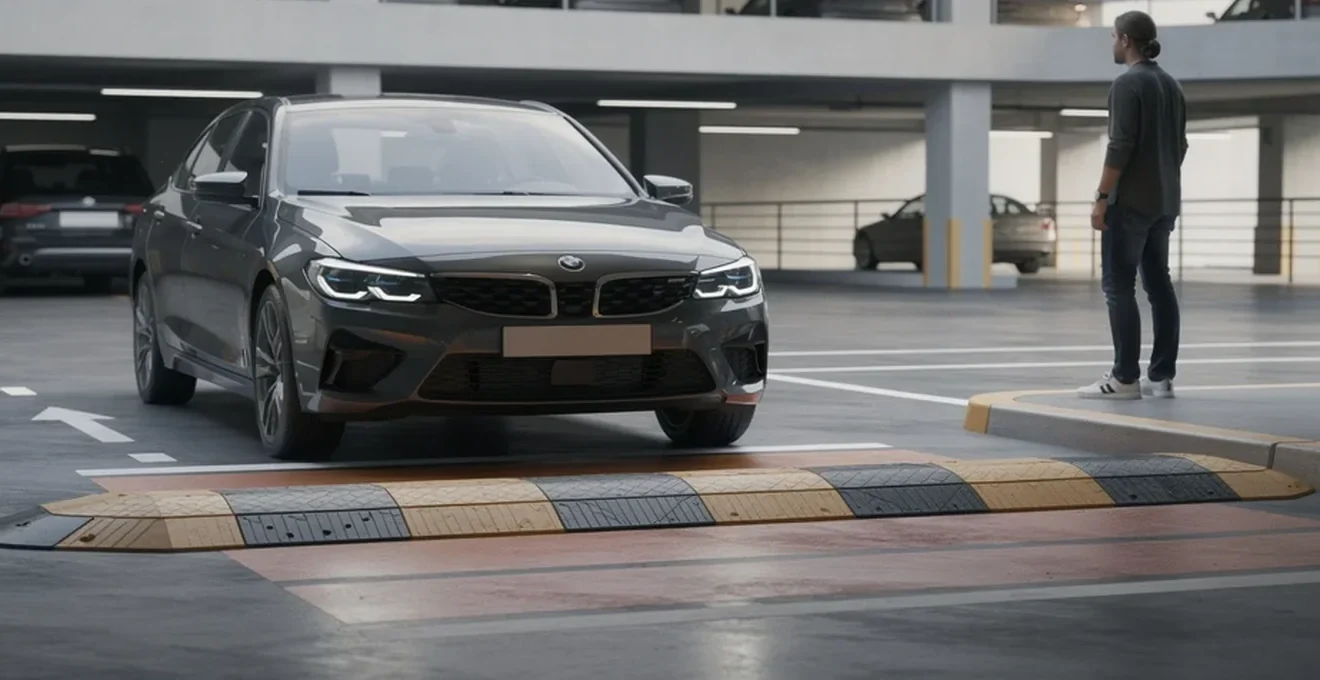
Speed bumps, humps and cushions are widely used in car parks because they physically prevent excessive speed rather than simply discouraging it. In car park settings, speed bumps—shorter and steeper than the speed humps used on public roads—are commonly specified, since vehicles are expected to travel at walking pace or only slightly faster in any case. Markings and surface treatments associated with these features should be applied in accordance with relevant road marking material standards, including BS EN 1436, which governs the performance of road marking materials in terms of visibility, durability and skid resistance.
Key considerations for car park applications include:
- Height and length appropriate to the very low target speeds typical of car parks (often 5–10mph)
- Clear colour contrast and edge marking so the feature is visible in low-light multi-storey environments
- Placement that avoids creating hazards for cyclists or mobility scooter users where these are permitted
- Positioning away from disabled parking bays and drop-off points where sudden deceleration could cause difficulty
Chicanes and lane narrowing techniques for vehicle deceleration
Where space allows, chicanes and lane narrowing can be used to break up long, straight aisles that otherwise encourage drivers to build up speed. By introducing a lateral shift in the vehicle’s path, these measures force a reduction in speed and increase driver attentiveness. In car parks, this is often achieved through the strategic placement of planters, bollards or kerb build-outs at aisle junctions, which narrow the effective carriageway and require more deliberate steering.
Rumble strips and textured surfacing as tactile deterrents
Rumble strips and textured surfacing provide an audible and tactile cue to drivers, alerting them to a change in environment—typically the approach to a pedestrian crossing point, a ramp transition, or the entrance to a lower-speed zone. These measures are less effective at achieving sustained speed reduction than humps or tables, functioning primarily as a warning rather than a hard speed control. In enclosed multi-storey structures, careful consideration should be given to noise, since the reverberation of rumble strips in a concrete structure can be more pronounced than in open-air settings.
Raised tables at pedestrian crossing points
Raised tables—flat-topped platforms that bring the carriageway level with the footway—are particularly well suited to car park pedestrian crossings. They combine speed reduction with a clear visual and physical signal of pedestrian priority, and because vehicles do not need to traverse a sharply profiled hump, they generate less noise and vibration than standard speed bumps. This makes them a strong choice at main pedestrian routes between parking areas and building entrances, where footfall is heaviest and where drivers should expect to give way.
Signage, road markings and regulatory compliance
Physical measures work best when reinforced by clear, consistent signage and markings that leave drivers in no doubt about expected behaviour.
Mandatory speed limit signage under the traffic signs regulations and general directions (TSRGD)
Although most car parks are private land, operators typically still follow the Traffic Signs Regulations and General Directions (TSRGD) as a recognised standard for signage design, since drivers instinctively recognise and respond to familiar sign formats. Clear speed limit signage should be placed at entrances and repeated at intervals through the car park, particularly at points where the layout changes—such as ramp transitions between levels—so that expectations are reinforced throughout the visit rather than only on arrival.
Directional arrows, Give-Way markings and One-Way systems
One-way systems, directional arrows and give-way markings reduce the likelihood of head-on conflict and confusion at junctions, particularly in multi-storey structures where sightlines around columns are limited. A well-designed one-way flow also has an indirect calming effect, since drivers are not required to make sudden decisions about oncoming traffic and can proceed at a steadier, more predictable pace.
Pedestrian crossing delineation using Zebra-Style markings in private car parks
Zebra-style markings, though not statutorily enforceable in the same way as on the public highway, are widely used in private car parks to delineate pedestrian priority at key crossing points. Combined with contrasting surface materials or raised tables, these markings give both drivers and pedestrians a clear, unambiguous signal about where crossing movements are expected, reducing the likelihood of pedestrians crossing at unpredictable points between parked vehicles.
Car park layout design for inherent speed control
The most effective traffic calming is often built into the fundamental layout of the car park, rather than added afterwards. A well-designed layout should encourage low speeds intuitively, without drivers needing to rely solely on signage.
Bay angle configuration and aisle width optimisation
The angle at which parking bays are arranged, and the width of the aisles serving them, directly affects the speeds vehicles can comfortably reach. Narrower aisles and angled bay configurations (as opposed to wide, straight aisles associated with 90-degree parking) naturally constrain speed by requiring more careful manoeuvring, while also reducing the distance pedestrians need to cross to reach their vehicle.
Sightline management at junctions and blind corners
Blind corners—common around stair cores, structural columns and ramp transitions—are a persistent source of risk in car parks. Sightline management, through the use of convex mirrors, kerb build-outs that prevent parking too close to junctions, and the removal of visual obstructions where feasible, allows drivers and pedestrians to see each other in good time and adjust their behaviour before a conflict arises.
Segregated pedestrian walkways and dropped kerb placement
Where footfall is high, segregating pedestrian movement from vehicle movement through dedicated walkways is one of the most effective ways to reduce conflict altogether. Dropped kerbs should be placed at logical, direct routes between parking areas and building entrances, since pedestrians will otherwise take the shortest route regardless of whether a formal crossing point exists there. Accessible design should be considered throughout, ensuring walkways and crossing points are usable by wheelchair users, those with prams, and people with visual impairments.
Technology-driven speed management solutions
Alongside physical infrastructure, a growing range of technology-based tools can support speed management, monitoring and enforcement in car parks.
Anpr-linked speed monitoring systems
Automatic Number Plate Recognition (ANPR) systems, already widely deployed in car parks for access control and payment purposes, can also be used to monitor vehicle speed between fixed points, flagging vehicles that consistently exceed the site’s internal speed limits. This data can support both targeted enforcement and longer-term layout review, identifying specific aisles or junctions where speeding is a recurring problem.
Vehicle-activated signs (VAS) and Radar-Triggered warnings
Vehicle-activated signs display a warning or speed reminder only when triggered by a vehicle travelling above a set threshold, making them a less intrusive alternative to permanent physical measures. Evidence from wider road safety practice suggests that the effectiveness of permanent VAS installations tends to diminish as drivers become familiar with them, whereas temporary or relocatable signs can retain effectiveness for longer by being moved between locations periodically. In a car park context, radar-triggered warnings at entrances, ramp transitions, and pedestrian crossing points can provide an immediate behavioural prompt without the noise or maintenance demands of physical speed bumps.
CCTV integration for enforcement and behavioural analysis
CCTV systems already installed for security purposes can be integrated with speed monitoring to support both enforcement and broader behavioural analysis. Reviewing footage alongside incident and near-miss data allows operators to identify patterns—such as particular times of day, entrances, or routes where speeding or dangerous manoeuvring is more common—and to target physical or signage interventions accordingly.
Compliance, maintenance and Long-Term performance monitoring
Traffic calming measures are only effective if they are properly maintained and periodically reviewed against their original objectives.
British parking association (BPA) guidance on traffic calming standards
Operators of private car parks in the UK typically look to British Parking Association (BPA) guidance as a benchmark for good practice in layout design, signage and traffic management. Aligning car park design with recognised sector guidance helps ensure consistency across sites, supports insurance and liability considerations, and gives visitors a more predictable, familiar experience regardless of which car park they are using.
Routine inspection schedules for speed bump degradation and marking wear
Physical measures degrade over time through repeated vehicle contact, weathering and, in multi-storey structures, exposure to de-icing salts and moisture. A routine inspection schedule should check for:
- Cracking, displacement or wear of speed bumps and raised tables
- Fading or wear of directional arrows, give-way markings and pedestrian crossing delineation
- Continued visibility and legibility of speed limit and warning signage
- Functionality of vehicle-activated signs, ANPR systems and CCTV coverage
Left unaddressed, worn markings and degraded physical measures gradually lose their calming effect, as drivers adapt to features that no longer present a genuine deterrent. Scheduled inspection and timely remedial work ensure that speed management measures continue to perform as intended, maintaining safety for pedestrians and vehicle occupants alike throughout the car park’s operational life.