Contrary to popular belief, our shrinking attention span isn’t a personal failure but a direct result of an economic system designed to eliminate “unprofitable” downtime.
- Digital platforms are engineered to create a cycle of perpetual, low-grade stimulation that ironically increases feelings of boredom.
- True engagement is found not in avoiding technology, but in actively curating our digital spaces and prioritizing scarce, collective real-world experiences.
Recommendation: Shift the focus from simple screen time restriction to teaching the skill of intentional engagement, both online and offline.
Have you ever found yourself with a spare moment, only to instinctively reach for your phone, scroll through a few feeds, and feel not refreshed, but more drained than before? This experience is nearly universal. For parents and educators, it manifests as a concern over a generation that seems incapable of tolerating a single moment of quiet. The common advice—”limit screen time,” “find a hobby,” “just be bored”—treats the symptom as a personal failing of willpower. It assumes the digital world is a neutral tool that we are simply using incorrectly.
This perspective, however, misses the fundamental truth of our modern media landscape. We are not failing to manage our attention; our attention is being systematically managed for us. What if the root of the problem isn’t our lack of discipline, but the very architecture of the platforms we use? What if the constant stimulation is not a bug, but the core feature of an economic model that views boredom as a market opportunity to be captured and monetized? This isn’t just about passive consumption versus active engagement; it’s about recognizing the deliberate, engineered erosion of our capacity for deep focus.
This article deconstructs the mechanisms of the attention economy. We will explore why our apps are built for distraction, how algorithmic traps narrow our worldview, and why, in reaction to this digital saturation, the demand for meaningful, real-world experiences is surging. By understanding the system, we can move beyond simple abstinence and develop robust strategies to reclaim our mental clarity and creativity, turning passive users back into active participants in their own cultural lives.
To navigate this complex environment, we will break down the key challenges and opportunities presented by today’s entertainment forms. The following sections offer a sociological lens on why we feel so distracted and provide actionable frameworks for restoring balance.
Summary: Deconstructing the System of Modern Entertainment
- Why Apps Are Designed to Fragment Your Attention Span Every 15 Seconds?
- How to Curate Your Social Media to Inspire Rather Than Depress You?
- Streaming Services vs. Live Theater: Is the “Experience” Dying?
- The Recommendation Trap That Narrows Your Cultural Horizons
- How to Structure “Low-Tech” Sundays to Recharge Your Creativity?
- How to Audit Your Digital Consumption in 5 Steps for Better Mental Clarity?
- Why a JPEG Can Be Worth More Than a Physical Canvas?
- Meaningful Collective Experiences: Why Live Events Are Booming After Years of Isolation?
Why Apps Are Designed to Fragment Your Attention Span Every 15 Seconds?
The feeling of a constantly divided mind is not an accident; it is the intended outcome of the attention economy. In this model, human attention is the scarce commodity, and digital platforms are locked in a zero-sum game to capture as much of it as possible. The business model of many “free” applications relies on maximizing the time you spend on their service to serve you more advertisements or collect more data. To achieve this, they are engineered not for user satisfaction, but for user retention, often through methods that explicitly fragment focus. Think of infinite scrolling, autoplay videos, and a constant barrage of notifications.

Each of these features creates a “hook loop”: a trigger (the notification), an action (opening the app), and a variable reward (an interesting post, a “like,” a new message). This system is powerfully habit-forming, training our brains to seek out micro-doses of dopamine every few moments. It makes sustained, deep focus on a single task feel unproductive and even stressful. With recent data showing that internet users now spend an average of 2 hours and 20 minutes on social media daily, the cumulative effect is a societal shift toward a state of continuous partial attention, where we are simultaneously aware of everything and focused on nothing.
For educators and parents, understanding this design is critical. It reframes the issue from a child’s “inability to focus” to a child’s predictable response to a powerfully engineered environment. The solution, therefore, lies not in blaming the user but in deconstructing and mitigating the effects of this pervasive and profitable design philosophy.
How to Curate Your Social Media to Inspire Rather Than Depress You?
The prevailing narrative around social media often paints users as passive victims of echo chambers and filter bubbles, algorithmically sealed off from dissenting views. While these mechanisms are real, the sociological reality is more nuanced. The impulse to simply delete all social media, while understandable, overlooks a powerful opportunity: to exercise agency through active curation. Instead of being a passive consumer of what the algorithm feeds you, you can become the architect of your own digital environment.
Research challenges the most simplistic version of the filter bubble thesis. For instance, studies show that using social media and search engines can actually lead to more diverse information streams than relying on offline networks alone. One review of existing literature found that reliance on these platforms is in most cases associated with more diverse news use. This suggests that agency plays a significant role. The algorithm responds to your inputs. If you consciously and consistently seek out content that is inspiring, educational, and diverse, the algorithm will begin to reflect those choices back to you.
Active curation involves several key practices. It means aggressively unfollowing or muting accounts that consistently evoke negative emotions like envy, anger, or inadequacy. Conversely, it means proactively seeking out and following creators, experts, artists, and institutions that align with your aspirations and intellectual curiosities. Treat your social media feed not as a source of entertainment, but as your personal museum, library, or inspiration board. By making deliberate choices—following sources that challenge your viewpoints, engaging with long-form content, and rewarding thoughtful posts with interaction—you can transform the feed from a source of depression into a powerful tool for self-directed learning and inspiration.
Streaming Services vs. Live Theater: Is the “Experience” Dying?
The rise of on-demand streaming services has given us unprecedented access to a near-infinite library of content, available anytime, anywhere. This convenience has led many to proclaim the slow death of traditional, appointment-based cultural events like live theater, concerts, or cinema. From a purely utilitarian perspective, why would someone pay more for a less convenient, one-time event when a cheaper, more flexible alternative exists at home? The answer lies in the fundamental difference between content and experience.
Streaming offers content; live events offer communal experience. The latter is defined by its scarcity, its shared social context, and its immersive, single-focus nature. When you are in a theater or a concert hall, you are part of a temporary community, collectively reacting to a performance that will never be exactly the same again. This shared emotional journey—the collective gasp, the shared laughter, the unified applause—creates a powerful sense of connection that cannot be replicated by solo viewing. It forces a commitment of attention that is the direct antidote to the fragmented consumption of digital media.
This desire for a genuine, communal experience is not a niche interest; it’s a primary driver of behavior. As a report from MIDiA Research on the post-pandemic return to live music found, the core motivation often transcends practical considerations like cost or location. It notes:
Fandom is by far the strongest factor in purchasing tickets, eclipsing price, and location.
– MIDiA Research, Return to Live: Post-pandemic music fans report
This highlights that people are not just buying access to a performance; they are buying entry into a shared ritual with a community of fellow fans. The “experience” is not dying; in a world saturated with digital content, its perceived value is arguably increasing as a necessary counterbalance.
The Recommendation Trap That Narrows Your Cultural Horizons
Recommendation algorithms are the invisible curators of our digital lives. They determine the next song we hear, the next movie we watch, and the next product we buy. Marketed as tools of discovery, they operate on a simple principle: if you liked X, you will probably like Y. While this can be effective for introducing us to new things within a specific genre, its long-term effect is often one of algorithmic funneling—a subtle, gradual narrowing of our cultural and intellectual horizons.
The trap is not that these systems create impenetrable “echo chambers” for everyone. In fact, research suggests the most extreme forms are relatively rare; studies in the UK estimate that only between six and eight percent of the population are in such politically isolated online spaces. The more pervasive and subtle danger is a slide into a comfortable cultural mainstream. The algorithm is designed for engagement, not for challenging you. It prioritizes content that is predictably enjoyable, leading you down a path of diminishing serendipity. You get more of what you already know, at the expense of the truly novel, the challenging, or the incidentally discovered.
Over time, this can stunt intellectual and creative growth. We lose the “happy accidents”—stumbling upon a book in a different section of the library, hearing an unfamiliar song on the radio, or being dragged to a movie you thought you would hate but ended up loving. For parents and educators, it’s vital to teach the importance of actively seeking out these non-algorithmic discoveries. This means encouraging young people to engage with human curators (librarians, critics, knowledgeable friends), explore physical media, and deliberately step outside their recommended content streams to ensure their world gets bigger, not smaller.
How to Structure “Low-Tech” Sundays to Recharge Your Creativity?
In a world of constant digital input, creativity and deep thought are not born from more information but from the space between information. Boredom, far from being a state to be avoided, is the fertile ground where our minds make novel connections and our creativity flourishes. The constant stimulation of digital devices effectively paves over this fertile ground. The solution is to intentionally carve out time for unscheduled, low-stimulation activities, a practice that can be institutionalized as a “Low-Tech Sunday.”
The goal of a Low-Tech Sunday is not a punitive “digital detox,” but a positive reallocation of attention toward analog and embodied experiences. It’s about creating intentional friction against the effortless pull of the screen. This means making passive digital consumption slightly harder and active, real-world engagement easier. This could involve designating a specific drawer where phones are kept for the day, or planning an activity that is inherently incompatible with screen use, like gardening, painting, playing a musical instrument, or taking a long walk without a destination.
Engaging in single-tasking with analog activities helps retrain the brain’s “attention muscle.” It creates the conditions for what researchers call a more immersive experience, which is fundamentally more satisfying than channel-surfing through digital content. As one psychological study noted when comparing different viewing styles, when you commit to a single, longer experience, “you are more likely to pay attention to what you’re watching.” This principle extends beyond watching content; committing to a single, non-digital task allows for a level of immersion that recharges our cognitive resources rather than depleting them. By structuring these periods of intentional disconnection, we are not just escaping our devices; we are actively cultivating the mental environment necessary for insight and renewal.
How to Audit Your Digital Consumption in 5 Steps for Better Mental Clarity?
The intuitive response to feeling bored or under-stimulated is to switch tasks—to flick from a social media app to a news site to a short video. We operate under the assumption that a novel input will alleviate the sense of monotony. However, emerging psychological research reveals a startling paradox: this constant digital switching, intended to relieve boredom, often exacerbates it. It creates a cognitive state of frantic-yet-unsatisfied searching, preventing the deep engagement that truly alleviates boredom.
This counterintuitive effect has been demonstrated in controlled settings. For example, recent research with 1,200 participants found people reported feeling less bored when watching a single video compared to when they were allowed to switch freely between multiple short clips. This highlights a critical misconception in how we manage our own attention. The problem isn’t just the content we consume, but the very pattern of consumption.
Case Study: The Paradox of Digital Switching Behavior
A study highlighted in PsyPost explored this phenomenon, finding that participants consistently believed that switching between videos would reduce their boredom. Yet, their self-reported feelings after the experiment showed the opposite. The study’s authors noted this “highlighted a common misconception: while people intuitively feel that switching helps avoid boredom, they do not anticipate it exacerbating their boredom.” We are systematically making choices that we believe will make us feel better, but which actually deepen the state of distracted dissatisfaction we are trying to escape.
Gaining mental clarity requires moving from an intuitive, reactive mode of consumption to an intentional, reflective one. The first step is a frank audit of your current digital habits. Just as one might keep a food diary to understand their nutrition, a consumption audit reveals the hidden patterns of your attention diet. It’s an essential diagnostic tool for anyone looking to reclaim their focus.
Action Plan: Auditing Your Digital Diet
- Track Your Triggers: For three days, note every time you instinctively pick up your phone. What was the internal feeling (boredom, anxiety, procrastination) or external cue (a notification, a pause in conversation) that prompted the action?
- Categorize Your Consumption: Inventory the apps and websites where you spend the most time (most phones have this in their settings). Classify each into categories: “Active Creation” (writing, editing), “Intentional Connection” (video calls, direct messages), “Passive Consumption” (scrolling feeds), or “Utility” (maps, banking).
- Analyze the Aftermath: After each significant block of screen time (15+ minutes), take a moment to rate how you feel on a scale of -5 (drained, anxious) to +5 (energized, inspired). Confront the data: does your time spent correlate with positive or negative feelings?
- Identify Mismatches: Compare your intended use of a platform with your actual use. Did you open Instagram to reply to one message but ended up scrolling for 30 minutes? Pinpoint these moments where intention and behavior diverge.
- Set One Concrete Goal: Based on your audit, identify the single biggest “empty calorie” in your digital diet. Create a specific, measurable rule for one week (e.g., “I will not open Twitter before 5 PM,” or “I will move the TikTok app to the last screen on my phone”).
Why a JPEG Can Be Worth More Than a Physical Canvas?
The art market has been turned on its head by the rise of NFTs, where a digital file—essentially a JPEG—can command a price far exceeding that of a physical painting. To an outside observer, this seems absurd. How can a file, infinitely replicable, be more valuable than a unique, tangible object? The answer reveals a profound shift in how we, as a society, are beginning to define value itself. The value is migrating from the physical object to the verifiable experience and community attached to it.
A physical canvas’s value is tied to its originality, its provenance, and its material existence. An NFT’s value, however, is derived from the blockchain’s public ledger, which provides an unimpeachable record of ownership. This digital ownership is the key; it acts as a ticket into an exclusive community, granting access to special events, direct contact with the artist, and a say in a project’s future. The JPEG is not the product; it is the token that unlocks a larger, ongoing experience. In this context, the “art” is the entire ecosystem built around the digital asset.
This conceptual shift is not confined to the art world; it reflects a broader trend seen across the entertainment landscape. The value is increasingly located in the hybrid space between the digital and the physical. As one industry analysis put it when discussing the future of concerts:
The future of live music is undeniably hybrid. While the excitement of in-person concerts will never fade, the digital shift brought on by the pandemic will continue to shape how fans experience live music. Hybrid events will become the norm.
– Musicians Today, Live Performances in the Post-Pandemic Era
Whether it’s a digital art token that grants access to a real-world gallery opening or a concert ticket that unlocks exclusive online content, value is no longer a binary choice between physical and digital. It is found in the fluid, verifiable, and experience-rich intersection of both worlds.
Key Takeaways
- The constant distraction of modern apps is not a user error but a core design feature of the “attention economy” that monetizes boredom.
- True digital wellness comes from active curation—treating your feeds as a space you architect, not just passively consume—which can lead to more diverse and inspiring inputs.
- As a direct reaction to digital saturation, the demand for scarce, collective, and immersive real-world experiences like live events is surging.
Meaningful Collective Experiences: Why Live Events Are Booming After Years of Isolation?
After years of lockdowns and digital mediations of social life, a powerful counter-current has emerged: a massive, demonstrable hunger for meaningful, collective, real-world experiences. While logic might suggest that the convenience of digital alternatives would persist, human behavior is proving the opposite. We are social creatures, and there is a deep-seated need for the kind of embodied, synchronous connection that no livestream or virtual space can fully replicate. The entertainment industry’s data provides stark evidence of this societal recalibration.
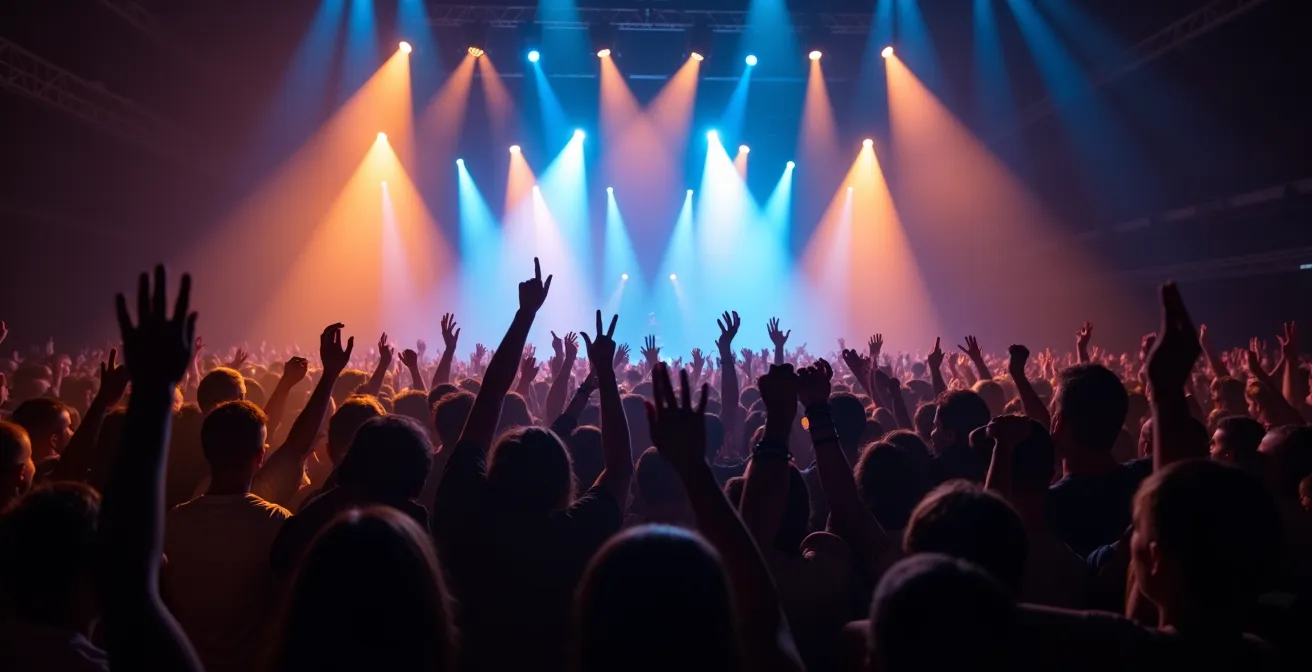
The live music sector, in particular, has seen a rebound that is not just a recovery but a historic boom. According to industry-tracking publication Pollstar, the live music industry has rebounded spectacularly with $9.17 billion in top 100 tour sales in a single year, a staggering 46% increase from the previous record. This is not a market returning to normal; this is a market responding to immense pent-up demand for something that was proven to be essential, not optional. People are voting with their wallets for the irreplaceable energy of a shared physical space.
Case Study: The Unifying Power of a Mass Gathering
The scale of this demand was vividly illustrated by Madonna’s free concert on Copacabana Beach in Rio de Janeiro. The event drew an estimated 1.6 million people, making it the largest standalone concert in history. It was more than a performance; it was a cultural pilgrimage. As Pollstar described it, the “ebullient fans” converted the beach into a “banging dance party,” a testament to the profound human need for shared ritual and celebration on a massive scale. Such an event serves as a cultural touchstone, a collective memory that stands in sharp contrast to the solitary and ephemeral nature of a digital feed.
This surge represents a fundamental rejection of the notion that digital is a sufficient substitute for the physical. For parents and educators, it offers a powerful lesson: fostering a healthy relationship with technology is not just about managing screen time, but also about championing and facilitating access to these vital, meaningful collective experiences. Whether it’s a local play, a school sporting event, or a community festival, these moments of coming together are the ultimate anchor against the isolating pull of the digital tide.
The path forward for parents and educators, therefore, is not to wage a futile war against technology, but to become teachers of intention. It involves guiding young people to audit their digital lives, to curate their feeds with purpose, and to actively seek the irreplaceable thrill of the live, communal experience. To cultivate a life rich with focus and creativity, start by championing the power of doing one thing at a time, together.