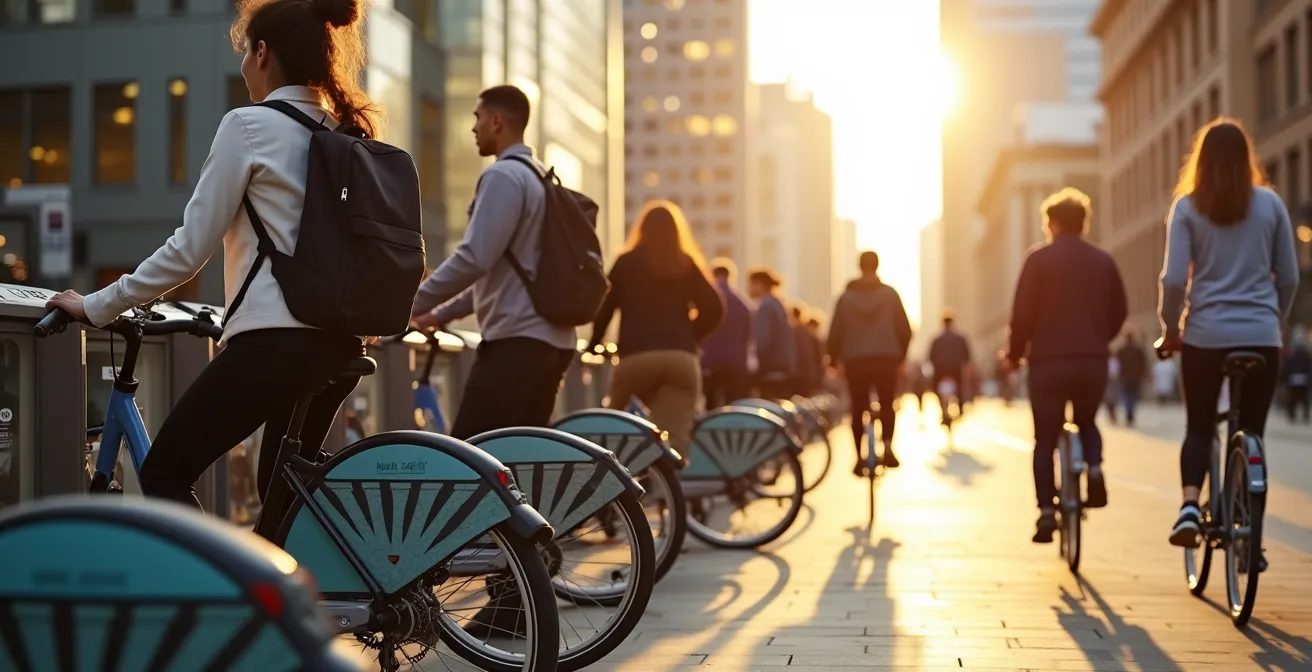
The most effective strategy against urban obesity isn’t a new fitness craze, but the systematic redesign of our daily commute through bikeshare programs.
- Bikeshare systems architect “incidental activity” into daily life, making exercise a byproduct of travel rather than a separate task.
- By solving the “last-mile problem” and integrating with public transit, these systems make the active choice the most convenient one.
Recommendation: For commuters, start by replacing one car or transit trip a week with a bikeshare ride. For public health officials, analyze bikeshare’s potential as a preventative health infrastructure investment.
For many urban dwellers, the desire to stay active clashes with the reality of a packed schedule. The common advice—join a gym, wake up an hour early for a run, or find time for a weekend workout—often feels like another item on an already overwhelming to-do list. We are told to fit exercise into our lives, but this approach frequently fails because it relies on willpower, a finite resource that is easily depleted by the demands of a busy work week. The result is a cycle of good intentions and missed workouts, while sedentary lifestyles continue to contribute to public health challenges like obesity.
But what if the solution wasn’t about finding more time for exercise, but about fundamentally changing the nature of our daily travel? The key to a healthier population may not lie in the gym, but on the streets. Bikeshare systems are emerging as a powerful public health intervention, not by demanding more from individuals, but by subtly reshaping their environment. By making the active choice the easy choice, these systems provide a consistent, low-impact form of physical activity that is woven directly into the fabric of the daily commute. This is a shift from planned exercise to incidental activity, and it’s proving to be a game-changer for urban health.
This article explores the evidence behind bikeshare’s impact on public health. We will examine the direct cardiovascular benefits, provide practical strategies for integrating shared bikes into your daily routine, and compare their health impact to other emerging mobility solutions. By the end, you will understand how these systems are more than just a convenient way to get around—they are a form of behavioral architecture that is actively reducing urban obesity rates.
Summary: Self-Service Bicycles and Their Impact on Urban Health
- Why Cycling 20 Minutes a Day Reduces Cardiovascular Risk by 15%?
- How to Find a Dock With Space During Morning Rush Hour?
- Docked vs. Dockless Bikes: Which System Keeps Sidewalks Tidy?
- The Overtime Fee Mistake That Makes Bikeshare More Expensive Than Uber
- When to Stop Riding: Safety Tips for Winter Bikeshare Commuting
- How to Build a Workout Habit That Survives Busy Work Weeks?
- How to Commute Using Train and Bike Without Being Late?
- Innovative Mobility Solutions: Are E-Scooters a Fad or the Future of Transport?
Why Cycling 20 Minutes a Day Reduces Cardiovascular Risk by 15%?
The public health case for cycling begins with a powerful and accessible number. It’s not about grueling marathons or elite-level training; it’s about consistency. Research confirms that the simple act of regular cycling delivers profound cardiovascular benefits. In fact, a landmark study found a 15% reduction in heart attacks for regular cyclists who ride for as little as 20 minutes per day. This is the sweet spot for incidental activity—a duration short enough to fit into a daily commute but significant enough to trigger positive physiological changes.
This isn’t just a short-term effect. Long-term research, such as the famous Copenhagen Heart Study, has established a clear link between consistent cycling and a reduced risk of fatal coronary heart disease. The study, which monitored over 5,000 individuals for 14 years, found that those who engaged in high-intensity cycling saw the most significant protective benefits. While a bikeshare commute may not always be high-intensity, the daily habit of moving your body, elevating your heart rate, and engaging major muscle groups builds a foundation of cardiovascular resilience.
The power of bikeshare systems lies in making this 20-minute habit almost effortless. Instead of carving out separate “workout time,” the commute *becomes* the workout. This shifts the focus from a single, strenuous activity to a sustainable, daily routine. For public health, promoting a system that encourages millions of people to achieve this 20-minute threshold as a byproduct of their daily travel is far more impactful than promoting gym memberships that go unused.
How to Find a Dock With Space During Morning Rush Hour?
For a bikeshare commute to become a seamless habit, it must be reliable. The most common point of friction for users, especially during peak hours, is the “last 50 feet problem”: finding an available dock at your destination. The anxiety of circling a block searching for an empty slot can be enough to deter a commuter from choosing a bike. However, with a bit of strategy, this challenge can be easily managed, ensuring your active commute remains stress-free.
The key is to think like a logistician and leverage the real-time data provided by bikeshare apps. Don’t just aim for the single dock closest to your office; build a mental map of several options. The illustration below shows a common scenario: a commuter proactively checking their options before arriving.

As you can see, a successful trip depends on planning. By adopting a few simple habits, you can virtually eliminate docking anxiety. The goal is to create a predictable and fluid experience that reinforces the positive choice of cycling. Here are some key strategies:
- Map out primary, secondary, and tertiary dock options near your destination before you even start your ride.
- Use the official system app (like Lyft or Citi Bike) which shows real-time dock availability. Refresh it when you’re a few blocks away.
- Expand your acceptable radius. A dock that’s a pleasant 3-5 minute walk from your final destination is often empty and a better bet than one right at a major transit hub.
- If possible, time your arrival 10-15 minutes before the peak of rush hour begins.
- Save your preferred “backup” dock locations as favorites in your app for quick reference.
Docked vs. Dockless Bikes: Which System Keeps Sidewalks Tidy?
From a public health perspective, the long-term success of a bikeshare system hinges on its integration into the urban fabric and its acceptance by the public. A system that creates clutter and obstructs sidewalks is unlikely to receive the political and community support needed to thrive. This brings up a critical debate in micro-mobility: the operational difference between docked and dockless systems and its impact on urban order. While dockless systems offer flexibility, docked systems provide the structure and reliability that are often more aligned with public health goals of creating a sustainable, long-term transportation solution.
The core difference lies in accountability and infrastructure. Docked systems require a permanent infrastructure investment, but in return, they create predictable hubs of activity and keep bikes confined to designated areas. This predictability is crucial for both user habit-formation and city planning. A commuter knows exactly where to find a bike and where to return it, reducing cognitive load. As the following comparison shows, this trade-off between flexibility and order has significant implications for the user experience and overall system health.
| Feature | Docked Systems | Dockless Systems |
|---|---|---|
| Sidewalk Organization | Bikes confined to designated stations | Can be left anywhere within geo-fenced zones |
| Reliability | Guaranteed bike location at stations | Variable bike availability and location |
| Maintenance | Regular service at fixed locations | Requires active fleet management |
| Urban Planning Integration | Permanent infrastructure investment | Flexible deployment without infrastructure |
| User Experience | Must find available dock to return | End trip anywhere in service area |
For a public health official, the “Sidewalk Organization” and “Reliability” features of docked systems are paramount. An orderly system encourages widespread adoption and minimizes public backlash, ensuring the program’s longevity. While dockless technology is improving with virtual corrals and incentives for proper parking, the inherent structure of docked systems provides a more robust framework for building a dependable active transportation network.
The Overtime Fee Mistake That Makes Bikeshare More Expensive Than Uber
For bikeshare to be a truly viable public health tool, it must be economically accessible. While it’s generally far cheaper than owning a car or taking a taxi, a common user error can quickly erase those savings: the overtime fee. Most systems offer a 30 or 45-minute ride window before punitive fees kick in. Misjudging your trip time by just a few minutes, especially if you struggle to find a dock, can result in a charge that exceeds the cost of a short Uber ride. This negative financial experience can be a powerful deterrent to future use, breaking the very habit public health advocates want to encourage.
However, avoiding these fees is simple with a bit of proactive management. The goal is to treat your ride time not as a limit, but as a budget. By building in a buffer and understanding the system’s rules, you can ensure your commute remains highly economical. In fact, when used correctly, bikeshare offers significant financial benefits; one analysis found that bike share users save an average of $563 annually. The key is to avoid the common pitfalls that lead to unexpected charges.
To help you maintain the financial benefits of bikeshare, it’s useful to perform a quick audit of your riding habits. The following checklist outlines key actions to prevent overtime fees and maximize your savings, turning potential financial stress into a predictable and positive part of your routine.
Action Plan: Auditing Your Bikeshare Usage to Avoid Overtime Fees
- Set a Pre-emptive Timer: On a 30-minute ride, set a phone timer for 25 minutes. This alarm is your cue to start locating a dock, providing a 5-minute buffer.
- Master the “Dock Swap”: For longer trips, identify a station along your route. Dock the bike to reset the timer, then immediately unlock it (or a new one) to continue your journey.
- Analyze Your Subscription: Compare your monthly ride frequency against the pay-per-ride cost. If you ride more than 5-6 times a month, a monthly or annual pass is almost always more economical.
- Track Surge Pricing: Be aware of when ride-hailing apps like Uber or Lyft have surge pricing (e.g., during rain or major events). During these times, bikeshare is overwhelmingly the cheaper option, even with a small risk of overtime.
- Calculate Total Commute Cost: Factor in not just the fee, but the time value and stress. A slightly longer walk from a guaranteed empty dock is often “cheaper” than the stress of hunting for a spot closer to your destination.
When to Stop Riding: Safety Tips for Winter Bikeshare Commuting
A key determinant of a habit’s staying power is its resilience to external challenges. For a bikeshare commute, the biggest challenge is often the weather. While fair-weather cycling is easy, committing to an active commute through the colder, wetter months requires a different mindset and a greater focus on safety. Knowing when to ride—and more importantly, when not to—is crucial for preventing injury and ensuring the habit remains a positive one. A single bad fall on an icy patch can create a fear that lasts for months, undoing all the progress made.
The key to winter riding is not bravado, but preparation and risk assessment. This involves checking your equipment, wearing the right gear, and understanding how different weather conditions affect road surfaces. The texture of the road and the equipment you use become much more important, as highlighted in the image below, where frost on the handlebars and grit on the road tell a story of a cautious winter ride.

Instead of an all-or-nothing approach, successful winter commuters create a set of personal weather thresholds. This isn’t about giving up; it’s about making intelligent choices. Your goal is to continue benefiting from your active commute on the days when it is safe to do so. Here are essential safety checks and tips for navigating winter conditions:
- Create Personal Weather Thresholds: Decide on your limits for temperature, wind chill, and precipitation. For example, you might ride in the cold but not in freezing rain.
- Check Road Treatment: Before heading out, look for signs of salt or grit on the roads. Treated surfaces are a strong indicator of safer riding conditions.
- Perform a Tire Squeeze Test: Cold air can reduce tire pressure. Before every ride, give the tires a firm squeeze to ensure they are properly inflated, which is critical for traction.
- Avoid Slippery Surfaces: Be hyper-aware of painted road markings (crosswalks, bike lanes), manhole covers, and metal plates, which become extremely slippery when wet or icy.
- Reduce Your Speed: A conservative rule of thumb is to reduce your normal speed by at least 30% in wet conditions and by 50% or more when ice is a possibility.
- Combat Glare: Wear polarized sunglasses, even on overcast days, to reduce the intense glare from the low winter sun reflecting off wet surfaces.
How to Build a Workout Habit That Survives Busy Work Weeks?
The greatest barrier to consistent exercise isn’t a lack of desire, but a lack of a sustainable system. Relying on motivation to get to the gym after a long workday is a losing battle. The secret to long-term fitness, especially for busy professionals, lies in building habits that require minimal willpower. This is where a bikeshare commute excels: it transforms a necessary daily activity (getting to work) into a consistent workout, leveraging a principle known as “habit stacking.” You aren’t trying to create a new behavior from scratch; you’re attaching it to an existing one.
The process works by linking the new habit (cycling) to a solid, pre-existing routine. For example, the moment you lock your front door, you open the bikeshare app. This creates an automatic trigger that bypasses the need for an internal debate. To make this even more seamless, you can “gamify” the experience by tracking personal best commute times or preparing a dedicated “office wardrobe” to eliminate morning decisions about what to wear. The goal is to reduce every possible point of friction.
The benefits of this forced consistency extend beyond physical fitness. A groundbreaking study from Stanford University examined individuals with insomnia who started cycling. The results were remarkable: participants fell asleep in half the time and gained an extra hour of sleep per night. This demonstrates how a cycling habit doesn’t just add to your day; it improves the quality of your entire 24-hour cycle. It’s a powerful feedback loop: the ride improves your sleep, and better sleep gives you more energy for the next day’s ride.
How to Commute Using Train and Bike Without Being Late?
For many city residents, the most efficient journey isn’t a single mode of transport, but a combination of several. The integration of bikeshare with public transit like trains and buses—a practice known as multi-modal commuting—is where its public health potential truly multiplies. Bikeshare solves the “first-mile/last-mile” problem: the often-inconvenient gap between a transit station and a person’s home or office. By making public transit more accessible and convenient, bikeshare encourages a shift away from sedentary car trips, a major goal for health-conscious urban planning.
However, a multi-modal trip introduces more variables and requires careful planning to avoid being late. The key is to work backward from your arrival time and add generous buffers for each transfer. Map out the 5-10 minute cycling radius around your key train stations and identify primary and backup docking locations at each end. A well-planned multi-modal commute is a symphony of logistics, but once mastered, it becomes a reliable and energizing part of your day.
The societal benefits of this integration are enormous. By enabling more people to use active and public transport, these systems generate significant public health dividends. A comprehensive analysis revealed that bike share systems save the U.S. an estimated $36 million annually in healthcare costs associated with physical inactivity. This staggering figure demonstrates that investing in bikeshare infrastructure is not just a transportation expenditure; it’s a direct investment in preventative healthcare. It provides a clear, data-backed incentive for cities to foster and expand these integrated networks.
Key Takeaways
- The primary health benefit of bikeshare comes from promoting consistent, incidental physical activity, not just occasional planned workouts.
- The success of a bikeshare system as a public health tool depends on its behavioral architecture—how well its design (docks, apps, pricing) reduces friction and encourages habit formation.
- When integrated with public transit, bikeshare is a cost-effective preventative health measure, generating substantial savings in healthcare expenditures and improving population-level health outcomes.
Innovative Mobility Solutions: Are E-Scooters a Fad or the Future of Transport?
The urban mobility landscape is rapidly evolving, with e-scooters joining bikeshare as a popular option for short trips. From a pure transportation standpoint, both offer a convenient alternative to cars. However, from a public health perspective, there is a critical and non-negotiable difference between them: one is active transport, and the other is passive. While e-scooters can help reduce car use, they do little to combat the negative health effects of a sedentary lifestyle. Bikeshare, in contrast, is fundamentally an engine for physical activity.
This distinction is crucial for public health officials and city planners making long-term investment decisions. The choice is not just between two types of vehicles, but between two different public health outcomes. As the data shows, the physical engagement required for cycling provides tangible health benefits, from calorie expenditure to cardiovascular conditioning, that a passive e-scooter ride simply cannot replicate. For every trip taken on a bicycle instead of an e-scooter, the city gains a small but meaningful deposit in its public health bank.
This following table, sourced from health impact analyses, starkly illustrates the difference in health benefits, making a clear case for prioritizing and promoting bikeshare systems as a primary tool for building healthier cities.
| Factor | E-Scooters | Bikeshare |
|---|---|---|
| Physical Activity Level | Passive (minimal exercise) | Active (moderate to vigorous) |
| Calories Burned (15 min) | 20-30 calories | 75-150 calories |
| Long-term Viability | Lower durability, higher maintenance | Higher durability, lower maintenance costs |
| Health Benefits | Convenience, reduced car use | Cardiovascular fitness, weight management |
| Infrastructure Needs | Minimal dedicated infrastructure | Benefits from protected bike lanes |
Ultimately, the numbers speak for themselves. The decision to invest in and encourage bikeshare is a decision to invest in human lives and well-being. A study by Colorado State University quantified this impact with stunning clarity, as noted in a report by Lyft Urban Solutions:
Implementation of bike share systems resulted in a calculated reduction of 4.7 premature deaths, 737 disability-adjusted life years and 36 million dollars in health economic impacts annually.
– Colorado State University, Lyft Urban Solutions
This powerful evidence solidifies bikeshare’s role not as a mere transportation amenity, but as a core component of a modern, preventative public health strategy. The choice between active and passive mobility is a choice between the status quo and a healthier, more resilient future.
Now is the time to reframe the commute. For individuals, the next step is to download your local bikeshare app and plan one trip this week. For public health and city leaders, the mandate is clear: evaluate, invest in, and expand the bikeshare infrastructure that makes your citizens healthier by design.