In summary:
- Your garden’s survival depends less on how much you water and more on creating a living, water-retentive soil structure.
- Strategic layering with a mix of perennials and self-seeding annuals provides continuous color and texture with minimal effort.
- Managing rainwater with features like rain gardens and dry creek beds prevents damage and creates beautiful, functional focal points.
- Attracting pollinators is about building a balanced ecosystem with host plants, not just planting flowers.
The frustration is palpable for homeowners in warmer climates: you invest in beautiful, expensive plants, water them diligently, yet watch them wither under the relentless sun. The dream of a lush outdoor sanctuary that boosts your home’s curb appeal quickly turns into a costly, high-maintenance battle against nature. Many guides suggest the usual fixes: plant succulents, install drip irrigation. But this approach often leads to sterile, uninspired landscapes. It misses the fundamental point that a thriving garden isn’t about fighting the climate; it’s about designing a resilient, interconnected ecosystem.
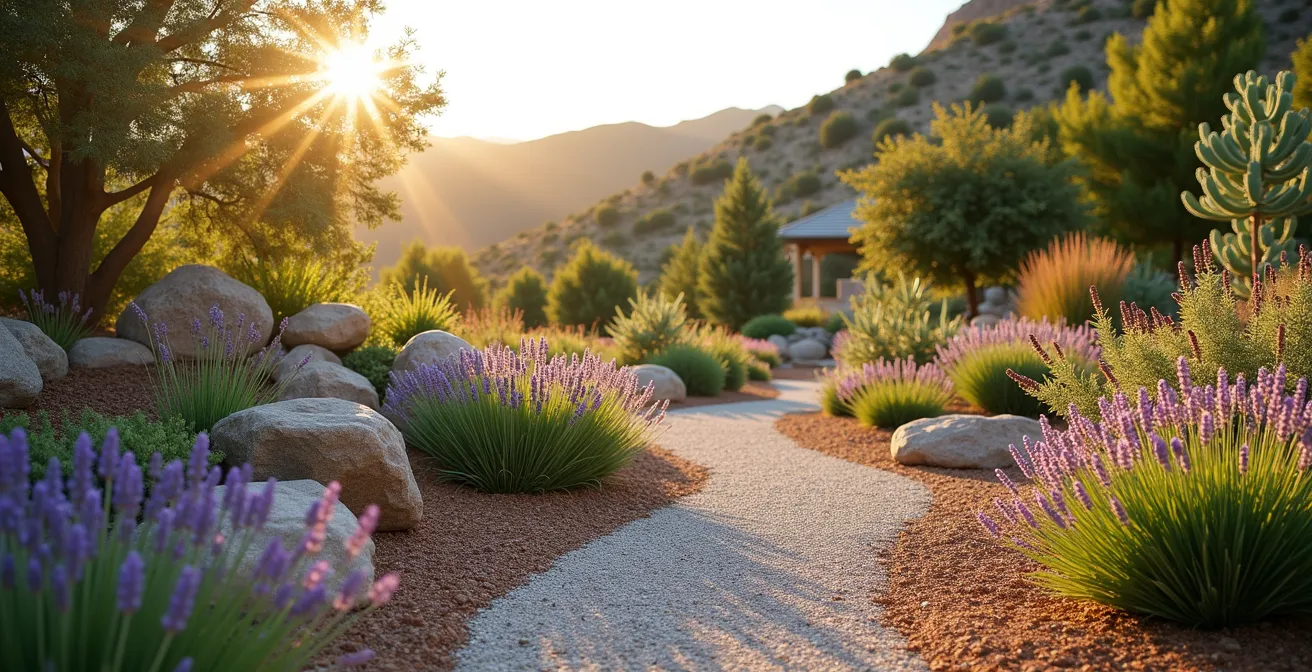
This isn’t about “zero-scaping” with rocks and a few lonely cacti. It’s about xeriscaping—a thoughtful design philosophy that creates vibrant, beautiful gardens with drastically reduced water needs. The secret lies not in simply choosing drought-tolerant plants, but in understanding the systemic relationships between soil, water, plants, and the micro-wildlife that supports them. It’s a shift from being a constant gardener to becoming a garden ecosystem architect.
But what if the key to this low-maintenance paradise was less about the plants themselves and more about the invisible world beneath your feet and the clever management of natural resources? What if you could create privacy, attract beautiful pollinators, and even protect your home’s foundation, all while using less water? This guide will walk you through the principles of systemic garden design, moving from the foundational soil to the final protective layers, to help you build a sanctuary that truly sustains itself.
This article will explore the core strategies for transforming your yard into a self-sufficient ecosystem. We’ll break down the essential steps, from diagnosing your soil’s health to selecting the perfect plant combinations for year-round beauty.
Summary: A Systemic Approach to Drought-Resilient Landscaping
- Why Your Expensive Plants Keep Dying Despite Regular Watering?
- How to Zone Your Garden to Create Privacy From Nosy Neighbors?
- Perennials vs. Annuals: Which Mix Offers Color With Minimal Replanting?
- The Grading Mistake That Floods Your Basement During Heavy Rain
- How to Attract Pollinators to Your Garden Without Inviting Pests?
- Carbon Offsetting vs. Insetting: Which Strategy Builds Real Brand Value?
- Why Controlled Risk-Taking Resets Your Dopamine Levels?
- Roof Renovation: How to Detect Hidden Damage Before It Ruins Your Insulation?
Why Your Expensive Plants Keep Dying Despite Regular Watering?
The number one culprit behind mysterious plant death in an irrigated garden isn’t a lack of water, but a lack of oxygen and the soil’s inability to absorb the water you provide. This happens because of soil compaction, a condition where soil particles are pressed together, reducing pore space. When you water compacted soil, it runs off the surface instead of penetrating to the roots. The little water that does get in can become stagnant, drowning the roots. This silent killer is a global issue; according to the Soil Atlas 2024, soil degradation causes financial losses of 400 billion US dollars annually on a commercial scale, a problem that starts in our own backyards.
Think of healthy soil as a sponge. It’s full of air pockets that hold both moisture and oxygen, allowing roots to breathe and grow deep. Compacted soil, often caused by foot traffic, construction, or even heavy rainfall on bare ground, acts more like a brick. University of Minnesota Extension reports that heavily compacted soils can experience up to a 50% reduction in water holding capacity. No amount of surface watering can fix this. The plants are simultaneously thirsty and drowning, their roots unable to access the resources they need to survive a hot afternoon.
Reversing this requires more than just tilling the surface. The solution is to de-compact the soil and reintroduce life. This involves mechanical aeration and, most importantly, incorporating organic matter like compost. This organic material rebuilds the “soil sponge,” creating a resilient foundation that holds water for dry periods and drains properly during heavy rains. Before you buy another plant, you must first invest in the ground it will live in.
How to Zone Your Garden to Create Privacy From Nosy Neighbors?
Creating privacy isn’t about building a “green wall.” A monolithic hedge of a single species is not only a monoculture risk but also visually boring and can feel claustrophobic. The architectural approach is to create “outdoor rooms” and visual layers that guide the eye, obscure direct sightlines, and build a sense of secluded sanctuary. Instead of one tall barrier, you design with a foreground, mid-ground, and background, using plants of varying heights, textures, and forms. This layered approach creates depth and interest while effectively blocking views from neighboring windows.
The key is staggered planting. Place taller, more open trees or large shrubs at the back, followed by a mid-layer of dense, evergreen shrubs, and a foreground of lower perennials and ornamental grasses. This breaks up the space and creates pockets of privacy. This technique also allows you to be strategic; you can frame a desirable distant view (like mountains or a beautiful tree) through a gap in your planting while completely screening out a neighbor’s second-story window.
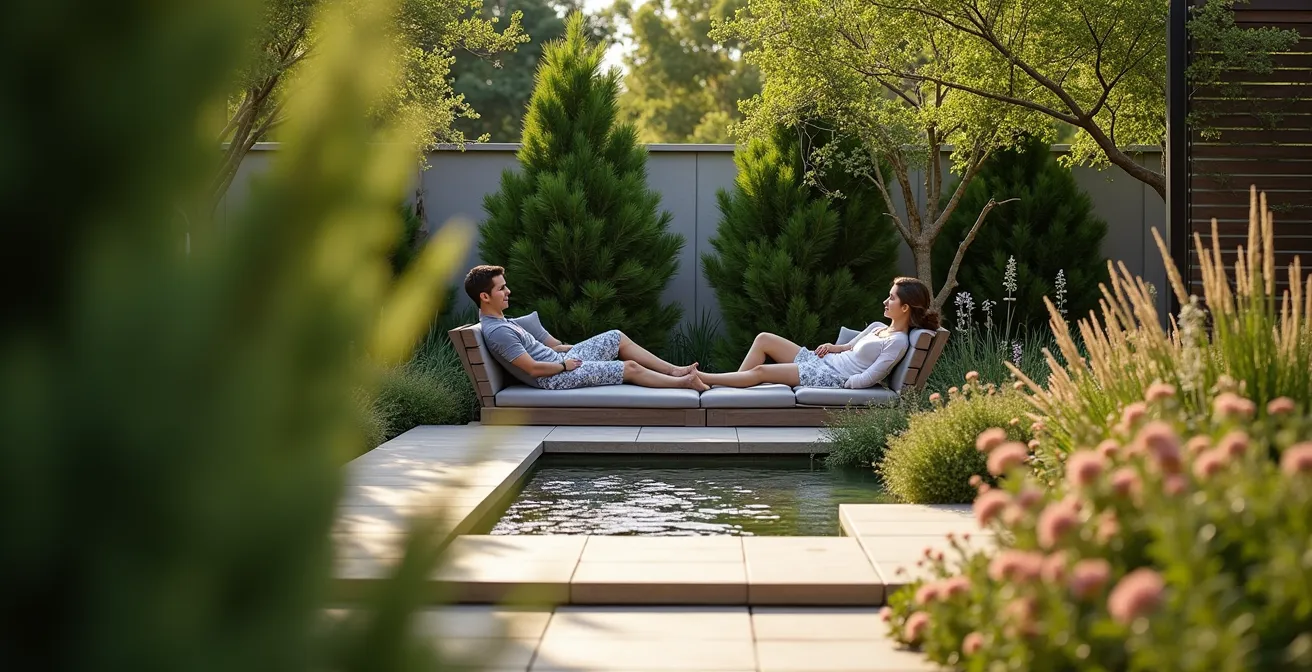
This layering also contributes to acoustic zoning. The varied surfaces of leaves and stems help to absorb and diffuse sound, reducing neighborhood noise. The rustle of ornamental grasses or the gentle hum of bees attracted to your layered plantings provides a natural, calming soundscape. This transforms your garden from a simple, exposed yard into a series of intimate spaces, each with its own character and feeling of enclosure.
Case Study: Colorado’s Pollinator Haven
Colorado State University Extension’s ‘Pollinator Haven’ project is a prime example. The design achieved complete visual screening by staggering native ornamental grasses (blue grama), drought-tolerant shrubs (lilacs, desert willow), and small trees (redbud). This created distinct ‘outdoor rooms’ and reduced water use by a staggering 60%, all while strategically ‘borrowing’ mountain views and blocking sightlines to neighboring properties.
Perennials vs. Annuals: Which Mix Offers Color With Minimal Replanting?
The classic garden dilemma is choosing between perennials, which return year after year but have a defined bloom time, and annuals, which offer a season-long burst of color but must be replanted. For a drought-tolerant, low-maintenance sanctuary, the answer is not one or the other, but a strategic blend. The goal is a garden with a strong “perennial backbone” for structure and reliability, punctuated by pockets of “self-seeding annuals” for spontaneous, evolving color.
Drought-tolerant perennials like Salvia, Coneflower, and Sedum form the foundation of the garden. They require an initial investment of time and water to get established (typically 1-2 seasons), but once their root systems are deep, they become incredibly self-sufficient. They provide the structure, texture, and form that give the garden interest even when not in bloom. Think of the architectural shape of a sedum in winter or the graceful movement of ornamental grasses in the breeze.
This approach is detailed in a comparative analysis by garden experts, which highlights the trade-offs. The table below summarizes the key differences to help you build your strategy.
| Characteristic | Drought-Tolerant Perennials | Self-Seeding Annuals |
|---|---|---|
| Initial Cost | Higher ($5-15 per plant) | Lower ($2-5 per plant) |
| Establishment Period | 2-3 years to full maturity | Immediate color (same season) |
| Water Needs Once Established | Minimal to none | Low to moderate |
| Maintenance | Deadheading, division every 3-5 years | Self-seeds, thin as needed |
| Best Examples | Salvia, Coneflower, Sedum ‘Autumn Joy’ | California Poppies, Portulaca |
| Four-Season Interest | Yes – seed heads, texture, form | Limited – mainly growing season |
To this perennial framework, you introduce self-seeding annuals like California Poppies or Portulaca. These plants provide vibrant color in their first year and then drop seeds that will sprout in subsequent seasons, filling in gaps and creating a natural, cottage-garden feel. They might not come up in the same spot every year, adding an element of delightful surprise. This combination gives you the best of both worlds: the reliability of a perennial structure and the dynamic, low-effort color of annuals, without the yearly replanting chore.
A truly low-maintenance, year-round sanctuary relies on the visual interest of perennials even when not in bloom: the movement of ornamental grasses, the stark beauty of seed heads in winter, and the diverse foliage colors.
– Proven Winners Research Team, Drought-Resistant Landscaping Guide
The Grading Mistake That Floods Your Basement During Heavy Rain
One of the most common and costly landscaping mistakes has nothing to do with plants, but with the land itself: improper grading. When the ground around your home slopes towards the foundation, it acts as a funnel during heavy rain, directing torrents of water straight to your basement walls. This creates immense hydrostatic pressure, leading to leaks, flooding, and potentially catastrophic foundation damage. The solution is not to fight the water, but to intelligently redirect it, turning a liability into an asset.
Instead of letting water pool against your house, you can sculpt the landscape to capture and manage it. This is where features like rain gardens and dry creek beds become both beautiful and functional. A rain garden is a shallow depression planted with water-loving species, strategically placed at least 10 feet from the foundation to collect runoff from roofs and hardscapes. The water pools there temporarily before slowly percolating into the ground, recharging groundwater instead of flooding your home.

A dry creek bed is another elegant solution. It’s a man-made channel lined with river rocks that mimics a natural stream. It functions as a drainage channel during a storm, guiding water safely away from the house to a rain garden or a suitable outlet, but remains an attractive, textural garden feature during dry weather. These solutions embrace the principles of systemic design, integrating water management directly into the aesthetic of your garden.
Case Study: Westminster’s Urban Mountain Meadow
A project in Westminster, CO, transformed a problematic slope that was flooding a home’s foundation. By creating gentle berms and swales, the design now functions as a rain garden. It captures and infiltrates stormwater, completely solving the basement flooding issue. The depression supports water-loving perennials like milkweed, while the higher berms are planted with drought-tolerant species, creating a beautiful and highly functional micro-ecosystem.
How to Attract Pollinators to Your Garden Without Inviting Pests?
A garden buzzing with bees and fluttering with butterflies is a sign of a healthy ecosystem. However, many gardeners fear that planting for pollinators will also roll out the welcome mat for destructive pests. The key is to move beyond simply planting pretty flowers and instead cultivate a balanced predator-prey dynamic. A truly resilient garden has its own security force of beneficial insects—like ladybugs, lacewings, and predatory wasps—that keep pest populations in check naturally.
You can actively recruit this “beneficial army.” This involves planting not just nectar-rich flowers for pollinators, but also specific “host plants” that provide food and habitat for the good bugs. For example, plants in the carrot family like dill and fennel are magnets for predatory wasps, while the tiny flowers of sweet alyssum attract hoverflies, whose larvae are voracious aphid eaters. Creating this habitat is a cornerstone of organic pest control and a far more sustainable solution than reaching for a chemical spray, which kills indiscriminately.
Furthermore, this strategy is intrinsically linked to water conservation. According to EPA data, switching to a garden rich in native plants that support local pollinators and beneficial insects can reduce outdoor water use by 30% to 80%. These plants are already adapted to the local climate and require far less intervention. By designing a complete habitat, you create a beautiful, low-water garden that polices itself.
Your Action Plan: Building a Beneficial Insect Army
- Host Plant Integration: Dedicate space for plants like dill, yarrow, and fennel to specifically attract lacewings, ladybugs, and other predators.
- Create a ‘Sacrificial’ Border: Plant aphid-magnets like nasturtiums along the garden’s edge to lure pests away from your more prized plants.
- Install ‘Bee Baths’: Place shallow dishes filled with pebbles and fresh water at different locations to provide a safe drinking source for bees and other insects.
- Provide Nesting Sites: Leave some bare earth patches and hollow stems from perennials over winter to offer nesting habitat for native solitary bees.
- Group Native Plants: Plant clusters of native species like milkweed to support specialist pollinators like monarch butterflies while also attracting pest-controlling predators.
Carbon Offsetting vs. Insetting: Which Strategy Builds Real Brand Value?
In the corporate world, “carbon offsetting” (funding an environmental project elsewhere) is being challenged by “carbon insetting”—building sustainable, regenerative practices directly into the supply chain. We can apply this powerful concept directly to our homes. Your garden is your immediate supply chain for beauty and tranquility. Creating a self-sustaining xeriscape is the ultimate form of “garden insetting.” Instead of relying on massive external inputs (municipal water, chemical fertilizers, weekly maintenance crews), you build a closed-loop system that generates value from within.
Every time you compost kitchen scraps to feed your soil, harvest rainwater in a barrel, or let leaves decompose into natural mulch, you are insetting. You are cycling resources and building “garden equity.” This approach creates real, tangible value for your property. A garden that is beautiful, requires minimal water, and largely takes care of itself is an enormous asset, both financially and for your quality of life. It reduces your home’s environmental footprint in a measurable way.
Xeriscaping uses the natural environment to create a low-maintenance garden that can withstand periods of drought while reducing the carbon footprint that comes with water transportation.
– Monrovia Garden Experts, Drought Tolerant Landscape Design Guide
This contrasts with an “offsetting” mindset, which would be akin to maintaining a thirsty, chemical-dependent lawn while donating to a rainforest fund. While the donation is good, it doesn’t solve the problem at home. Garden insetting creates a resilient landscape that is a daily, visible testament to sustainable living, enhancing your home’s “brand value” in a way that is authentic and deeply rewarding.
Case Study: Denver Water’s Insetting Success
Denver Water’s xeriscaping initiative showed this principle in action. Homes that implemented closed-loop systems like composting and rainwater harvesting saved an average of 120 gallons of water daily. More than that, they reduced landscape maintenance costs by 36 cents per square foot annually by eliminating the need for external fertilizers and constant inputs, creating true ‘garden equity’ through on-site resource cycling.
Why Controlled Risk-Taking Resets Your Dopamine Levels?
A perfectly manicured, predictable garden can become a chore. The real joy of gardening, the magic that keeps people coming back, often lies in experimentation and discovery. This act of controlled risk-taking—trying a new plant that’s borderline hardy for your zone, testing an unusual propagation method, or combining plants in a novel way—is a powerful psychological driver. When that risk pays off, the brain releases dopamine, the neurotransmitter associated with reward and pleasure. This creates a positive feedback loop that turns garden maintenance into an engaging and deeply satisfying hobby.
Your garden should have a “laboratory.” Dedicate a small, 10-15% portion of your space as a test bed. This is where you can play without fear of ruining the overall design. Try that Mediterranean lavender that might not survive your winter. Attempt to propagate a favorite drought-tolerant shrub from a cutting. Plant a new variety of native grass and see which pollinators it attracts. This process transforms you from a passive caretaker into an active participant and scientist in your own backyard.
It’s possible to keep your garden gorgeous without all the fuss, and xeriscaping might be just what you need. By planting native and drought-resistant plants adapted to your unique landscape, you can create a thriving garden that practically takes care of itself.
– John Murgel, Colorado State University Extension
Documenting these experiments in a simple journal—noting what thrived, what failed, and why—builds an invaluable personal knowledge base that no book can provide. It connects you to the unique microclimate of your property. This process of observation, experimentation, and learning is what resets your perspective and fosters a genuine, lasting connection with your landscape. It’s the antidote to landscape burnout.
Key takeaways
- A thriving garden starts from the ground up; prioritize de-compacting and enriching your soil before anything else.
- Design for privacy and beauty by using staggered layers of plants to create “outdoor rooms,” not just green walls.
- Combine a strong backbone of drought-tolerant perennials with self-seeding annuals for a low-maintenance garden with year-round interest.
Roof Renovation: How to Detect Hidden Damage Before It Ruins Your Insulation?
Just as a home’s roof is its primary defense against the elements, protecting the vital insulation within, a layer of mulch is the “roof” for your soil. This protective covering is arguably the most critical and cost-effective element in a drought-tolerant garden. It acts as the soil’s insulation, shielding it from the baking sun, drastically reducing water evaporation, and suppressing weed growth. Leaving soil bare is like leaving your house without a roof—it exposes your most valuable asset to damage.
However, not all mulches are created equal. The choice of material is a strategic decision that impacts water retention, fire safety, and long-term soil health. Organic mulches like wood chips or compost are excellent at retaining moisture and break down over time, feeding the soil microbiome. Inorganic mulches like gravel or decomposed granite offer a permanent, fire-safe solution, ideal for areas near structures, but they don’t improve the soil’s fertility. The right choice depends on the specific zone within your garden.
This decision is crucial for protecting your investment in soil health. A thick, 3-4 inch layer of the appropriate mulch can reduce water needs by 50% or more, keeping the soil cool and moist for days after a watering. This “insulation” gives plant roots the stable environment they need to grow deep and strong, making them far more resilient to drought. As a guide on landscape materials shows, matching the mulch to the application is key.
| Mulch Type | Water Retention | Longevity | Fire Risk | Best Application |
|---|---|---|---|---|
| Organic Wood Chips | High (4 inches deep) | 2-3 years | Moderate | 30+ feet from structures |
| Pine Straw | Moderate | 1-2 years | High | Acid-loving plants only |
| Decomposed Granite | Low | Permanent | None | Near structures, pathways |
| Gravel/Rock | None (but reduces evaporation) | Permanent | None | Xeriscaped areas, slopes |
| Compost | Very High | 6-12 months | Low | Vegetable gardens, new plantings |
By choosing and applying mulch thoughtfully, you provide the final, essential layer of protection for your garden ecosystem. It’s the simple step that locks in all the benefits of healthy soil, smart plant choices, and effective water management, ensuring your sanctuary doesn’t just survive, but truly thrives.
Begin designing your resilient, self-sustaining sanctuary today by evaluating your soil’s health, and transform your relationship with your landscape from one of constant work to one of creative collaboration.